
This summer I managed to finish the 100-mile Western States Endurance Run in 29:43:16, less than 17 minutes before the 30-hour cutoff. Clearly, a close run thing. Here are my thoughts on the race and advice for those who get a chance to run in the future.
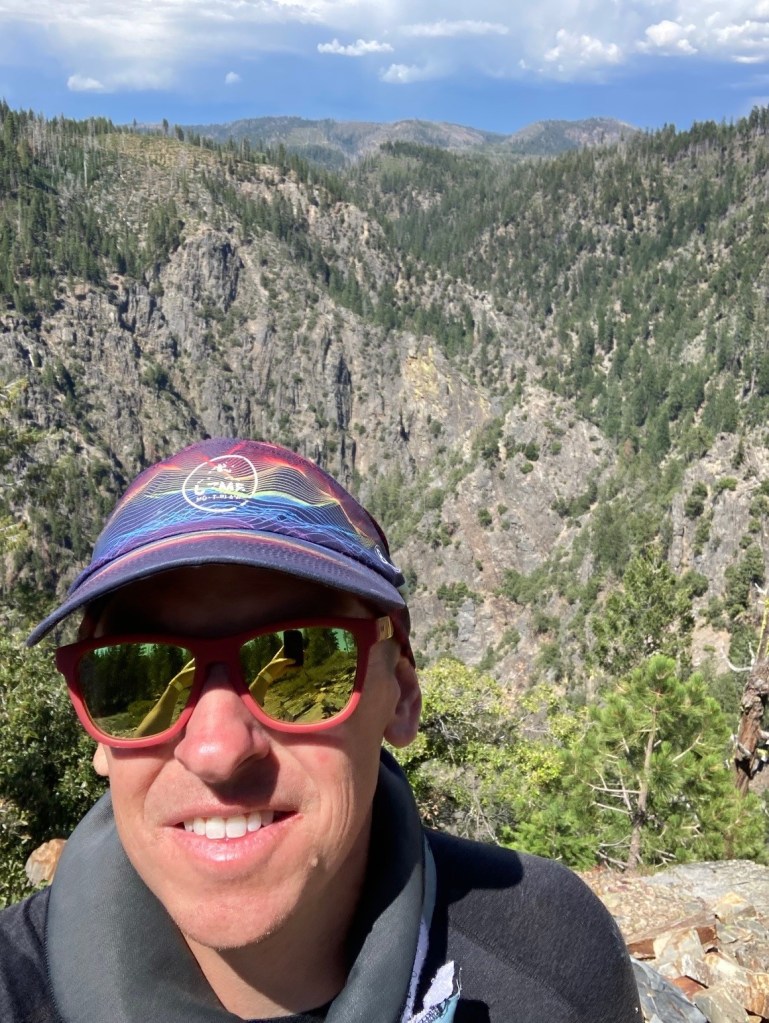
Western States is a bucket-list race for a reason. The overall feel of this race is unique. There are faster and harder courses, but not many races that have the same vibe as far as history and hype. The only ultra in my experience that compares, atmosphere wise, is UTMB, but because Western States is capped at 369 runners, the race is much more intimate. The field is small enough that you make friends on the course.
All the organization, schwag, aid stations, and crowd support are top notch. The registration scene the day before the race was great with people from all over the world, professional ultrarunners mingling with weekend warriors, and lots of spectators. Thousands of volunteers, many of whom are race veterans, make the race something special.
Western States is an awesome race for us runners who are not professionals and not fast, but just trying to finish. At the mandatory race briefing, the organizers spoke about the “Golden Hour” between 29:00 and 30:00. The race celebrates the struggle of regular people to make it, and in fact more people end up finishing in the Golden Hour than any other hour of the race. As the race awards ceremony immediately follows the 30 hour mark, everyone involved with the race is at the stadium for the Golden Hour runners and the place is nuts.
The 30-hour cutoff is the crux. The course is not easy. It has lots of elevation and its very hot and exposed at points. In terms of difficulty as far as climbs and trail conditions, the course comparable to the Bear 100 and Run Rabbit Run. What makes Western States harder than those races is that you have six fewer hours to finish. This means that for someone like me there is no margin for error. Walking it in slowly is not an option. There are no extra hours on the board to get lost or change clothes or mess around in an aid station. The whole race is hustle, hustle, hustle.

Race volunteers do a great job of encouraging runners to deal with the time crunch. As an example, when I got to the Devil’s Thumb aid station at mile 47.8, it was 5:41 pm. While a volunteer was filling my water bottle, I sat down and retied my shoe. Another aid station volunteer, seeing me sitting, came up and said, “Just want to let you know that this aid station closes at 7.” I said, “Why are you telling me that?” – thinking I had at least an hour in the bank. He said, “You are cutting it close. If you are going to finish you need to move now.” I thanked him, and immediately got up and took off.
A few miles later, down a hot canyon, I rolled into an aid station and the volunteer captain said “What can we get you?” I said, “Just water. I am just going to grab a handful of oreos and keep walking.” He said, “I love it when runners say that. You are going to finish with that attitude.” At every single aid station the volunteers were helpful, positive, and reminded me that time is of the essence.
The heat is annoying, but not a big deal if you are prepared. Less daunting than the cutoff, but still a challenge, was the heat. Much of Saturday is on trails exposed to the sun, and the canyons in the afternoon were stifling. Many runners were dry heaving, unable to eat, and having other issues because of the heat. For me, the heat was a minor annoyance and not a serious issue. But I was prepared for it. Here are some of the things I did to deal with the heat.

- Trained in the heat. I intentionally went for training runs at 4 pm, which in May in Austin is hot and humid. I bonked on a few of these training runs, but they helped me dial in salt pills and gear. Speaking of gear…
- Lost the vest. I run almost all of my ultras with a Salomon running vest. The downside of a vest, however, is that it can act like a jacket, trapping heat. I made the switch to Naked Running Band, which worked excellent and was way cooler than a vest. There is no need for a vest at Western States.
- Carried plenty of liquid. I carried an Amphipod 20 oz handheld (which I picked up at an REI garage sale for $8). In hot weather handhelds work great because I drink more often from a handheld than a bottle in a pack. For longer sections, I had two 17-oz soft flasks, which stowed in the running band.
- Adhered to a salt pill schedule. I took a salt pill every hour until nightfall, when I backed off to every two hours.
- Ice, Ice Baby. Every aid station had plenty of ice. I ended up running with ice carried around my neck in a device John and I have developed, and ice in a buff on my head. I had so much ice on that I would get ice-cream headaches as I left each station, but the ice would all melt before the next aid station. Advice for anyone running this event: have something to carry ice on your neck and head. I did not have them, but many runners had sun sleeves that they also packed with ice. Those are a good idea.
- Used the Creeks. At one creek crossing in the heat of the day, I completely immersed myself. The water was shockingly cold, being fed by snowmelt. This 3 minute break dramatically lowered my temperature and it allowed me to eat a bunch of calories as I marched back up the canyon.
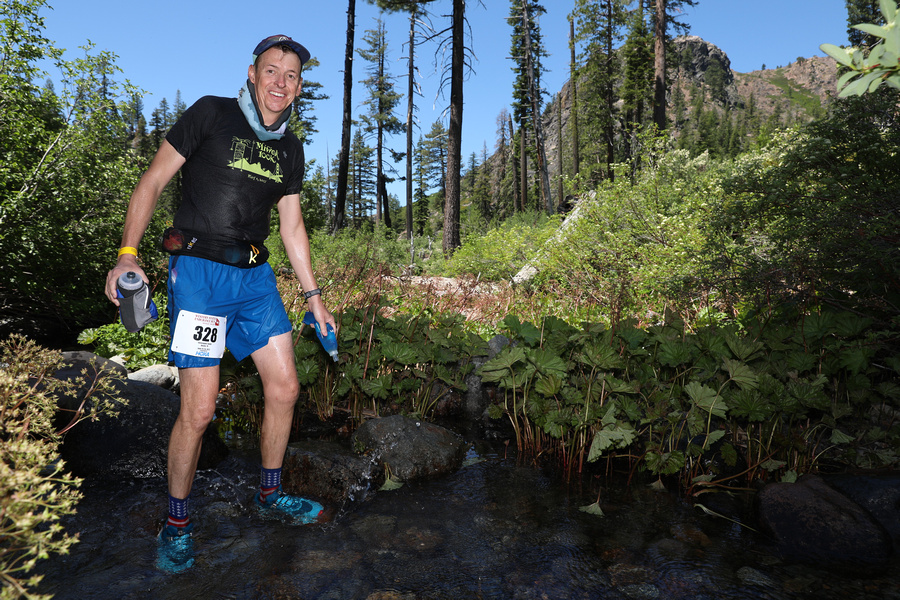
Bottom line is the heat is something one can mitigate if properly prepared.
Goal setting: The only goal was a buckle. Unless one is really in contention for the 24-hour buckle, I don’t see any reason for setting A, B, or C goals. Just finish. As this was my 10th ultramarathon and 4th 100, I had a realistic picture of the challenges of the race and my limitations as an athlete. I knew that a 24-hour finish was not remotely in play, and that the 30-hour cutoff was right at the edge of the possible. I said back in December, my only goal was to finish. That never changed and informed my preparation and conservative race strategy.

Realistic goal setting is vital for Western States because if things go wrong, there is not a lot of buffer time. My advice for recreational runners who are thinking they can run a 26-27 hour race would be to be careful. I ran portions of the race on Saturday with runners aiming for these times, many whom ended up having the wheels come off and either DNFing or just hanging on. For most of us this is a once in a lifetime chance. Don’t blow it by being dumb.
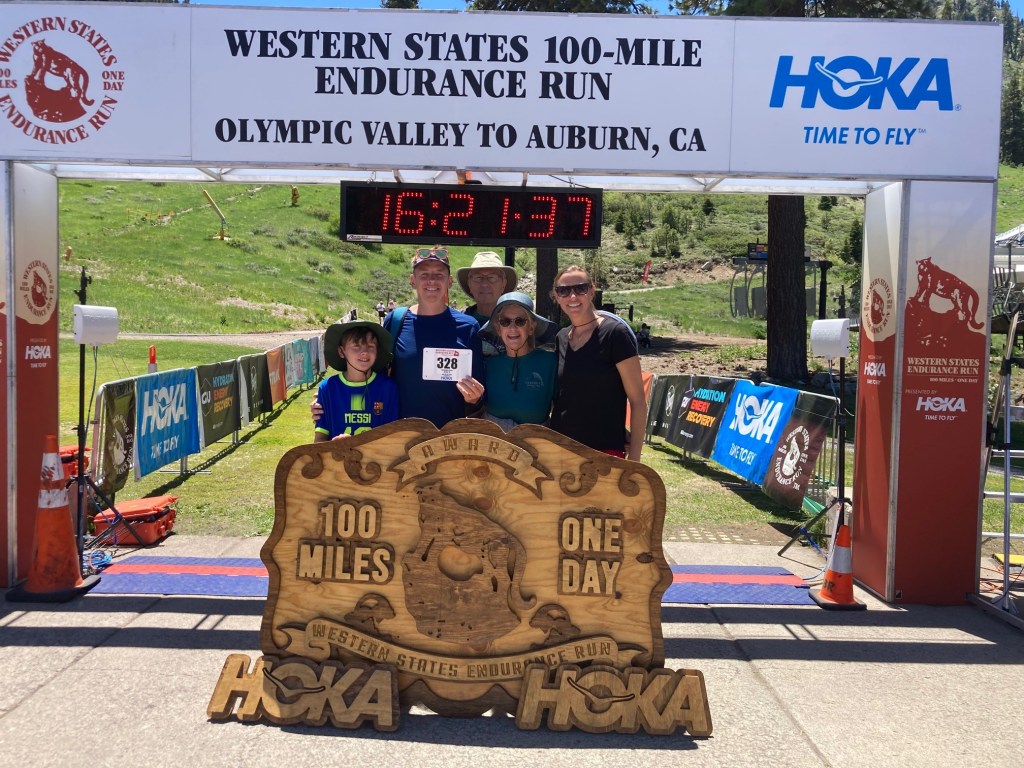
Crews and Pacers: I was lucky to have a great crew including my dad (who has been to all of my 100-milers), my mom (who has been to 3), my son Sam, and for the start my sister Liz. They met me at Michigan Bluff and Foresthill, and were able to walk me in the last mile from Robie Point.
Training: What is the least amount of training possible for a 100 mile race? I came close to finding out. Due to a seriously bum knee, I had to re-think my approach to training. The tried and true method of lots of miles and lots of vertical simply was not going to work. Instead, I employed a minimalist approach with light weightlifting 2x-3x per week and a tiny amount of very slow running and hiking. Only in May did I actually increase mileage to something approaching a typical training plan. Per Strava, my monthly mileage: Jan: 29 miles, Feb: 89 miles, Mar: 96 miles, Apr: 48 miles, May:142 miles, June – zero until race day. I did one hot 32 mile run in May as a prep long run.
By keeping the mileage very low, I was able to (mostly) keep my knee from flaring up. But the little I did run was intentionally designed to resemble race conditions. Usually I ran in the middle of a Texas afternoon, with temps over 100. I also practiced lots of fast, 14-15 minute per mile hiking.
I do NOT recommend my this minimalist approach , and if I had been healthy I would have done a regular training plan. For an experienced runner, training for Western States should include running (not hiking) lots of miles in the heat.
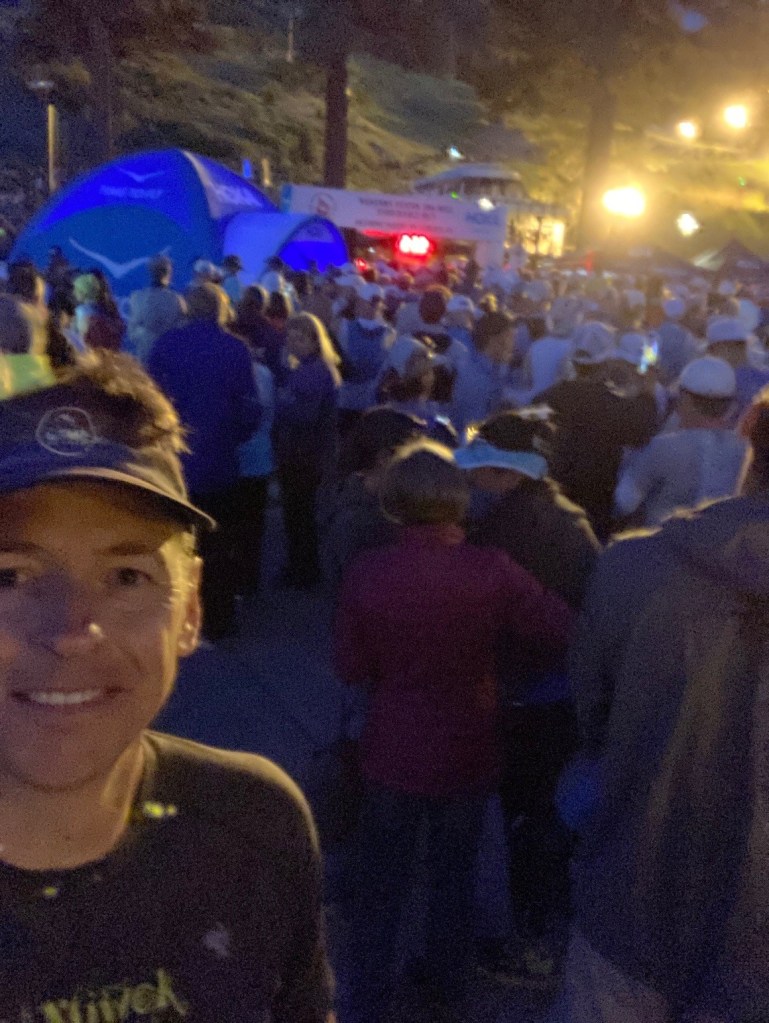
My race strategy was dialed in. Knowing that my fitness was going to be borderline at best, my strategy and in-race mental approach had to be close to perfect. My overall strategy was to take it very easy for the first 50 miles, focusing on hydration and nutrition, and saving my legs while trying to stay at or just barely ahead of the 30-hour pace.
I had two ways to gauge my pace. First, the race has its own pace chart and the 30-hour pace was on a sign at every aid station. These times ended up being relatively accurate. I started the race about 15 minutes behind the official 30-hour pace, then during the day Saturday slowly worked my way to 1:15 ahead of the 30-hour pace. Over the night and next morning, I drifted back to finish just under 30 hours.
Second, I ran with a total average pace (in mins/mile) on my watch. I knew I had to keep that number close to 15:00 min mile for the first day to account for the night-time slowdown. 18:00 min mile is a 30-hour finish.
While I had to run for probably 40 of the 60 miles, I never ran for long stretches at a time. Every 10 minutes I would stop and walk for a few minutes. This had the effect of keeping me very measured. In ultramarathons, the euphoric emotional highs can be dangerous, especially when one feels awesome 30 miles in. All day Saturday, I kept reminding myself that there was a whole lot of race to run.
Another key part of my strategy was to minimize time in aid stations. There are 20 aid stations. Five minutes at each aid station is 1:40 mins that I did not have to lose. I was in and out of almost every aid station in under 2 minutes, and many were less than 1 minute. Basically, the approach was to always be moving (slowly). During the day Saturday I ran for a few miles with runners who eventually pulled away. I did not push to stay with them even though I felt good, trusting the plan.
Mental, as always, is key. Beyond grit, which is required for every 100 mile race, at Western States I really focused on gratitude and trying to enjoy the moment. In most of my previous races, I viewed the race just as an obstacle to conquer, not something to be thankful for. Maybe it comes with getting older, but at Western States I was able to savor the suffering. I made an effort to talk to other runners and be positive. I thanked volunteers at every aid station. A few times I stepped off the trail and took 20 seconds to snap a picture and be thankful for the chance to be in beautiful mountains and canyons. I smiled and laughed.
Most importantly, I accepted that only a portion of the race outcome was within my control. This mental approach was novel for me because Western States is the first time I have toed the starting line not confident about a finish. When we started up the ski slope at the start, I put my chances of finishing under 50%. During the days before the race, I told my parents that there was a very good chance that I would not be at the finish line. Oddly, however, this realistic view of the race was liberating. The only thing in my control was to be smart, be tough, and keep going until either they pulled me off the course or I finished. And while I really wanted the buckle, I would have accepted not finishing provided I gave it my best. The only outcome that would have caused regret would have been me voluntarily quitting, which was the one thing I could control.

Aid-by-Aid Report
Olympic Valley to Escarpment to Lyon Ridge – At 10.3 miles, this is the longest stage and the one with the most climbing. I took my time up the mountain and took it easy on the downhills. I also ate 750 calories on this opening stage (the only non-aid station food) as I wanted to start nutrition out right. Other than some minor knee pain, this section was fine and I cruised into Lyon Ridge near the back of the pack in 269th place.
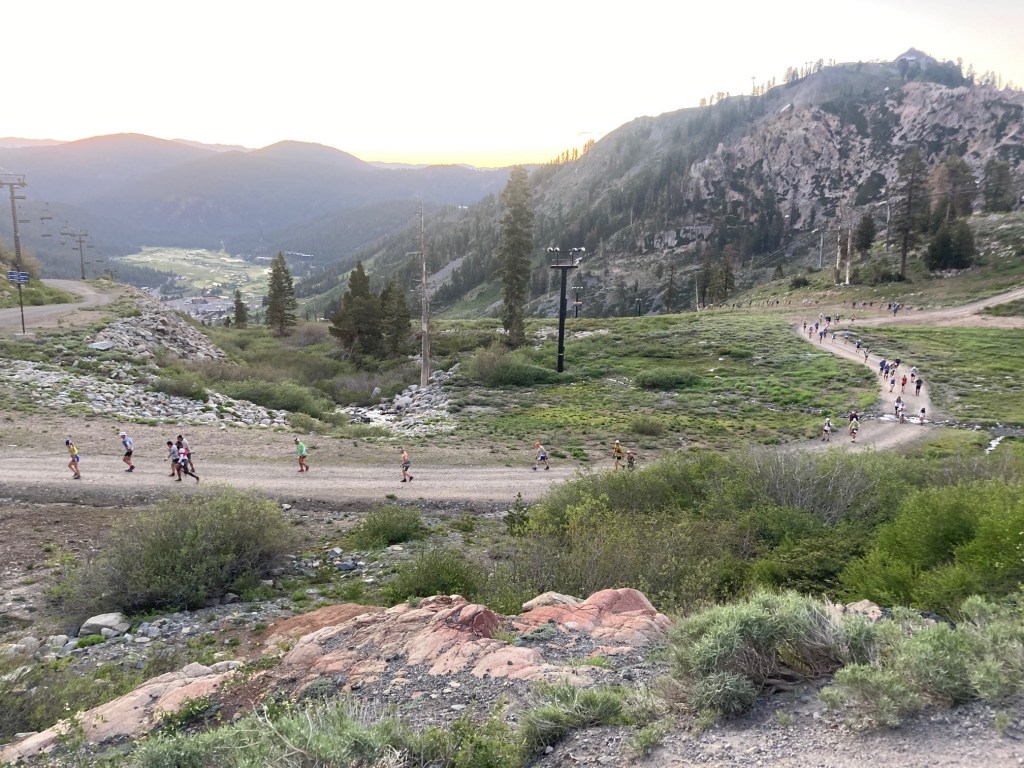
Lyon Ridge (10.3) to Last Chance (43.3)- This section took me from 7:47 a.m. to 4:01 p.m. on Saturday. There are 5 aid stations between Lyon Ridge and Last Chance, all relatively closely spaced. Lots of sun and relatively gradual climbs and descents. I moved pretty well through this section and kept hydrated and measured. Last Chance marked my lowest cumulative pace, at 15:15 per miles through 43 miles. From this point forward my average pace started to increase.
Last Chance (43.3) to Devil’s Thumb (47.8) – This is the first big canyon (Deadwood Canyon). Very steep descending switchbacks, which started to work the legs, followed by a slog straight up the other side. This section requires deliberate marching, and there is no way to avoid an elevated heartrate.

Devil’s Thumb (47.8) to Michigan Bluff (55.7) – This is the second canyon, with an aid station at the bottom where the trail crosses El Dorado Creek. El Dorado Canyon is longer but not as steep as Deadwood Canyon. I felt pretty good as I climbed into Michigan Bluff.

Michigan Bluff (55.7) to Forestville (62.0) – This section goes through Volcano Canyon, which is the smallest of the canyons, but was the worst. Darkness fell as I was going down the canyon, and I kept getting passed by runners cheerfully chatting with their fresh pacers. It was so dry the dust looked like fog in my headlamp, and I was in a bad spot as I climbed up toward Forestville. By the time I hit the asphalt I had about convinced myself that I was done, but then I recovered as I marched though the town. My parents and Sam were encouraging when I saw them at the aid station, but I told them that if I was going to finish it would be in the last 30 mins.
Forestville (62) to Rucky Chucky (78) – This section basically descends from Forestville to the river crossing. As I left Forestville, I saw that I was making 16:00 min miles on flat ground. Knowing that the worst part of the trail was behind me, doing the math I realized that a finish was possible but very tight. This section took about 5 hours (10:03 pm to 3:17 a.m) and was a fast night march with a little running. I managed to average 16-17 minute miles, which was great. This is the easiest part of the course.
Rucky Chucky (78) to Green Gate (79.8) – This where the race crosses the American River. The aid station was crowded with a whole bunch of end-of-pack runners trying to make it. The crossing was uneventful and there were plenty of volunteers in the cold water making sure we did not let go of the aid cable. After the crossing, the trail is up for two miles to Green Gate aid station. This was my slowest section at 27 min miles, mainly due to the delay in crossing.

Green Gate (79.8) to Quarry Road (90.7) – This section is up and down a number of moderate hills – not easy but not that hard either. But this is where I really understood how close I was to the cutoff. I started running a lot. From here on the only thing I did at aid stations was fill a water bottle. I talked with other runners with experienced pacers, and they all said don’t worry there is plenty of time. But I was worried.
Quarry Road (90.7) to Pointed Rock (94.3) – This is the section where Jim Walmsley famously took a wrong turn, and I understand how that could happen. It is also a sneaky late-course climb that keeps going up far longer then it feels it should. The Pointed Rocks volunteers tried to get me to stop and eat, saying I needed to feel good for the lap around the track, but I was too worried and just took a Gu and some water and rolled. I had 2 hours and 20 minutes to cover the last 6 miles.
Pointed Rocks (94.3) to Robie Point (98.9) – This is a long down section to a bridge across the river, then a super hot exposed trail up to Robie Point in Auburn. I was running out of steam. As I climbed up through the woods, I could hear the race going on. I marched into Robie Point with 45 minutes to go, saw my parents and Sam, and for the first time knew that I was going to finish.
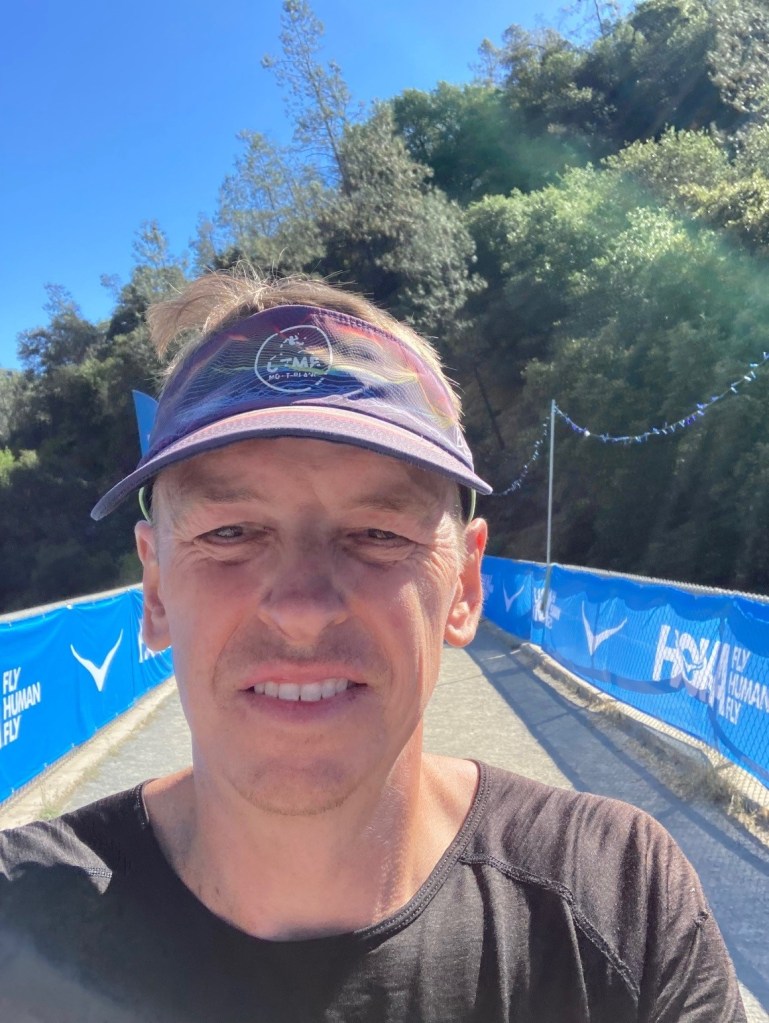
Robie Point to the Finish – The only other experience like this is walking through Chamonix the last mile of the UTMB finish. There were thousands of people out cheering. I walked with my family, and an enthusiastic volunteer with a megaphone who went in front of us yelling: “Lets hear it for Chris from Texas!” every 30 seconds. I was not in any hurry, and just enjoyed the moment.

Closing thoughts. The desire to get a Western States buckle started back in 2014 in a bar conversation with my buddy John. It was the genesis for signing up for my first ultra (Bandera 2015) and for going back to get a lottery ticket race all those years. In the last eight years I have run thousands of miles, including hundreds of miles racing on some of the most beautiful trails in the world, made great memories with friends, and had a blast. I would not change anything about those races, nor this race. Struggling to finish, nursing a chronic injury, and then making it with only a few minutes to spare and sharing the moment with loved ones, cannot be improved upon – it was a perfect race. I will treasure the buckle not just because it is a badass buckle (and it totally is) but because every time I put it on I think of all of the steps it took to earn it, the ups and downs (literally), the humbling of pride, the blisters and lost toenails, the early morning practice runs, the friends, the adventures and mishaps, and the journey to get here – and I know that I am truly blessed.


I love reading about your experience. This is sn awesome feat! Congratulations!!! How special to have your mom, dad, Sam and sister there.
LikeLike