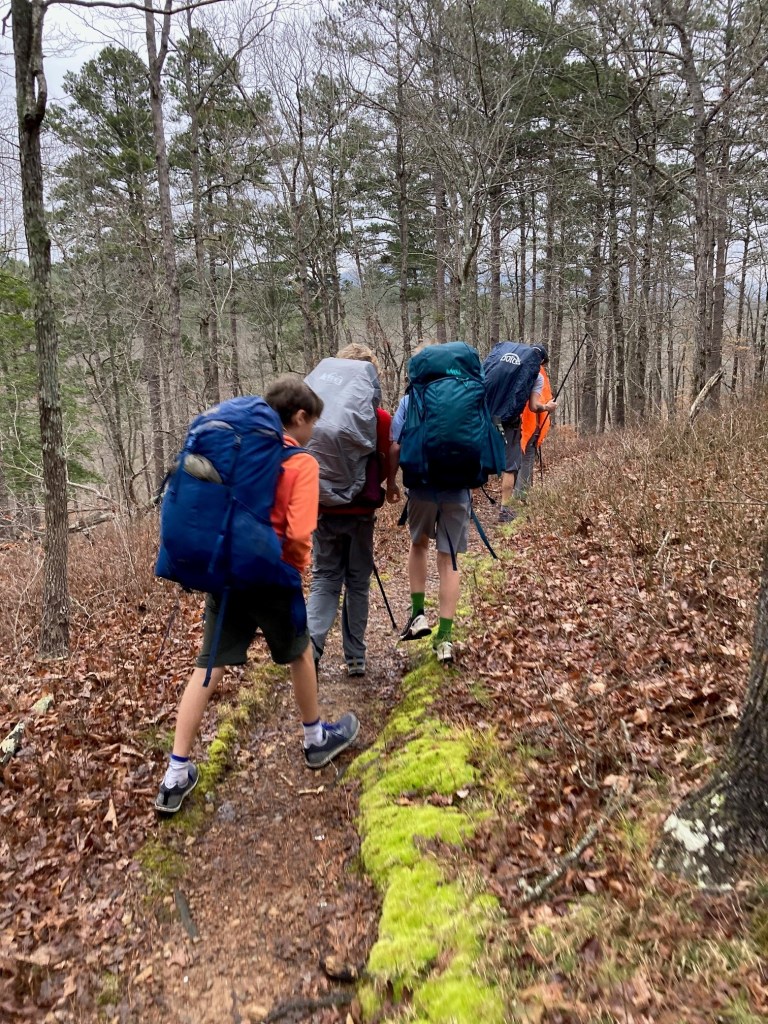
There are plenty of resources on lightweight backpacking for adults. But there is not much on outfitting kids, particularly late-elementary and middle school kids, for practical backpacking. As the den leader for a bunch of 5th grade Cub Scouts, this post explains the gear we have found to be useful for backpacking trips. Note that much of the gear is going to be more lightweight and minimal than traditional backpacking. Many of our scouts successfully used this equipment on a recent two-night backpacking trip in Arkansas, carrying 100% of their own gear.
Why Backpacking is Different for Kids
(1) For Kids Going Ultralight is a Necessity, not a Philosophy. While we all have different ideas about how much weight is “too much,” a starting point is the 20% rule which states that total pack weight should be less than 20% of body weight. For my 190-pounds, this equals a pack weight of 38 pounds which experience has taught me is pretty heavy for long days in rough terrain. My load-out weight for a five-night backcountry trip is usually 25-27 pounds. If anything, the 20% rule is pushing it for everything but short, mild trips.
Now apply the 20% rule to an 80-pound kid. That means total pack weight needs to be 16 pounds to be manageable and comfortable. Above that, there is a good chance that backpacking will stop being fun, and it needs to be FUN. Where “ultralight backpacking” is a philosophical point for many adults, particularly those with the stamina to suck it up and haul a heavy pack, it is a point of necessity for kids.
(2) Kids are hard on gear. A 5th grader will not appreciate the need to baby that dyneema composite shelter and may forget that the premium down sleeping bag needs to stay dry. He is going to set up camp and then start a game of tag with his friends. That means gear for kids needs to be simple, durable, and have a margin for user error.
(3) Kids bodies are growing. My decade-old pack fits the same as it did when I bought it. A 5th grader’s pack may not fit the same in six months. When shopping for kids’ gear, special consideration must be given to adjustability.
(4) Kids need affordable gear. Cost should not be a barrier for anyone wanting to get outdoors, particularly youth participating in scout programs. There is nothing wrong with a $300 ultralight tent, but I am not going to recommend that a young person needs to have one to get outside.
Specific Recommendations
Below I provide specific recommendations for the big-ticket items: packs, shelters, sleep systems, stoves, and water. I am sure there are many other products that work great, but these are the ones we have tested with 10- and 11- year olds. I have no affiliation with any of the companies below other than as a customer.
Pack: REI Tarn 40 Kids Pack ($100). This pack is great. It is a 40 L in internal frame pack weighing 2 lb. 10 oz. with an adjustable harness. The main compartment is top loading and hydration bladder-compatible, and it also has two hip belt pockets, two side mesh pockets, a large open topped back pocket, and a zippable top compartment. The main compartment is big enough to hold a synthetic sleeping bag, self-inflating pad, clothes, food, and stove. The back pocket is big enough to hold a light shelter.

Unfortunately, it appears that REI may have discontinued the 40 L version and now only offers the 60 L version. The 40 L is far superior for smaller kids for a few reasons. First, the 60 L version has a listed weight of 4 lb. 5 oz; an increase of over 1.5 pounds in the pack weight alone. Second, and more importantly, the 60 L version is large enough that it encourages bringing more stuff than necessary, further increasing pack weight. On our den’s backpacking trip, every scout who hiked with the 60 L version had to have assistance from a parent at some point in carrying gear. Most 10- to 12-year-olds are going to have a hard time carrying 60 L of gear for anything over a couple of miles. Third, the 60 L version is significantly more expensive at $165. Once a pack is climbing north of the $150 price point there other, lighter options to consider. If the $100 40 L Tarn is not restocked, I would consider the following over any of REI’s kids packs:
ULA CDT ($145) – this is a 25 oz., 45 L top loading pack (size small). These packs are made in Utah. I have the larger version (the Catalyst) and its build quality and durability are outstanding.
Gossamer Gear G4-20 ($180) – this is a 25 oz., 42 L top loading pack (size small) and is time-tested lightweight pack.
Both the CDT and G4 are used by through hikers and have more than enough volume for a scout backpacking trip and are over 1.5 pounds lighter than anything REI offers.
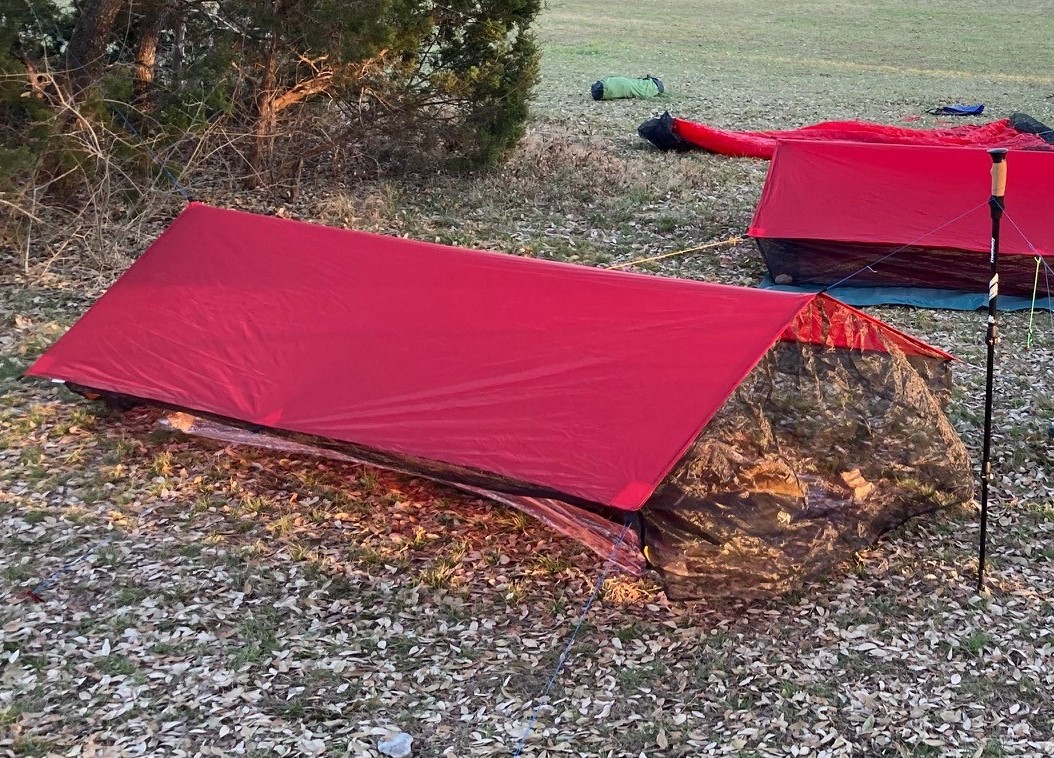
Shelter: Oware Net Tarp 1 ($120). This is a 15 oz, 5×9 flat tarp with perimeter bug netting. There is no floor but the scouts use polycro or an emergency blanket as a groundsheet. Dave at Oware made our den a custom order in scarlet red. The only shelter option that keeps the weight close to a pound and the cost close to $100 are tarps. The perimeter netting is nice for Texas bugs.

The challenges of having kids use a tarp as a shelter are (1) the steeper learning curve on proper pitching and (2) the mainly psychological hurdle of camping in a shelter without an integrated floor. These challenges are not insignificant, however once a scout masters the tauntline hitch and can set up his net tarp by himself, he will have developed relatively advanced backpacking skills. It takes 10-15 field-realistic practices to learn tarp setup. One thing we noticed was that in a group setting all of the tarp lines can be a tripping hazard, and many scouts are replacing their lines with reflective glowline.

If a tarp is simply not going to work or is not allowed (i.e., Philmont), there are other options, but they are significantly more expensive. I recommend the Tarptent Protrail ($229), which is a 25 oz. single wall tent with an integrated floor.
Sleep Pad: Thermarest Trail Scout ($55) This is 1 lb. 6 oz. self-inflating pad fits the sweet spot between cost, weight, compactness, and durability.
Sleeping Bag: REI Trailbreak 30 ($90) My son has slept warmly in this 2 lb. 8 oz. synthetic bag under a tarp in nighttime temps dipping into the 20s. There are many lighter, more compressible options, but those are all going to be twice as expensive.
Stove and Pot: Soto Amicus Stove Cookset Combo ($45) This gas canister stove comes with two pots; the kit is 11 oz but normally the little pot may be left at home.
Water Treatment: Lifestraw GoFilter 22 oz. ($40) Provided your trip has ample water sources, these bottles with incorporated filters are tough and easy to operate.
Scout Backpacking Checklist
Here is the checklist we used. With the recommended gear and adhering to this list (and not adding a bunch of other stuff) most of the boys were able to keep their packs right around the 16-18 pound range.
- Backpack – < 3 lbs. and around 40 L capacity
- One 18-gallon trash compactor bag to line backpack
- Sleep Pad – < 1.5 lbs.
- Sleeping Bag – < 3 lbs. and rated to at least 30° F
- Shelter – < 2 lbs. and able to set up by scout
- Water bottle and water treatment
- Backpacking stove, pot, utensil, and fuel
- Collapsible cup – for hot chocolate
- Food stored in stuff sack or other bag
- Bear/varmint hang: 50’ paracord and small carabiner
- Personal first aid kit – (including moleskin for blisters)
- Sunscreen
- Bug Spray
- Hand Sanitizer
- Knife
- Compass and Map
- Whistle
- Trekking Poles (optional)
- Clothes in Pack
- Raingear – this can be a poncho, rain jacket, rain pants depending on conditions
- Insulating layer – fleece or light down jacket
- Sleeping clothes – shorts or sweatpants and t shirt
- Warm hat
- Gloves (optional)
- Camp shoes (optional)
- Bandana
- Clothes to Wear
- Comfortable, broken in shoes (no Gortex because they do not drain)
- Non-cotton socks
- Hiking pants or shorts (synthetic, no cotton)
- Synthetic t shirt
- Sun hat
If you have other tips or questions on outfitting young scouts for the backcountry, please leave them in the comments.
 Vamonos Baby!
Great post, thanks for sharing!
LikeLike