
Last week I signed up for the Bandera 100k as insurance in case my main race set for August is cancelled. By waiting until late October to enter a January race, I left myself only eleven weeks to prepare. Not very long.
My preference is to leave plenty of time to train. Pushing to run a 100k with less than three months of dedicated training risks injury and poor performance. But sometimes living the vigorous life requires us to roll the dice. Here is my plan in case anyone out there is thinking of trying something similar.
The Race
The Bandera 100k is held at the Hill Country State Natural Area in Bandera, Texas. The course is rocky with lots of softball and baseball sized stones. There is a moderate amount of vertical, just over 100 feet of climb and descent per mile. There are no big climbs, just lots of hills. The flat sections are very runnable when the weather is dry; when wet they become mud pits. The setup is basically two convoluted 31-mile loops. Overall, it is a relatively easy 100k course.
To get my Western States lottery ticket I need to finish under 17 hours, but I would like to be faster.
The Last-Minute Training Plan: Eliminate Everything but the Necessities
With a taper and a couple of built-in rest weeks, I have seven weeks to train hard. Only race-specific adaptations are important. That means focus on endurance, nutrition, and terrain that simulates the rocky Bandera trails. Everything else, like road runs, speedwork, tempo runs, and hard hill repeats, must go. That is not to say that these workouts are not important; normally I include them even for 100-mile ultramarathon training. But there is no time left for electives.
Endurance
For endurance, I am going to build mileage but keep the pace at a very comfortable level. Hopefully, this will reduce the chance of injury and will better simulate race conditions. The bigger the mileage jump the more I will back off the pace.
One of the most important parts of endurance is training the body to deal with hills. The race has about +/- 100 feet of vertical per mile. I plan to train at an average of +/- 150 to 200 feet of vertical per mile. In other words, accustom my body to moving comfortably in more difficult conditions than I will likely experience on race day.
Nutrition
I also need to train to take in fuel during the race. Nutrition/hydration issues cause lots of DNFs and poor races. Even though I generally know what works for my body, I still plan on breaking out the vest and loading up with food (mainly PBJs), water, and salt pills during long training runs to make sure it all works.
One nutrition wrinkle this year is COVID. I don’t really have a good sense of how the aid stations will work. I don’t know how everyone will safely get food and water in cramped quarters and I have no desire to mess with masks during a race (which may be a reasonable requirement to protect volunteers). Right now, my plan is to carry everything I need for each 31-mile loop and having a single refill drop bag at the start/finish area. As I have never done that before, I will plan a couple of long shakedown runs to make sure this setup does not have unforeseen issues.
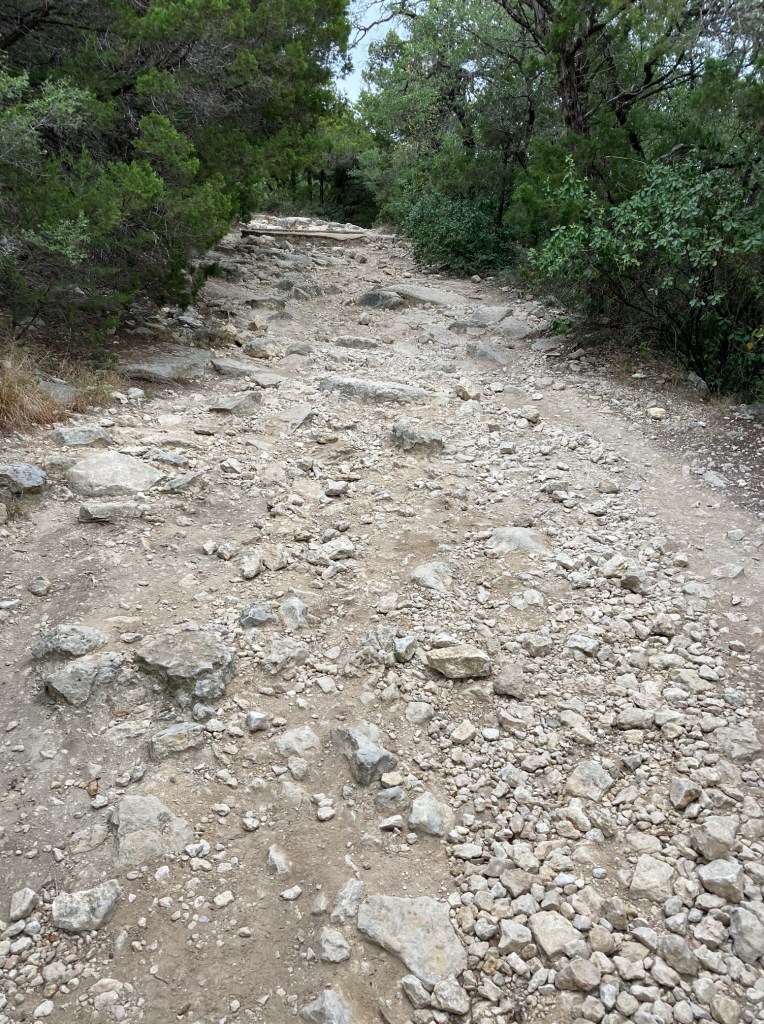
Terrain
At the macro level the Bandara course is tame, but at the micro level the trails are rough. Other than nutrition, probably the biggest cause of ultramarathon DNFs is muscular/ligament pain and breakdown. The best way to avoid that is to train on surfaces that mimic the race. For Bandera, this means spending lots of time on the rockiest trails in town. I plan to do 90% or more of my training on rough trails. I will also do quite a bit of training in the dark as navigating rough trails under headlamp is quite a bit harder than daylight running.
Weekly Plan
With all the above considered, and knowledge of how I deal with training, my basic plan for work weeks is as follows:
- Monday and Tuesday – Long slow hill repeats (6-10 miles @ +/- 300 feet per mile)
- Wednesday – Flatter trail run, moderate pace (8-12 miles)
- Thursday – Kettlebells
- Friday – Short slow hill repeats (5 miles @+/- 300 feet per mile)
- Saturday – Long run aiming to simulate course, including hiking breaks. (15-30 miles @+/- 100 feet per mile)
- Sunday – Rest
The Die Is Cast
Will this work? I don’t know but my registration fee is gone so I am committed to finishing. There is nothing like a race on the calendar to ensure accountability. Whether it is a success or disaster, I will report back in January with a race postmortem.
 Vamonos Baby!
All right!!!
LikeLike