At almost every race I get inspired by somebody. But rarely is it the race winner. Its humbling to see elites rolling through 100 miles at 8 to 10 minutes per mile. Its crazy to think about the pace of a 2-hour marathon (I think I can hold it for about 200 meters). I respect the athleticism, the work ethic, and the toughness to achieve these results.
You know who does not get enough props?
The big girl who takes 5 hours and 50 minutes to finish a marathon, but finishes, nonetheless.
The middle-aged dude with chicken legs and a belly who spends 50 hours a week behind a desk and realizes his life is passing by, a guy who looks terrible in spandex, but gets up, starts running, enters a big race and finishes.
The vet who lost a leg but does not give a shit and finishes with a prosthetic leg.
The runner who signs up for a long race, gets out there and DNFs, then signs up again for the same race and goes back and kicks its ass.
The addict who is trying to put the pieces back together who stubbornly pushes through to accomplish something that they never thought possible.
The person with MS who signs up for a bike race but can’t bike so instead drives an arm powered wheelchair at a painstakingly slow pace to finish.
The racer who has had the wheels fall off, but who keeps moving and who is ultimately caught by a cutoff but never gives up.
All these people are trying to make themselves better. All have discovered courage that they may not have known they had. All are tough. Every single one has grown in confidence.
The fact is that we all only grow, we only accomplish something, if we put ourselves in a position where we might fail. There is no growth without pain and no success without risk. We don’t need to look to the elite athletes on the cover of Sports Illustrated or Outside to know what it takes to succeed. That inspiration is in the normal, but exceptional, people all around us.
Last weekend I paced my brother Tim for the last half of the Brazos Bend 100 miler. While I did not compete, I did spend an entire night on the course and have a good feel for the pros and cons of the event. The race took place in Brazos Bend State Park, about an hour southwest of Houston. I will be posting a separate review of the park, so this post focuses on the race.
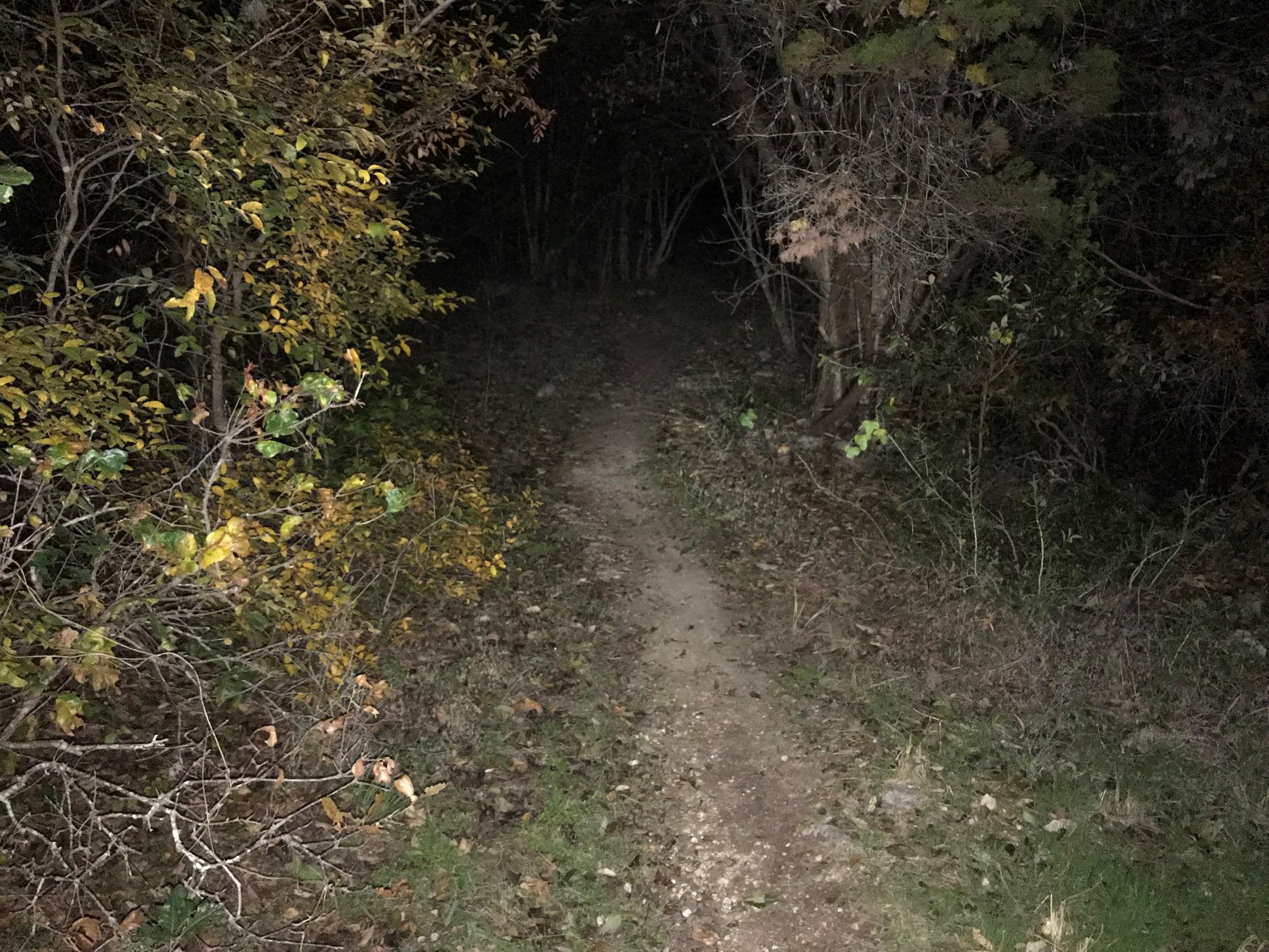
Typical terrain for the race. Be careful negotiating some 3/4″ pebbles, they can break ankles.
The Brazos Bend 100 is a good race for runners seeking an easy course with simple logistics. Many people will find it the ideal course for a first 100-miler. It would also be a good race for someone trying to PR for 100 miles. The course is about as flat as a trail can be and has a 30-hour cutoff. The race is worth 5 UTMB points but is not a Western States or Hardrock qualifier. The scenery is good, especially if you like swamps.
Me standing on the course along 40 Acre Lake, with friend in background.
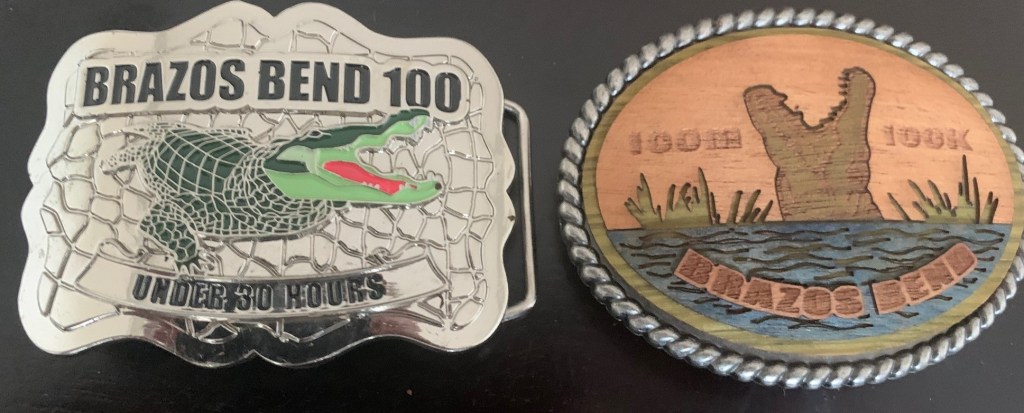
If you finish, you get a silver buckle that pairs well with some tasteful alligator skin boots.
Right buckle is for 100 miler. Left is for running both the 100 miler and 100k (held in April) in the same year.
The Course – The course is six 16.7-mile laps, with each lap consisting of a series of out-and-backs and lollipop routes. This means that runners are never very far from an aid station and return to the start/finish every 16.7 miles. Although the race allows drop bags at aid stations, drop bags other than at the start/finish are overkill. Did I mention that it was flat?
Course laps look complicated but things are well marked and its almost impossible to get lost. The out and back to Sawmill aid station in top right is the least liked part of the course by most runners.
Weather – The weather in December along the gulf cost is generally mild and predictable. Bring a warm fleece and hat for the night and, depending on the forecast, a rain jacket.
More views of the course. Many of the trails run along low levees by the water.
The Vibe – The race is put on by Trail Racing Over Texas (TROT). The race volunteers were great, and the race has a positive atmosphere. There is zero pretentiousness and everyone is laid-back.
Swag – the main swag is a red bad sweater race hoodie. Its unique, and better than the standard race shirt.
Aid Stations – The aid stations are pretty basic and all served traditional ultramarathon snacks. They lacked chairs, so runners who had to tape a toe or get a rock out of a shoe were forced to sit on the ground. This had the positive effect of keeping the racers moving and discouraged the trap of hanging around aid stops, but a couple of chairs wouldn’t hurt. The race guide indicated that the aid stations were “cupless,” but that did not appear to be the case as the aid stations gave out disposable cups. As the race went on, styrofoam cups started appearing along the trails. This disappointing behavior by some of the racers should encourage race management to truly run a cupless race in the future.
Challenges and Possible Improvements – The multiple laps of out-and-backs and lollipops present challenging racing psychology. Some portions of trail were crossed 12 times! Given the limited amount of public land in Texas, I don’t know that much can be done about the course layout. But this race could be improved by having more checkpoints where runners are verified. The only places this happened were the start/finish line and the Sawmill aid station, which is at the end of a long out-and-back 12.1 miles into the 16.7-mile lap. More checkpoints would greatly improve the live tracking of the race. It would also discourage potential cheaters. Thanks to websites like Marathon Investigation, we know that cheating at ultras is not uncommon. Under the current setup, someone could cut the course everywhere but the Sawmill out-and-back. This potential could be eliminated, and live tracking improved, by:
Recording runners at the Horseshoe Lake out-and-back;
Recording runners at the 40 Acre Lake aid station;
Recording runners at the Windmill aid station; and
Recording runners on the Hale Lake lollipop or moving the Windmill aid station so runners check in there before heading to Hale Lake.
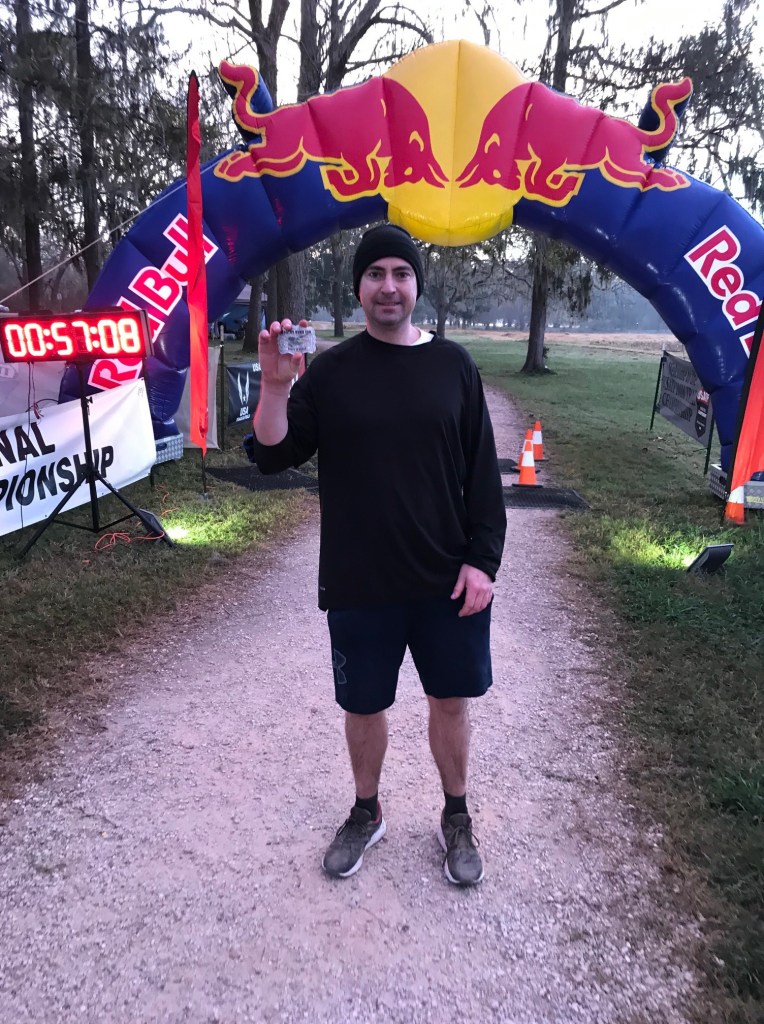
Tim with a well-earned buckle.
Bottom line: The Brazos Bend 100 is a good race if you want a pancake flat and fast course with easy logistics, provided you can tolerate the monotony of a bunch of laps and out-and-backs (and you are not scared of alligators).
Adventures don’t stop when it gets dark. When you are depressed and cold at 3 am on a lonely trail you don’t want to be messing with a dimming light. That’s when you want t he spotlight they have on police helicopters. The kind of light that causes people across the valley to wonder, “Why is there a locomotive on that trail?” The kind that lights up everything.
Lots of lumens. Not practical for most runners.
I have a collection of headlamps and flashlights that are are not up to snuff. That’s OK because I have a bunch of kids that love to steal headlamps. At my house headlamps go missing like yappy dogs in coyote country. The kids get all my old lights with:
Plastic frames that crack in cold and break after a while.
Big on/off buttons that can be accidentally turned by stuff in my pack.
Tiny AAA batteries that are hard to change in the dark with cold hands.
A single rechargeable battery. Nice in theory but not in practice.
Lack of waterproof seals.
Dim, underpowered lights.
Lights with huge battery packs and a bunch of wires.
Vastly exaggerated performance specs.
My real lights are secured in an undisclosed location, safe from little hands. Before we discuss details, what do I need to move effectively at night?
Brightness. Too many “ultralight” headlamps just don’t throw enough light for hustling down a rocky trail at night. What is bright enough? Factors like the difficulty of the trail, the weather, moonlight, and tree cover impact how much light you need. But in tough conditions I want a light that can throw a minimum of 200 lumens. That is pretty bright. For comparison most car low-beam headlights are about 700 lumens. So what I want is not actually as bright as a car but is WAY more than most running headlamps can sustainably produce.
Toughness. My lights will get dropped, wet, and dirty and they need to keep working.
Simple Operation. Headlamps today are way to complex. I don’t need a red light and I don’t need my headlamp going on strobe-light mode every time a push a button.
Reasonable battery life. Almost all headlamp specs are lies. Most will put out something close the published max lumens for a few minutes and then rapidly dim. Changing batteries every couple of hours is fine, as long as the light can produce a bright beam for the whole time.
Simple battery changes. This means headlamps that use a single AA battery. I can change these in the dark in 15 seconds, even with cold hands and they are ubiquitous. I use regular alkaline for training and the more expensive but lighter and better performing lithiums for races.
Redundancy. Lots of races (e.g. UTMB) require runners to carry two lights. Even when not required, I carry two lights. This has a few advantages. First, I have a backup. Second, running two lights lets me raise overall light output while increasing the time between battery changes. For example, two lights on medium may throw as much light as one on high, but I have many more hours between changes. Third, running two lights from different positions lets me see more depth and reduces shadows.
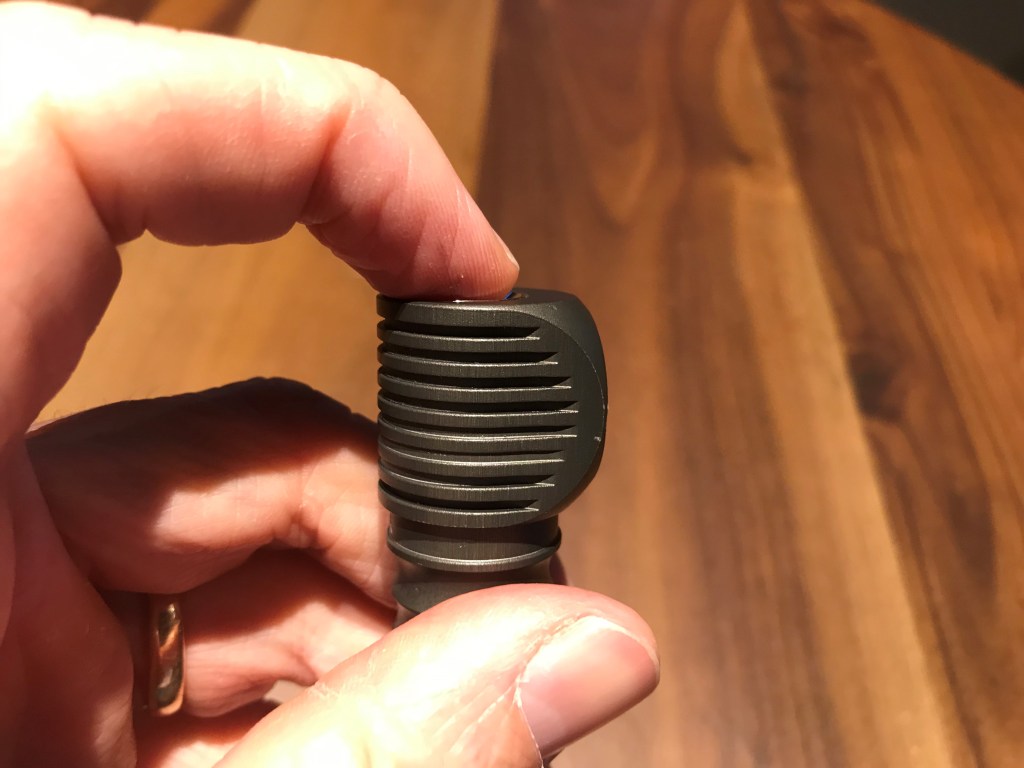
The system that works for me is to use two Zebralight H53 AA headlamps, one on my head and one on my waist. The waist light is pointed on the ground right in front, while the head light is a high beam down the trail.
My lights. The one on the left is a 2017 model, on the right is the 2019 model.
These headlamps weigh 2.8 oz each, including band and loaded with a single AA Energizer lithium battery.
One battery = very easy to change.
They are made of metal, they are bright, waterproof to 2 meters for 30 minutes (I suspect the actual waterproofness is way beyond these limits), and they work. The light fits in a flexible silicon holder and you just rotate it to point the beam.
The headbands are comfortable and big enough to fit my head and my 33” waist. No need for a special waistband mount.
Zebralight’s claimed specs are generally accurate. The lights have three basic settings: High, Medium, and Low. Within those settings there is an option for sub-settings. Once you set up the preferred sub-setting, the operation is simple High/Medium/Low. I set the High setting to 198 lumens (which lasts over 2 hours) and the Medium to 65 lumens (which lasts over 8 hours).
The specs. I set the sub-levels at home. In the field its just three modes.Recessed on/off button is simple to use but does not get accidentally pressed when crammed in my pack.
The great thing about these lights is that they do not dim. Instead, when the battery is drained they step down to the next lower level. This means when the light is on High, it is throwing the specified lumens the whole time until it is forced to switch to Low. This makes it obvious when to change batteries. Most other headlamps just go dim.
Many people have never heard of Zebralight because they don’t sell through the usual outdoor retailers. I discovered the company on an the candlelpower internet forum, which is the online home for flashlight nerds. The lights retail for $59 and are available on Amazon and directly through the Zebralight website. (Note: I have no affiliation with Zebralight but I do receive a small commission for items purchased through links to Amazon on this blog)
How many batteries to bring?
I do not hesitate to run with (or put in drop bags) enough batteries to run one light on bright and a second on medium. That means over 250 lumens all night long. In really challenging conditions I bring a couple extra so I can run both lights on high for extended periods. Some people may think that overkill, but a few ounces is worth the ability to light up the woods and roll.
My load-out for an all nighter. The rubber bands are an easy solution to keeping the headbands need in my pack.
I don’t claim that this system is the best one in the world, but its the best that I have found. If you find night running challenging, a bright light system that lets you see and helps keep your mood positive might be the solution.
The Run Rabbit Run 100 is solid race with an outstanding
vibe. Its unique in that runners must
elect to either be a Hare – fast runners subject to a 30-hour cutoff and racing
for prize money – or a Tortoise – everyone else subject to a 36-hour
cutoff. I wisely chose to be a Tortoise
and plodded my way to a 34-hour 32-minute finish.
Overview
RRR 100 is a Western States and Hardrock qualifier, but not a UTMB qualifier. It’s the kind of race where just finishing in the allotted time is an accomplishment for us mortals. For 2019, 40 of the 75 officially entered Hares finished (53% finish rate) and 178 of 299 Tortoises finished (59% finish rate). The number of non-finishers includes both DNSs and DNFs.
Officially, the course is 101.7 miles long with 20,391 feet of assent and the same amount of descent. I ran the entire race recording a GPX track on my iPhone using the Gaia GPS app, which I then imported into Strava. My recorded track came out to 107.35 miles in length and 17,112 feet of ascent and descent – significantly longer but less vertical than the official stats. This is consistent with my subjective experience. Lots of runnable terrain but longer than expected distances between some aid stations.
The race is well organized. Packet pick-up at the main hotel at the Steamboat resort base was simple. Race schwag included a t-shirt and ceramic mug that is either for a ridiculous sized coffee or, more reasonably, a nice pint of craft beer. At 6 pm the night before the race, the organizers held a “mandatory” pre-race briefing. I don’t think that attendance at this meeting is vital if one knows the course – but it was kind of fun. The race coordinators are obviously passionate about the race, their community of Steamboat Springs, and the charities supported by the race proceeds. Interspersed throughout the briefing were giveaways of Altra shoes, Ultimate Direction vests, Black Diamond poles and headlamps, and other things. The race director also offered to give a full refund to anyone who thought they were not trained or doubted that they would be able to finish the race. All we had to do was walk up in front of 300 people and the money would be ours! There were no takers as at this point we all still had our pride and dignity intact.
Aid Stations and Drop Bags
The aid stations were all well-run and well stocked with
standard ultramarathon food. They all
had PBJ, bananas, chips, cookies, candy, ginger ale, coke, etc. Many had breakfast foods like pancakes and
sausage. At night they served
traditional fare of broth and noodles, grilled cheese, and quesadillas. The volunteers were also cheerful,
encouraging, and helpful. If you don’t
finish the race it won’t be because of the aid stations.
Each runner is allowed three small drop bags. But because of the course layout you hit these drop bags a total of seven times. The drop bags are dropped off when you pick up your number, and volunteers were quick to retrieve drop bags at each aid station. All my drop bags were back at the finish by the time I crossed the line and hugged the official hugger. Yes, there is an official race hugger.
Overall Strategy and Training Considerations
As mentioned above, the course has a large amount of
runnable trail. In very general terms, a
training approach that focuses on long, forever pace, running will be better
for most people than one that focuses on steep, power-hiking climbs. The ability to sustainably run downhill
through mile 50 will set most runners up for a solid finish. Of course, its 100 miles – actually, 107 – so
a conservative start and running within your comfort zone on the first half of
the course is key. The last 20 miles are
almost all runnable if you have saved enough legs to run. Altitude is not a big problem. The high point of the course is only about
10,500 feet. This is a mountain race
that a flatlander from sea level can finish, and finish well, with proper
training and a conservative race strategy.
Crews
I have an unpopular view of crews: unless you are elite trying to place you don’t need them, and they are just as likely to give you a weaker mindset as they are to help. Crews also take up valuable aid station space. Thankfully, the RRR100 did a better job than many other ultras of protecting runners from out-of-control crews. All that said, it appeared that the shuttles to for crews and spectators to the various access points were well run and efficient.
Course Breakdown – A detailed descriptions of these segments is on the RRR100 website. Here are a few additional thoughts on strategy for each section.
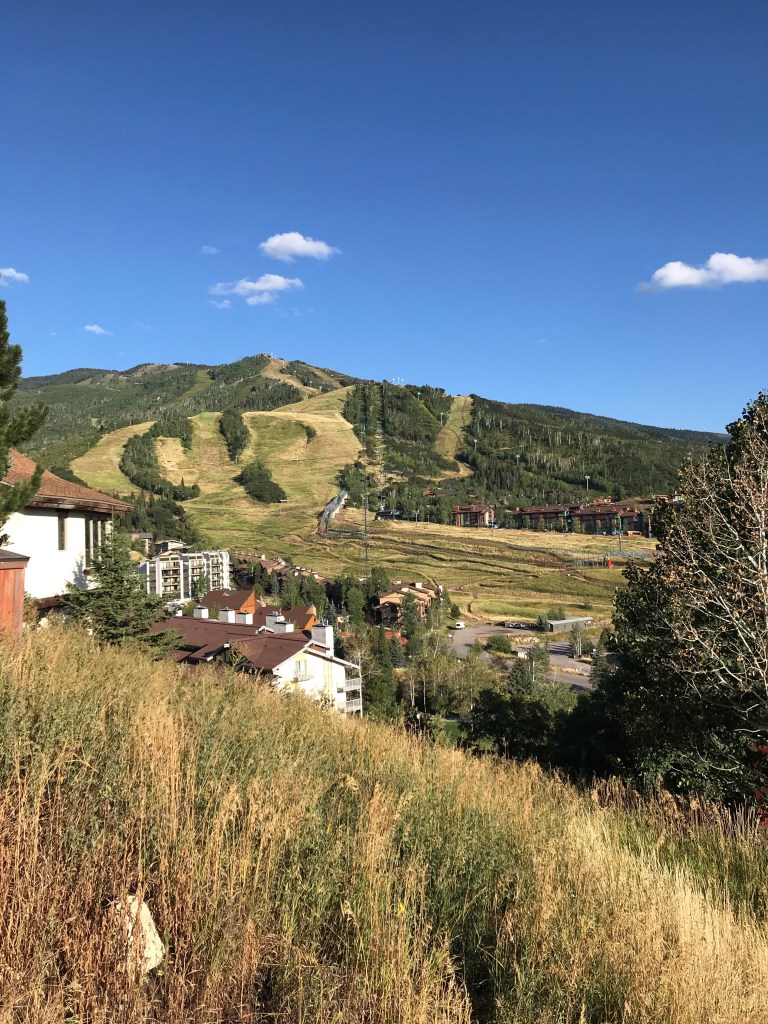
The shoes look so clean! The start goes right up that mountain.
Start to Mt. Werner Aid Station – Don’t worry and let most of the crowd rush to the front to start the climb. There is absolutely no problem with being in the back of the conga line. You are going to be out there for at least a day, maybe a day and a half. Just get into rhythm.
Mt. Werner Aid to Long Lake – This is an
easy, slightly downhill section out to Long Lake. Almost all this section is runnable on nice
single track. Most runners are still
part of a conga line. The conga line is
your friend. You have almost 100 miles
to go.
Long Lake to Fish Creek Falls – The first
half of this segment is almost flat and very runnable. Then you go through a steep, sunny, technical
section. The bottom part is runnable but
still steep. You cannot make your race
on this section, but you can break it if you trash your legs. Mantra for this one is easy, save the legs.
Fish Creek Falls back to Long Lake – This
climb is not that bad. Most of the way
up will be a steady march. The last 2
miles have opportunity for running.
Long Lake to Summit Lake – This rolling
section is long, but you can make good time using a “jog the down and flats and
hike the ups” strategy.
Summit Lake to Billy’s Rabbit Hole – The
first 2 miles out of Summit Lake are very runnable. After that, its jog/hike through rolling
terrain. BRH was surprisingly good for a
limited aid station.
The course has great views as you proceed along the CDT.
Billy’s Rabbit Hole to Dry Lake – I hated
this section. It would make a great day
run, but where it is in the race – 35 to 45 miles – with night falling, it was
tough. Physically, this is where you
find out if your legs can take the downhill pounding or if you blew it out when
you went down to Fish Creek Falls.
Mentally, it just keeps going, switchback after switchback. You can hear the Dry Lake Aid Station miles
before you get there, which also makes it bad.
This is the section where the first Hares passed me.
Dry Lake to Olympian – This is a downhill
trail, with a mile or so of gravel road before you get to town. Depending on how your race is going, it may
be time to reset expectations.
Olympian to Lane of Pain to Olympian – A
long half-marathon. Nothing too bad,
nothing too special; just a slog through the night. The Olympian Aid Station is the only indoor
station. As such, it is a “Venus fly
trap” for runners. Shoes off. People laying down. Don’t do that. Get out of there.
Olympian to Dry Lake – Finally heading
back to the Finish Line! Most likely its
early morning, and time to dig down and grind back up the hill to Dry Lake. Grind it.
Dry Lake to Billy’s Rabbit Hole – Most
technical and hardest climb of the course.
Nothing to do but march up it.
Billy’s Rabbit Hole to Summit Lake – You
are up. The race is not over, but it’s
done. If you made it here, you are
finishing.
Summit Lake to Long Lake – Nothing in
this downhill rolling 8 miles is hard other than the 80+ miles on your
legs. Just keep moving.
Long Lake to Mt. Werner – This section
seems WAY longer than it should be.
There are also a bunch of small climbs that were not even noticeable as
downhills on the way out.
Last section is back down this mountain. Ouch!
Mt. Werner to Finish – 6.4 miles and
3,500 painful feet down. Victory
lap. Almost all of this is a road, but
the last mile turns to trail. The finish
is great; run down the trail, jump in the creek, hug the bunny, and get that
buckle.
Gear List
The forecast for 2019 was for zero percent chance of rain. Daytime was sunny with temps in the upper 60s on most of the course. Nighttime temps were cold – in the 20s up high and the 30s lower down. The way to think about gear is that you need to prepare for two very different races: a nice daytime run then a cold night. With that in mind, here was my packing list:
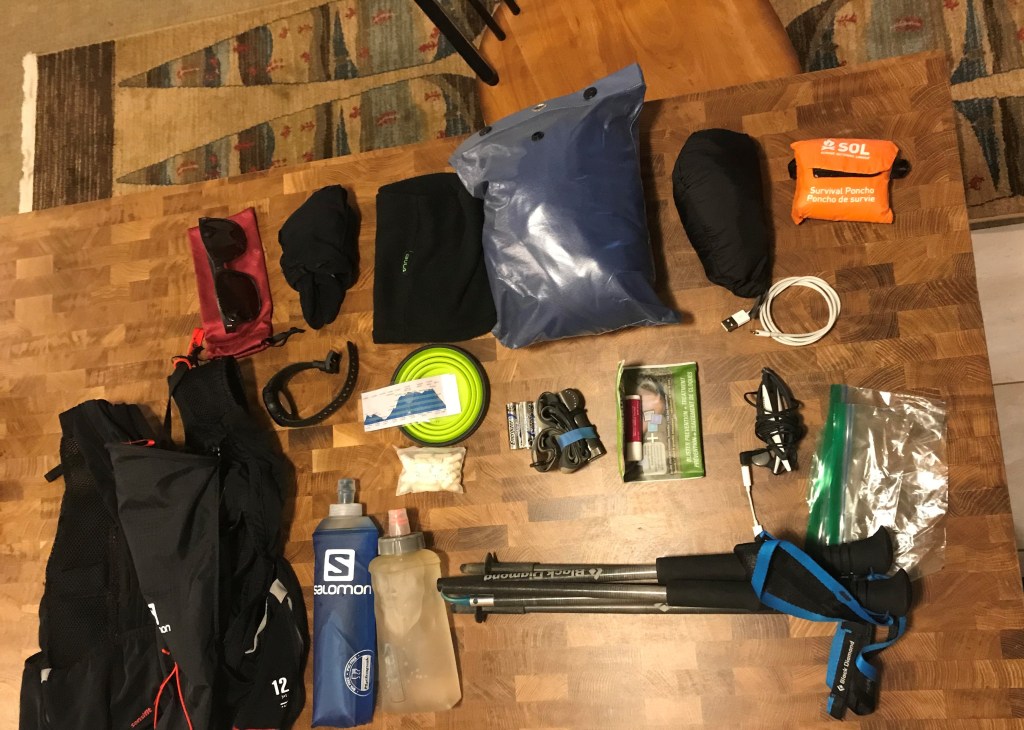
Wear: Shoes, shorts, shirt, visor, sunglasses, Suunto Core watch, arm warmers (ditched at Long Lake drop bag)
All the stuff I carried.
Carried:
Salomon Vest & Quiver
BD Carbon Z Poles
2 water bottles
Collapsible cup
Patagonia Houdini
Emergency Poncho – did not use but was backup in case of rain or extreme cold.
Regular Buff
Fleece Buff
Liner Gloves
Blister kit
Light fleece jacket.
Zebra light AA headlamp
4 AA Energizer Lithium spare batteries
Headphones
I-Phone with Gia GPS and route pre-loaded
Long Lake Drop Bag – Empty, just used to discard items.
Summit Lake Drop Bag – 2nd Headlamp, batteries,
warm hat, extra socks
Olympian Drop Bag – warm gloves, batteries, extra fleece,
tights, extra socks
Mental
To paraphrase Yogi Berra, the 100-mile distance is 90% mental, the other half is physical. I struggled to maintain positive attitude, particularly for miles 30-75. Also, I had been hoping for a sub-30-hour finish. When I realized that was off the table, I had to mentally re-calibrate. I really wanted the race over at mile 50. Around midnight I did some calculating and concluded that to finish I would need to keep pressing; finishing in 36 was in jeopardy. I marched all night alone having strange internal conversations. I got pissed at myself for entering the race, for not training properly, and for then having a bad attitude. Kept going. When dawn came, I knew that I had a long hard day ahead but also that I would make it if I kept grinding. I got very sleepy with about 17 miles to go. Sat down beside the trail for about 5 mins and realized that I had to get up and go. I listened to a David Goggins interview that I had downloaded for use in case of emergency. Spent 10 minutes yelling at myself while walking through woods. Got pissed that most of the sections were longer than reported. When I got to the last aid, I just pounded a coke and rolled. The 3,500’ downhill hurt every step. Got to 1 mile out, and they routed us onto single track. Mood got better, stowed the poles, and rolled. Finish was fantastic, almost cried. Gave Dad a hug at the finish. Felt like I lived a month in 34 hours.
Closing Thoughts
I give the RRR100 an overall Grade of an A. I don’t recommend that anyone attempt a 100-mile race, but if you want to try one, RRR is a challenging course, beautiful setting, great volunteers, and a fun (to the extent that term can apply to going 107 miles) and encouraging feel. Just come trained, with realistic expectations, and ready to put your mental toughness to the test.









 Vamonos Baby!