Chilling Out About Middle School

For those without little kids, it may come as a surprise to learn that much has changed when it comes to school choice.  With a current 7th grader and 5th grader, among others, I have learned that going to middle school is no longer “just go the middle school.”  Instead, students in our district may choose to apply to one of two “magnet” middle schools, another middle school with a “Green Tech Academy,” or, if the student is a girl, a school for “Young Women Leaders” (“Young Men Leaders” are, apparently, out of luck).   All these options have put pressure on the regular non-magnet middle schools to up their game and many now have impressive academic programs.  For those with the means to send their kids to private school, there are even more choices.  All this is great.

But the plethora of choice is not without stress.  Among many parents there is an unspoken fear that if my kid is not in the “right” school from a young age, there go the hopes of educational and career success.  That type of thinking is nonsense.

The one thing that distinguishes successful people is not smarts, or looks, or innate skill, or where the diploma is from, or certainly not where they went to middle school, but rather whether they can grind.  Someone who grinds can set a long-term goal and consistently put in the work to achieve that goal.  Grinders develop skills and expertise.  Grinding is not checking boxes or putting in face time at the office or being content to be comfortable just because of the money, it is an unrelenting process of improvement.  Grinders do not stand still; they are always moving up.  People who grind are valued by employers and, after a while, the process of grinding imbues a sense of confidence that allows grinders to choose their own career path.  Whether a plumber or a physicist or a pediatrician, grinders have options, and options equals power in the real world.

School needs to be interesting enough and challenging enough to keep students engaged so that they can learn how to grind.  For some kids that might be a rigorous academic program with lots of homework.  For others it might be a school with good athletic programs where the lessons of practice, teamwork, and winning and losing are learned on the field.  For others it may be a school with a great drama teacher who brings out the inner thespian in a shy student who spends many nights staying up late memorizing lines.  Point being, there are opportunities to learn the value of hard work at every school provided students push themselves, and parents push their children, to take advantage of those opportunities.

Parents who think a specific school is going to make their kid a success – or not getting into a school will limit success – are missing the picture.  It’s up to us to teach our kids how to grind by example, by setting and enforcing expectations, and by helping them discover the interests that bring out their passions.  Engaged and supportive parenting that demands accountability is way, way, way more important than any specific school.

There is a lot of pressure when it comes to instilling our children with the tools for success.   But that pressure is not getting our kids into the magnet middle school (though if they do and want to go, great).  That pressure is on us parents to be involved with our kids’ lives and teach them the value of hard work.  After all, raising kids is a grind.

Colorado Bend

One can live for decades in the same place and yet be ignorant of awesome things near home.  For me one of those things is Colorado Bend State Park, which is now my favorite Texas State Park.

Colorado Bend is located a little over two hours from Austin and San Antonio; just far enough to reduce crowd pressure compared to the more popular parks like Enchanted Rock, Guadalupe River, and Inks Lake.  What makes Colorado Bend special is the diversity of things to do.  Whether you like fishing and playing in a river, hiking, mountain biking, caving, or plunging into spring-fed pools, Colorado Bend has it all.   I visited this week on a short backpacking trip with eight families from my son’s Cub Scout den – we had an absolute blast.

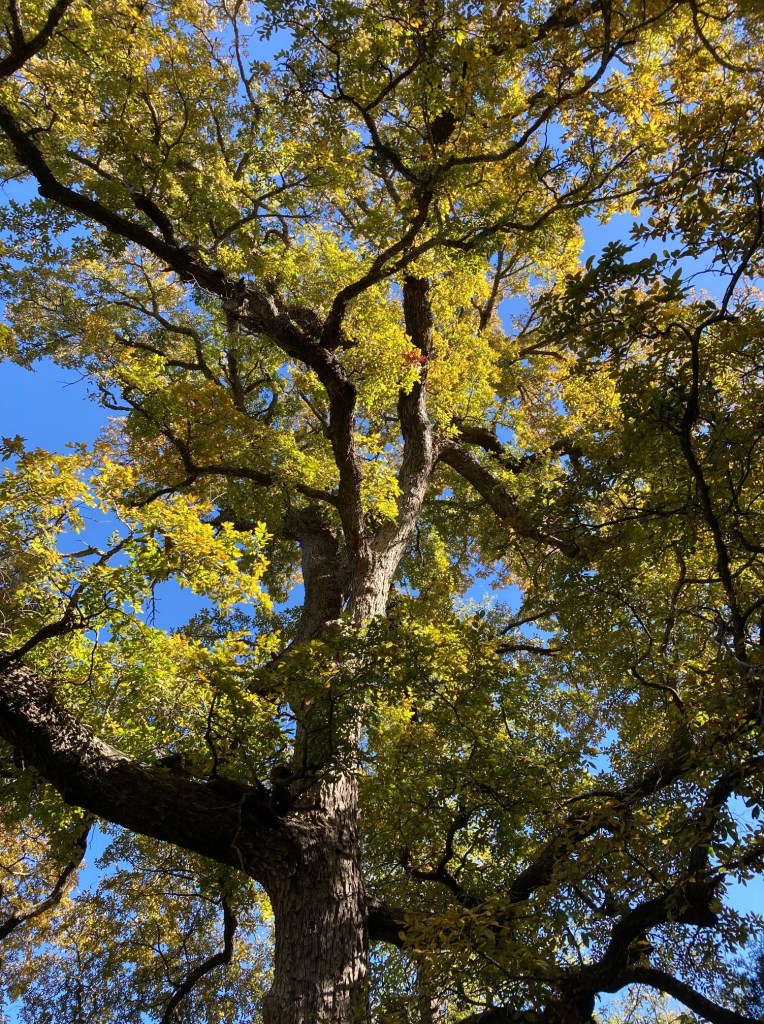
Fall is here. Elm tree showing color at Colorado Bend.

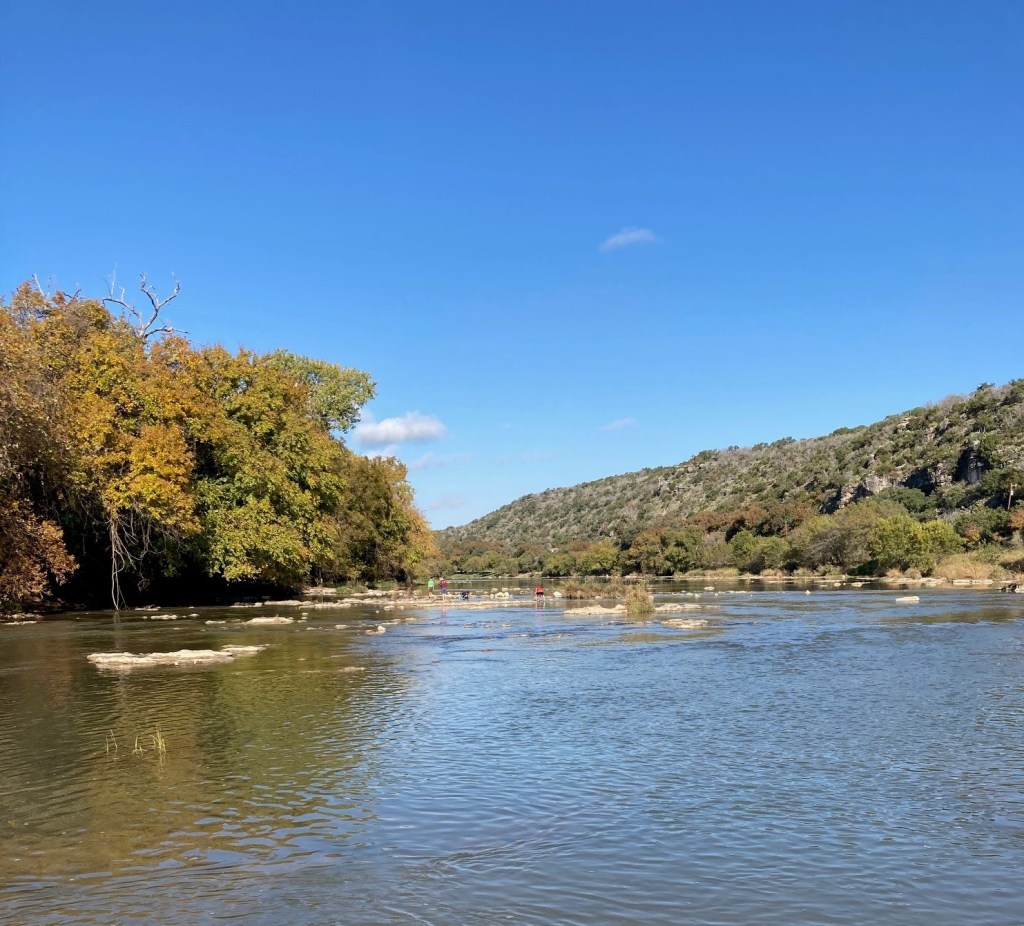
The River – The park is located on the last section of the Colorado upstream of the highland lakes.  Although at high water levels Lake Buchanan backs into the park, often the river is free flowing over shallow limestone shelves.  For a state chocked full of dams and lakes, the chance to play in a large natural river is rare.  The bass fishing is supposedly good, but I failed to catch any in a half hour of messing around with my 3-weight fly rod.  During non-COVID times kayaks may be rented but most of the river is shallow enough to walk across.

A natural flowing river – Rare in Texas.

Trails – There are 35 miles of trails ranging from rocky uplands to paths along the river.  The trails have large areas of shade, which is important in the Texas sun and heat.  Although we were on foot, almost all of the trails are open to bikes as well.  One of the park highlights is a hike to Gorman Falls where springs pour over a cliff with delicate travertine formations.  It is an oasis of lushness in the otherwise arid hill country landscape. The hiking was so good that in two days our group of 10 year-olds hiked over 17 miles and everyone had fun even with a couple of blisters and skinned knees.

The River Trail

Exploring Underground – The limestone cliffs along the river hold caves, including Gorman Cave.  The cave is only open to the public for scheduled tours; you cannot just walk in because TPWD is trying to limit the spread of white nose disease for the resident bats.  But during non-COVID times you can reserve cave tours. Our scouts explored some of the shallow unnamed caves. I am confident we will go back for the full wild cave tour.

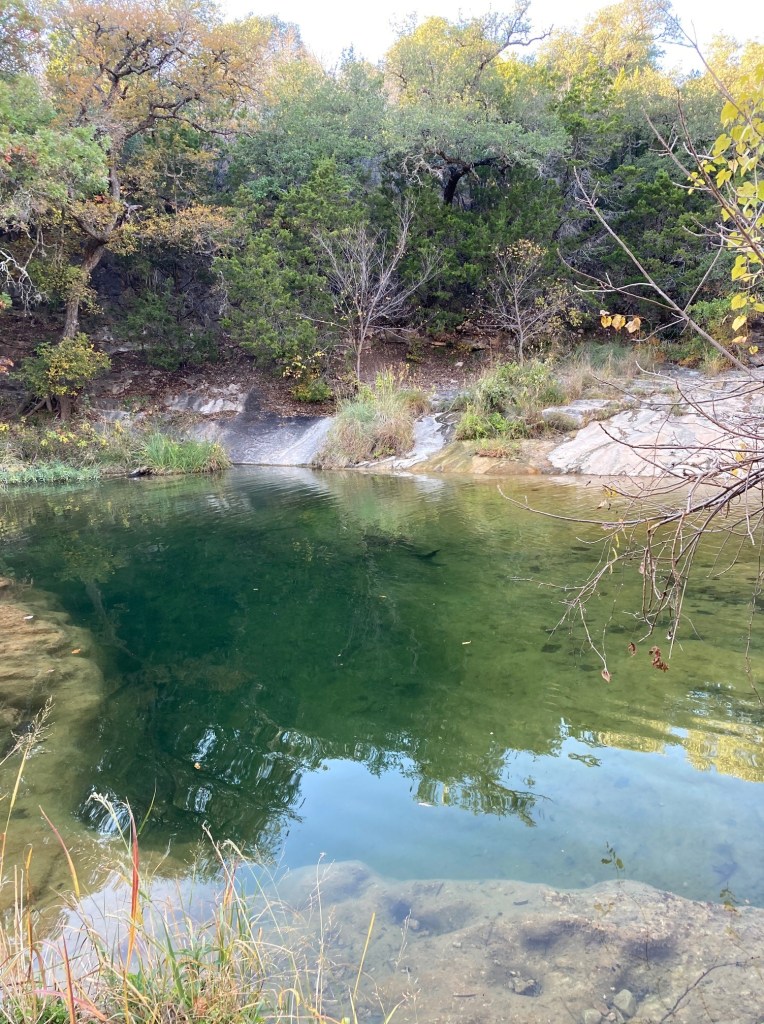
Cold but refreshing.

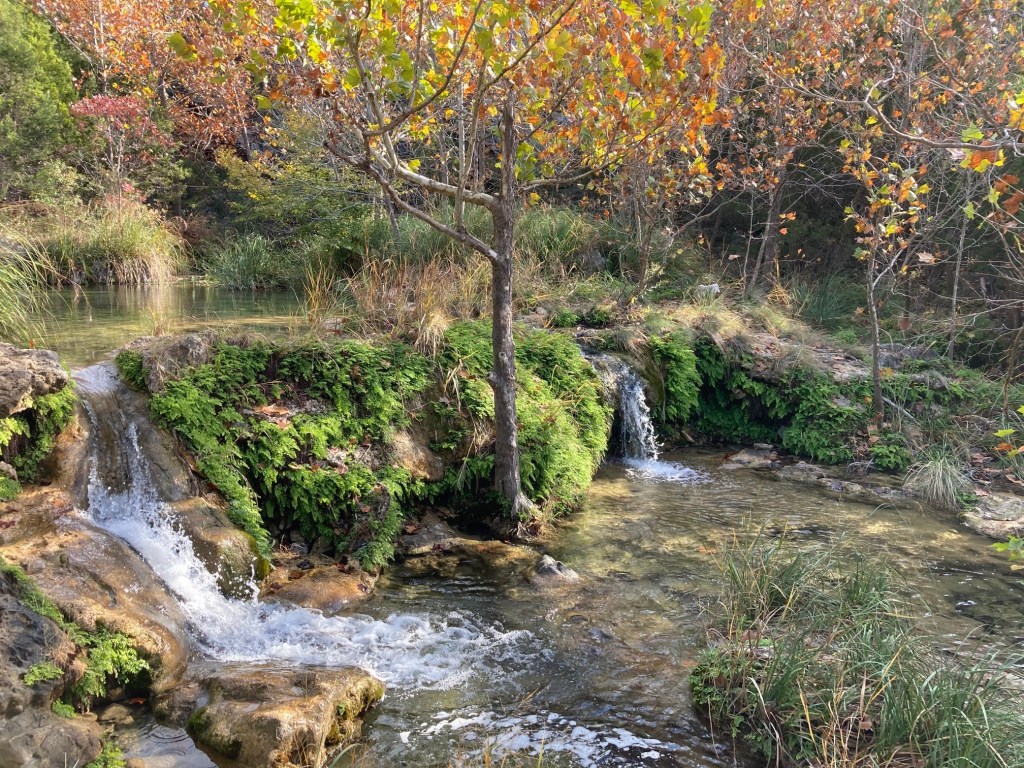
Getting Wet – While swimming is not allowed at Gorman Falls, getting wet is part of the adventure at the park’s other spring system, Spicewood Springs.  A 3.5-mile trail follows the Spicewood Springs creek from its junction with the river up to the high-country.  All along this path are absolutely stunning pools and waterfalls with ferns and moss growing everywhere.  This trail has some of the best swimming holes in Texas.  Of course, the entire river frontage is also open to swimming.  This makes the park a great hot weather destination.

So beautiful that it is hard to believe its real!

Camping – Colorado Bend camping favors real camping using tents and backpacks.  There are only 15 sites that are drive in and RV friendly and even those lack electricity.  The rest of the campsites are for tents only.  This is a good thing.  The backpacking sites are on the river with about a 1-mile walk, which is perfect for introducing kids to backpacking.    

Overall Rating: A+.  For a state park it does not get much better. 

Last-Minute Training

Last week I signed up for the Bandera 100k as insurance in case my main race set for August is cancelled.  By waiting until late October to enter a January race, I left myself only eleven weeks to prepare.  Not very long.

My preference is to leave plenty of time to train.  Pushing to run a 100k with less than three months of dedicated training risks injury and poor performance.  But sometimes living the vigorous life requires us to roll the dice.  Here is my plan in case anyone out there is thinking of trying something similar.

The Race

The Bandera 100k is held at the Hill Country State Natural Area in Bandera, Texas.  The course is rocky with lots of softball and baseball sized stones.  There is a moderate amount of vertical, just over 100 feet of climb and descent per mile.  There are no big climbs, just lots of hills.  The flat sections are very runnable when the weather is dry; when wet they become mud pits.  The setup is basically two convoluted 31-mile loops.  Overall, it is a relatively easy 100k course.

To get my Western States lottery ticket I need to finish under 17 hours, but I would like to be faster.

The Last-Minute Training Plan: Eliminate Everything but the Necessities

With a taper and a couple of built-in rest weeks, I have seven weeks to train hard.  Only race-specific adaptations are important.  That means focus on endurance, nutrition, and terrain that simulates the rocky Bandera trails.  Everything else, like road runs, speedwork, tempo runs, and hard hill repeats, must go.  That is not to say that these workouts are not important; normally I include them even for 100-mile ultramarathon training.  But there is no time left for electives.

Endurance

For endurance, I am going to build mileage but keep the pace at a very comfortable level.  Hopefully, this will reduce the chance of injury and will better simulate race conditions.  The bigger the mileage jump the more I will back off the pace. 

One of the most important parts of endurance is training the body to deal with hills.  The race has about +/- 100 feet of vertical per mile.  I plan to train at an average of +/- 150 to 200 feet of vertical per mile.  In other words, accustom my body to moving comfortably in more difficult conditions than I will likely experience on race day.

Nutrition

I also need to train to take in fuel during the race.  Nutrition/hydration issues cause lots of DNFs and poor races.  Even though I generally know what works for my body, I still plan on breaking out the vest and loading up with food (mainly PBJs), water, and salt pills during long training runs to make sure it all works. 

One nutrition wrinkle this year is COVID. I don’t really have a good sense of how the aid stations will work.  I don’t know how everyone will safely get food and water in cramped quarters and I have no desire to mess with masks during a race (which may be a reasonable requirement to protect volunteers).  Right now, my plan is to carry everything I need for each 31-mile loop and having a single refill drop bag at the start/finish area.  As I have never done that before, I will plan a couple of long shakedown runs to make sure this setup does not have unforeseen issues.

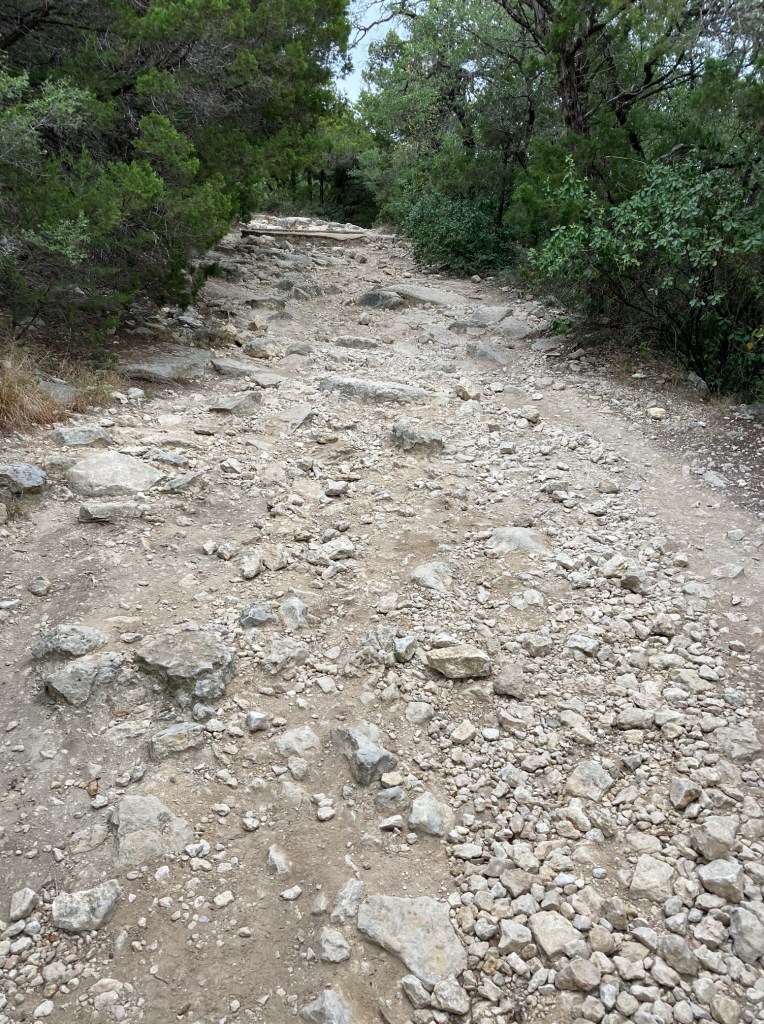
The Hill of Life on the Barton Creek Greenbelt. My training home for the next couple months.

Terrain

At the macro level the Bandara course is tame, but at the micro level the trails are rough.  Other than nutrition, probably the biggest cause of ultramarathon DNFs is muscular/ligament pain and breakdown.  The best way to avoid that is to train on surfaces that mimic the race.  For Bandera, this means spending lots of time on the rockiest trails in town.  I plan to do 90% or more of my training on rough trails.  I will also do quite a bit of training in the dark as navigating rough trails under headlamp is quite a bit harder than daylight running.

Weekly Plan

With all the above considered, and knowledge of how I deal with training, my basic plan for work weeks is as follows:

  • Monday and Tuesday – Long slow hill repeats (6-10 miles @ +/- 300 feet per mile)
  • Wednesday – Flatter trail run, moderate pace (8-12 miles)
  • Thursday – Kettlebells
  • Friday – Short slow hill repeats (5 miles @+/- 300 feet per mile)
  • Saturday – Long run aiming to simulate course, including hiking breaks. (15-30 miles @+/- 100 feet per mile)
  • Sunday – Rest

The Die Is Cast

Will this work?  I don’t know but my registration fee is gone so I am committed to finishing.  There is nothing like a race on the calendar to ensure accountability.  Whether it is a success or disaster, I will report back in January with a race postmortem.

2021 Race Picture

For most of us COVID scratched the 2020 race season.  There were a few early races that went off, as well as a handful later in the year in states that opened up or never closed (Way to go Bear 100!).  But many of us haven’t raced since 2019 and are itching to get something on the calendar. Planning to race in 2021 is going to be different than past years.

Trails over Marathons

I am skeptical that many big city road races will be held in 2021.  The number of runners and spectators and the density in corrals, aid stations, and finishing areas, plus the political situation in large cities, make these races unlikely.  If you really want to road race, targeting the smaller races in rural areas may be the best strategy. 

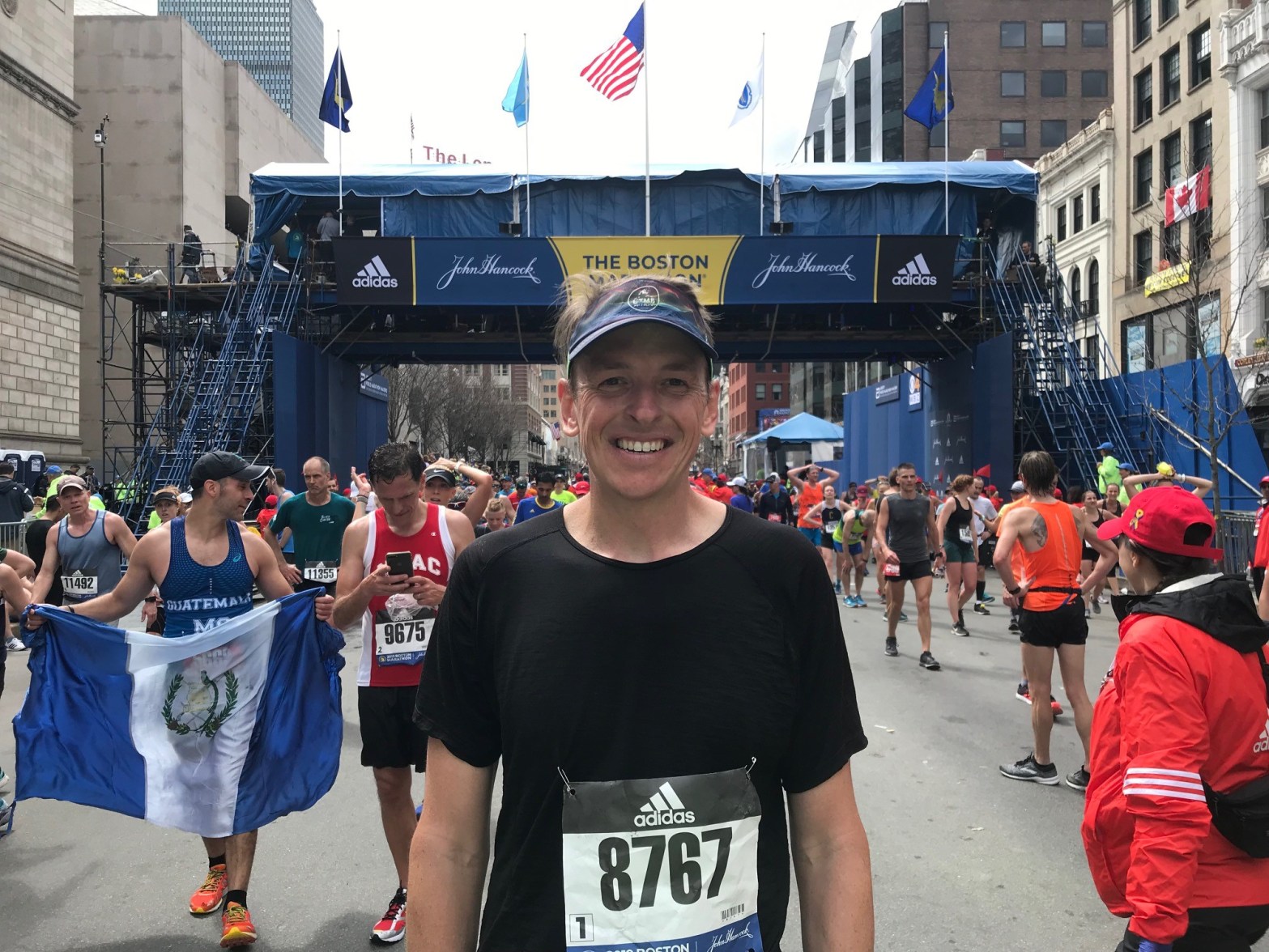
It is unclear whether the big bucket list races (Boston, NYC, Chicago, London) will be back to normal in 2021 or even 2022.  Do I want to put in the effort to try and qualify for one of these only to have them turn into “virtual” events?  No, running 26 miles around my neighborhood is not the Boston Marathon.  For now, I am waiting until there is greater certainty before planning on road racing.

COVID issues can be easier dealt with in trail ultramarathons due to the smaller fields, greater spacing, and the fact that trail races generally take place in rural areas with more flexible regulations. There is a good chance that many trail ultramarathons go forward in 2021.

Sign Up Soon

Most of the races that were cancelled in 2020 gave runners the option of rolling entry to 2021.  That means that many races are already more full than normal.  Waiting until the last minute to register, or even until early 2021, may not be an option.

Consider Early Races

If 2020 taught us anything, it’s that things are unpredictable.  We simply don’t know what things will look like next summer.  Perhaps we will be in a lockdown.  Races that are on for early 2021 may be a better bet.

Think Local

I love flying to interesting places to race.  But, as we have seen, travel restrictions may be prevent us from even getting to a race location.  If there is a race that seems fun within driving distance, consider signing up.

Ultramarathon Lottery Considerations

Western States, Hardrock, and UTMB were all cancelled.  These races all allowed runners who were set to run in 2020 to roll over to 2021, or in the case of UTMB to 2021, 2022, or 2023.  Hardrock changed its qualifying race window to allow races in 2019 to count for the 2022 lottery.  Based on the backlog, I expect that the odds for each of these races, which were already poor, to get worse.  I also expect that the demand for entering qualifiers will be up this year.

COVID Racing Strategies

I am not terrified of COVID but I don’t want to get it either. While I have not made any decisions, I suspect that my approach to racing will be more self-supported then in the past. I may carry most or all of my food and more water than normal to limit or eliminate aid station stops. Who knows, maybe this will make me faster. One positive side effect of COVID may be the reduction or elimination lots of crews crowding aid stations to pamper runners. With less support in aid stations and from crews, runners will may have to be mentally stronger than in past years. Harder is better.

What am I doing?

I am registered for the Castle Peak 100k in Lake Tahoe in August.  My entry was rolled over after the race was cancelled this year.  It looks like a fun, challenging event and is a Western States qualifier and UTMB 4 pointer. This is my main race.

However, I think there is a non-trivial chance that Castle Peak 100k gets cancelled again.  This is because it’s in California, the state that seems to be most prone to shutting things down.  This is also because its in the mountains in August and there is always risk of cancellation due to fire and smoke.  I don’t want to be in a situation where my only race is cancelled.

So I also signed up for the Bandera 100k.  I don’t really have a lot of love lost for the Bandera course, which was my first ultramarathon.  I am looking at this as an option to exact some revenge for the 19 hour and 46 minute beating it put on me in 2015. But, more practically, its a Western States qualifier (17 hour limit), is close to Austin and is likely to go off in January.  Now I just have to get in shape.

Urban Treasures

On a trip to visit family I found myself with an hour to kill in downtown Baltimore.  Wanting to stretch my legs I consulted the map and saw a big square of green labeled Patterson Park.  I was born in Baltimore and spent much of my life in the area but had never heard of Patterson Park. So decided to investigate.  It’s situated on 137 acres on a high spot overlooking Fort McHenry.   While Francis Scott Key was penning the Star-Spangled Banner as a prisoner on a ship in the harbor, American cannons on what is now Patterson Park fired on the British.  Later, during the Civil War the site was used as a hospital for wounded Union and Confederate soldiers. 

After the war, designers Frederick Law Olmsted, Jr., George Frederick, and Charles Latrobe redesigned the park in a “Late Victorian” landscape.  The Olmstead influence is obvious and has a mini-Central Park feel.  On a warm late October morning, Patterson Park was sublime.

I love exploring big urban parks – sometimes they have an almost magical aura that is simply not present elsewhere.  As I wandered around Patterson Park, I thought about what separates those urban treasures from other parks that are fine, but not as inspiring. 

For one thing, the great urban parks all have sufficient size.  How big is big enough?  I am not sure, but they need to be big enough so that you can get a little lost.  Certainly, if you can stand in one spot and see the whole park, it’s too small.

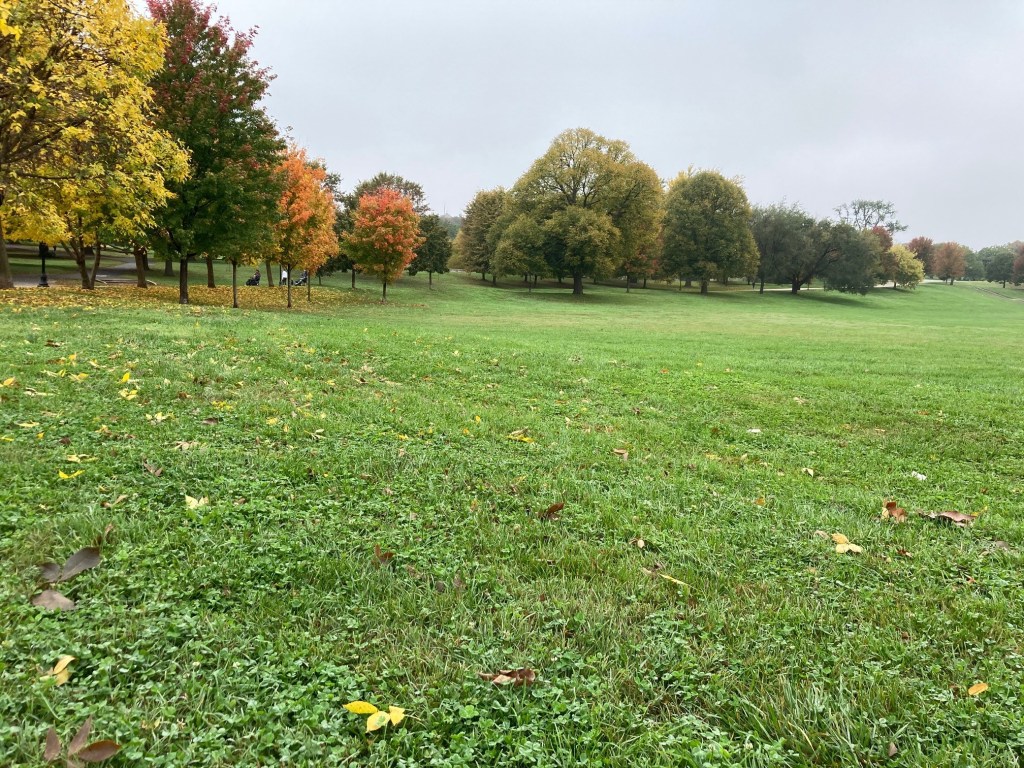
Great urban parks must also have great trees and – this is key – great lawns.  The kind of grass that makes you want to take off your shoes and run barefoot.  The lawns need to be huge – hundreds of yards across. 

The best urban parks also have interesting things to see beyond grass and trees.  It may be a spectacular skyline view of the city, a water feature, a historical object, or interesting natural outcropping.  Patterson Park, has cannons, monuments to old generals, big flags, and fountains.

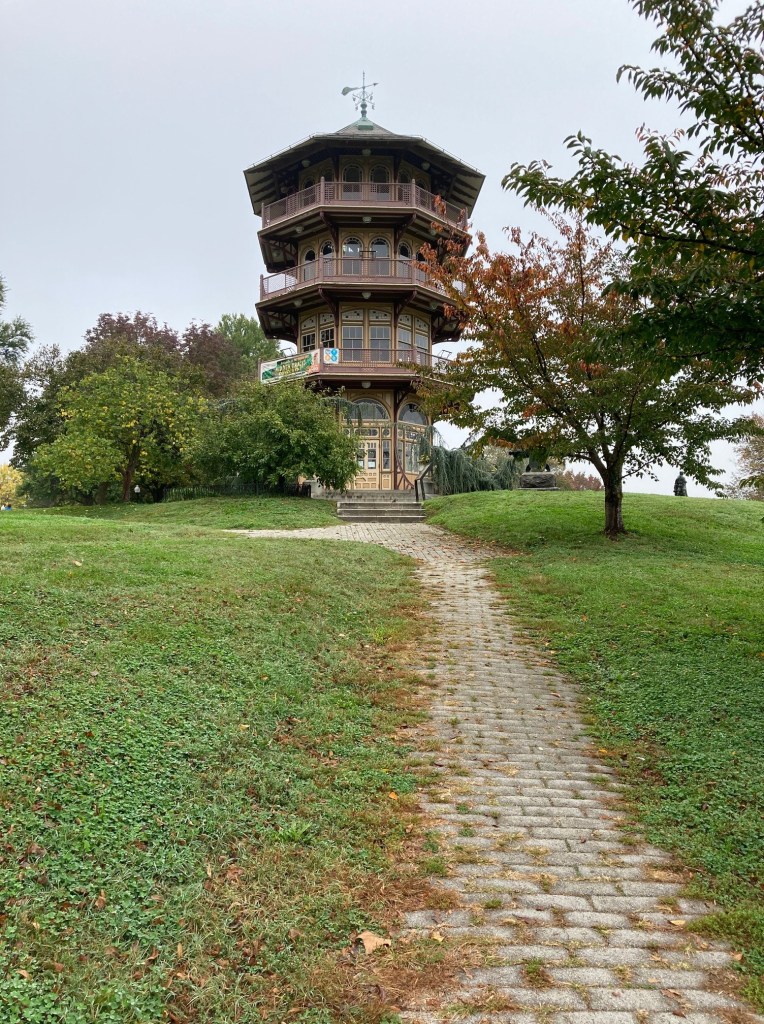
It even includes a pagoda that was built in 1892 as an observatory.  

Great urban parks are also practical. They have ball fields. Places to train. They are not botanical gardens but spaces to use, places for action.

They must also have good bones.  By that I mean they must be designed with a light touch that accentuates the natural geology but does not replace what nature created.  Great parks seamlessly incorporate hills, streams, and wetlands which beckon further exploration.  Paths don’t plow in straight lines across the landscape but wander.  A great urban park is clearly manmade, but you can still feel the nature.

Finally, and most importantly, great urban parks reflect lots and lots of time, money, and vision.  Many of the great urban parks were established by community leaders of the past who wanted to create a sanctuary for generations to come.  The designers knew that they were not going to even live long enough to see those parks come into full blossom.  Many urban parks are supported by dedicated volunteers who continue to labor to build on what came before.  The selflessness of parks is also reflected an opportunity cost; in every case some development money was “left on the table” to create something that benefits everyone. 

I wonder how much of that civic spirit remains.  If we had to do it all over, would we still decide to set aside a large parts some of the most valuable land in our cities to create parks, or would we focus on a what makes the most money now? And if we are not confident that we would make the right choice, what are we doing about it?

The next time I take off my shoes to run across the lawn in Central Park or Boston Common or Patterson Park or Zilker Park, I am going to feel the grass, listen to the laughter of families having fun, take in the beauty, and and appreciate those that came before who made the right choice.

The Hard Way

Modernity has created comfortable pitfalls that prevent most of us from reaching our potential.  Most of us train in the expensive, complex, and easy way.  Only a minority really trains the simple, hard way. 

What do I mean?  I mean in every discipline only a small proportion of amateur athletes, usually the highest performers, train to maximize the performance of mind and body.  Most people actively shy away from the things that work most efficiently and instead just “exercise” comfortably or conveniently.  The acid test of competition and real-world experience exposes the softness of the latter approach.

To identify the hard way, ask whether it sucks to do and whether most people avoid it.  If the answer is “yes,” then it’s likely the hard way. Here are “hard way” things: six hours of hill repeats in the heat, three hour rocky trail runs in 35-degree rain, 800 meter track repeats, long hilly road rides in the afternoon sun and wind, getting under a barbell and grinding a hard set of squats where you can barely do the last rep and then doing it again, and open-water swims. Hard way things are not just physically difficult, but they take mental concentration and effort. One cannot just zone-out and get through hard way workouts.

In contrast, the easy way involves training that does not make one tough.  Things like easy runs with a friend where you talk, jogging on the treadmill in the AC because its hot outside, the spin bike, cable crossovers and bicep curls, and swimming in a heated pool are all easy way things.  These things may have their place as an accessory to hard way training, but they should never take the place of hard way training. 

For hard events one must train the hard way.  That means if we are running a marathon we better be sucking wind during beatdown track workouts.  For a mountain ultra, we better be running on rough trails in all weather and counting vertical feet and time more than miles.  For a big bikeride, we better be going on real rides in the hills. 

Failure to train the hard way often results in hilarity.  Go to almost any road race, ultramarathon, or bike ride and you will hear people complaining about the weather or the course.

This is Allen Parkway in Houston. This hill represents about half of the vertical change for the whole Houston Marathon – one of the flattest marathons in the country. Lots of people complain about the hills on Allen Parkway.

News flash: you signed up for and paid good money to participate in an event takes place outside.  People that complain about the wind or rain or heat or cold or rocks or hills or snow are soft, not because of anything inherent but because they did not prepare themselves for the event.  Do not be that person. 

Train the hard way.

Old shoes never die, they just fade away

Recently a friend new to running asked how often I replace my shoes.  She had heard that they should be replaced every 250 miles and was surprised when I told her that some of my shoes last over 700 miles even though I do lots of running on rough rocky trails.

These trainers have 734 Strava miles and have worn like iron. The outsole is just starting to separate but with some Aquaseal repairs they should make it to 1,000 miles.

Throw out any “replace shoes after X miles” rule.  Those rules were written by the shoe companies.  Instead, look at the shoes to see whether they need to be replaced.  Inspect:

  • The uppers (the cloth).  After a while they will develop holes.  Eventually they will fall apart.  I usually keep running until they fall apart or until the holes get too big to keep rocks out.
  • The outsole (the tread).  When you run through the rubber or run off the tread they are done.  
  • The mid-sole (the foam).  This one is trickier because it’s less visual.  Some shoes simply get squashed over time but the uppers and outsole look fine.  The shoe loses its ability to cushion.  This problem is worst with shoes with soft foam.  Some super soft shoes can be destroyed in one race. Mid-sole foam compression is often determined by feel.  If your dogs are barking when they should not be, this may be the cause.

To increase longevity, use shoes for their specific purpose.  For instance, one of my favorite muddy trail shoes is the Salomon S-lab Sense SG.  It’s a lightweight, thin stack, trail shoe with huge lugs.  If I took that shoe on a road run it would work but would needlessly wear down the tread. 

These S-lab SGs have 437 miles on them according to Strava. They probably have at least another 250 miles in them but I don’t waste the tread on the road.

When I run on the road, I use my road shoes with more cushion and a road-specific flat tread outsole.  Likewise, some light road shoes will fall apart early with heavy trail use as they don’t have robust uppers. 

These road shoes have 581 Strava miles. The outsole is almost worn through in one spot, but probably still have at least another 100 in these. These light breathable uppers would get shredded on some rough trails.

When shopping for shoes understand that there is a lot of variability in durability.  Although I like to save money, I generally run in expensive shoes (mainly the Salomon Sense Pro and Salomon S-lab Sense models).  I do this because these models fit but also because they are durable.  If amortized over 500+ miles the per mile cost of my Salomons is less than cheaper shoes that fall apart an a couple of hundred miles.

How can one tell which shoes are likely to be durable?  Reviews can often be a good source of information on durability, but my rule of thumb is that if the shoe feels like a soft slipper when you try it on it is going to fall apart quickly. Shoes that are comfortable, but firm are more likely to last.  That is why I usually go for shoes with harder midsole foam – they provide more long-term cushioning.

Finally, for races considering buying a dedicated pair of race shoes.  For me, this is the exact same model as my primary trainer – so it a model that I have hundreds of miles in in the months right before the race.  Other than a 10-mile break in just to make sure there are no defects, these sit in my closet and only come out when I am on the starting line of a big race.  That way my feet have maximum protection, cushion, and tread for the event.  It’s a good confidence booster to know that whatever goes wrong, I don’t have to worry about my shoes.  And, of course, NEVER EVER run a race with a shoe model that is unproven through hundreds of miles of training outdoors, in the weather, on surfaces similar to the race or a shoe that has questionable fit. 

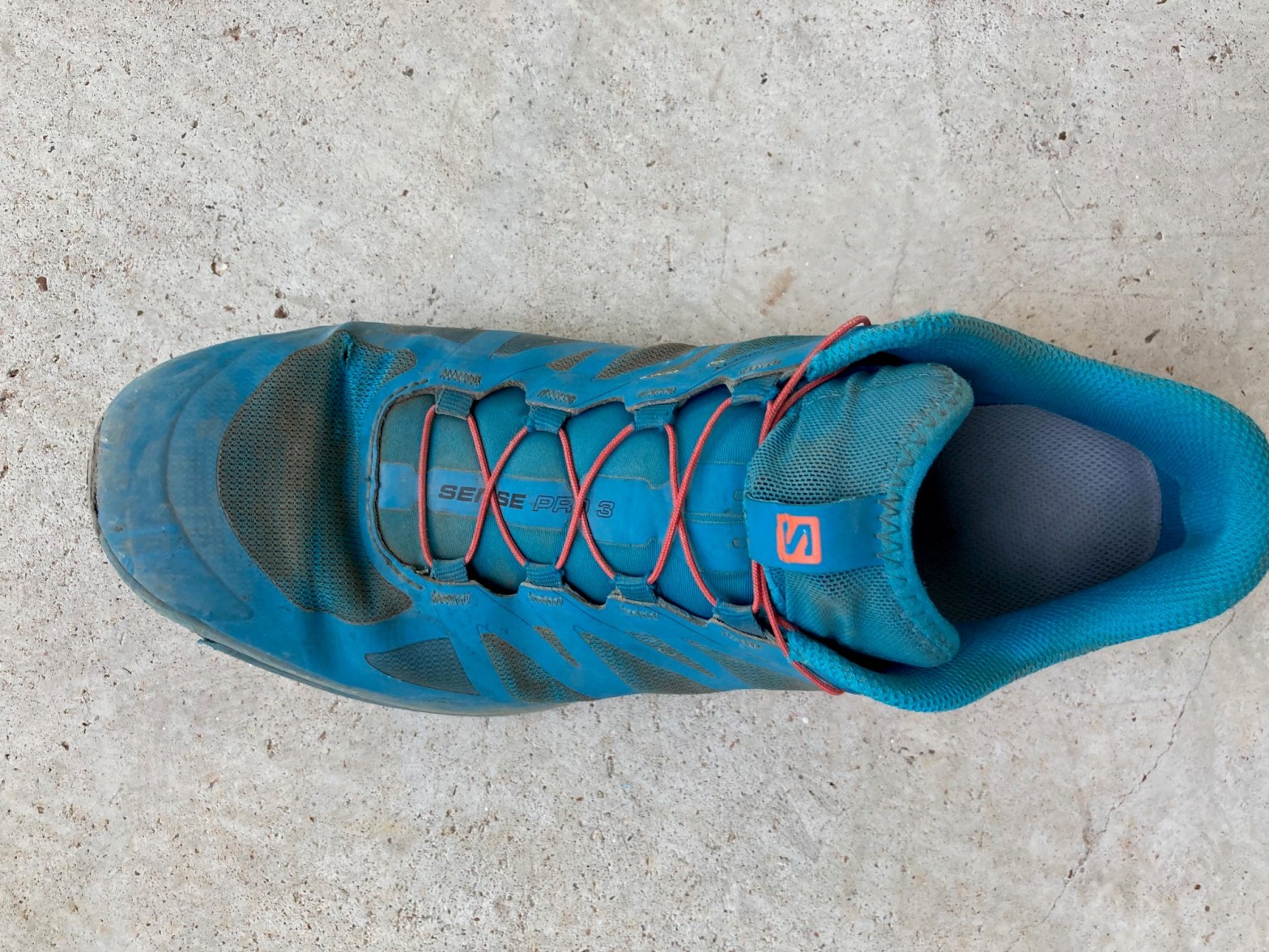
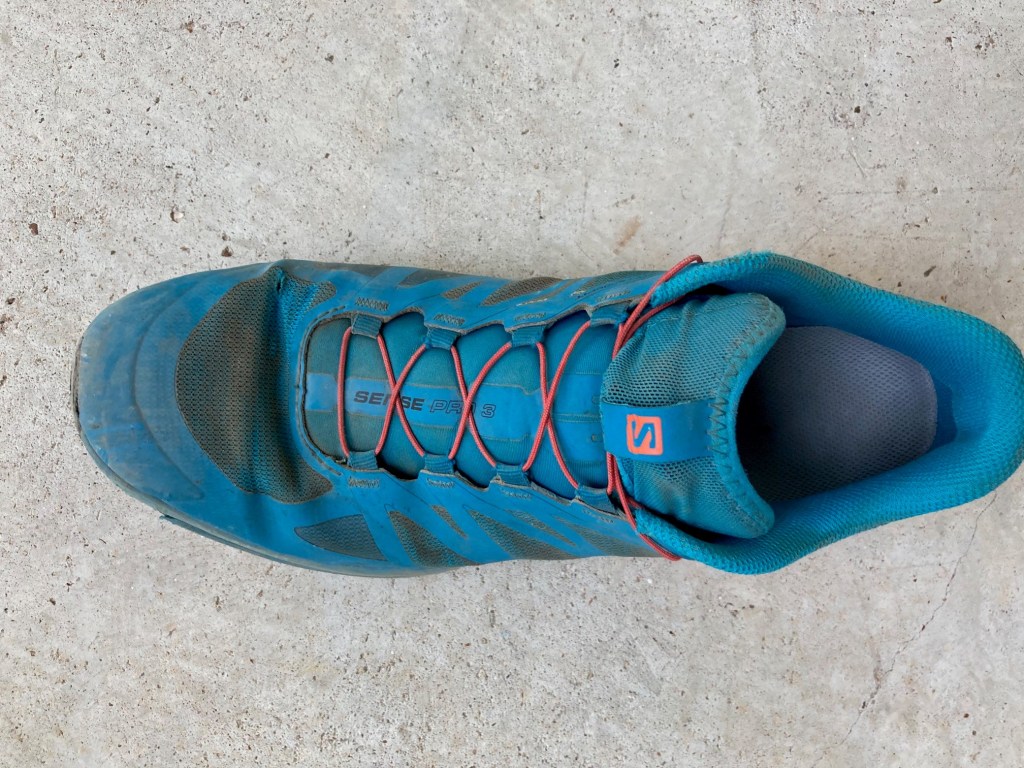
The Salomon Sense Pro 3. This (and the prior models) is my all around go shoe. Good for everything from marathons to 100s to weeklong backpacking trips. This one has a small hole in the upper after 300 miles. I get a new pair for each big boy race.

Happy running.

Time for Real School

As a follow-up to my recent COVID post, this weekend I came across a survey database of infection rates at schools in the US.  It strongly suggests that schools are not impacting the spread of COVID and that in-person schools are not an elevated risk for teachers.

These data were collected by a company called Qualtrics and the survey responses account for over 200,000 students in 47 states.  The survey responses were voluntarily submitted by school districts and therefore do not represent a true random sampling of schools across the country.  But even with that limitation, the results are enlightening.

The database looks at the “confirmed infection rate” – which is the number of confirmed COVID infections for students and teachers, respectively, over a two-week period divided by the estimated student or teacher attendance.  It also looks at a “confirmed and suspected infection rate” – which adds suspected cases to the numerator. 

The database allows one to parse the data depending on the learning mode of in-person at full capacity, a hybrid partial in-person and remote approach, or completely remote. Here are the numbers:

 In-personHybridRemote
Student Confirmed 0.17%0.14%No data
Student Suspected + Confirmed 0.47%0.86%No data
Teacher Confirmed 0.24%0.25%0.32%
Teacher Suspected + Confirmed 0.65%0.76%0.85%
Nothing to see here folks.

There appear to be no material differences between learning models. These data suggest that school has little, if any, effect on COVID rates.  If teachers (the population most at risk of people at school) were contracting COVID at schools, the in-person and hybrid teachers should have higher infection rates than those teach remotely. The data do not show that.

The database allows one to select for other variables including the State, whether the school is urban, suburban, or rural, and whether the school is public or private.  Changing those variables does not significantly change the infection rates, which further suggests that schools do NOT matter much when it comes to spreading COVID. There is no evidence in the dataset suggesting that remote learning schools are safer in terms of COVID.

Can we rely on this?

Before the stats people jump on me, I concede that the table above is not a substitute for a rigorous statistical analysis.  But these data are best I have seen to date on the issue. I am unaware of any data showing the opposite – that schools actually are a nexus for contagion.  Hopefully, similar, data driven studies are underway regarding school transmission (or lack thereof) of COVID, including additional detail on the effects of social distancing practices, if any, at schools.  

We are a long way from March when schools shut down. The time for making decisions based on fear, politics, or relying on worst-case assumptions of what might happen is over. Administrators, teachers, and parents need to be provided with data and facts to make decisions. If the data in this study continue to be confirmed, I can’t see any real argument for doing anything other than opening schools fully back up.

Of course, my mind is open and if anyone knows of data that show schools-based COVID transmission above background community transmission is real, please let me know.

Its Time

Like everything else these days, reopening schools has become just another issue for political cultists to fight about.   The lack of nuanced leadership based on an objective view of what we know and what we don’t is, and I say this with extreme understatement, disappointing.  My family is re-engaging with most of the pre-COVID activities of life, and I wanted to write down the reasons why. 

First, the things I think are proven:

  • The risk of death posed to school age children by COVID is less than other risks of other illnesses that we have always accepted.  The CDC’s current estimated COVID infection fatality rate or “IFR” (number of deaths/number infected) for age 0 to 19 years is 0.00003.  To put that in perspective, the IFR of the 2017-18 influenza season for age 5-17, based on CDC data, is 0.00007.  (I picked the 2017-18 flu season just because it was the last one with full data on the CDC’s flu website.  Different years have slightly different numbers, but not enough to change the conclusion.  There may also be differences in testing for COVID v. influenza, so this may not be a true apples-to-apples comparison, but I think the general patterns likely hold.)
  • The risk of death posed to parents and young teachers by COVID is about the same as the flu.  The IFR for COVID for ages 20-49 is 0.0002.  The IFR for the 2017-18 flu for ages 18-49 was 0.0002.
  • The risk of death posed to older people by COVID is greater than the flu.  The COVID IFR for ages 50-69 is 0.005.  The 2017-18 flu IFR for ages 50-64 was 0.0005.  For people 70+ the COVID IFR is 0.054 and for people 65+ the 2017-18 flu IFR was 0.009
  • The risk of severe COVID complications is significantly affected by “comorbidities” including cancer, chronic kidney disease, chronic obstructive pulmonary disease, immunocompromised state, serious heart conditions, sickle cell disease, Type 2 diabetes, and obesity (defined as a BMI of 30 or higher). 
  • Among those who die from COVID, over 90% have at least one comorbidity. Here is the CDC report with the data.  Thus, for healthy people the risks are probably an order of magnitude lower than stated above.

Things I think data show are likely, but not settled:

  • A significant portion (maybe half) of the population has pre-existing resistance to COVID.  A paper in Science showed that blood samples taken before COVID existed have T cells that are cross reactive with COVID.
  • A significant portion of people who have COVID are asymptomatic.  Studies suggest that asymptomatic people may be contagious but to a lesser extent.  Its unclear whether asymptomatic children are contagious.
  • Some people report long term effects.  It is unclear what is happening here, and I have not found a study that sorts it out, including all the potentially complicating factors.  But it does appear that some people report COVID symptoms for months.
  • Masks may help reduce transmission if properly worn.  Unclear whether the actual real world “wearing” of masks by people has much effect.  Pretty sure that having kids wear masks is useless, based on years of observing kids.
  • Outdoor activities have a significantly lower risk of COVID transmission.  Not only is there more spacing and airflow, but COVID does not live long outside.  There are a bunch of primary studies showing this, but DHS has an interesting “SARS-Cov2 Airborne Decay Calculator”.  As I type this in Austin Texas it shows the 99% virus decay at about 23 minutes, with the 50% decay at just 3:30.

The big thing that the politicians assume but for which I have strong doubts:

We will have an effective vaccine in the near future.”  Maybe.  We don’t have a fully effective vaccine for the flu and there are no vaccines for other coronaviruses.   I think it much more likely that COVID is an endemic part of our world for at least the next few years than its eradicated through a vaccine. 

Things on the other side of the ledger:

Not living our lives has real costs that are not reflected in the COVID count.  What is the damage to relationships because we cannot be physically close?  How many people have spiraled into depression?  How many have become addicted to alcohol or drugs?  How many committed suicides?  How many grandparents have been unable to hug their grandkids while a half a year of life has slipped through the hourglass, with not that many grains of sand left?  How many kids for whom school was the island of stability are adrift?  How many students who without resources and diligent parents fell ever further behind – and are still falling – because “virtual” learning is useless to them?  These harms are difficult to quantify but they are real.  And we each need to give them appropriate weight in deciding how to proceed.

Why I am pretty much done with COVID:

We are presented with a virus that is a low risk to healthy kids and most adults, but which can be dangerous for older people and unhealthy people. I don’t want to get it, but I am not terrified of getting it.  Our immediate household is low risk, but we have parents and other friends and relatives who are older, so we need to be mindful.  This is the situation for the foreseeable future.    

The benefits of (smartly) reengaging in activities appear worth it considering those risks.  For us that means outdoor sports are on. The kids can hang out with other kids outside. During the online school lunch break we let my son ride his bike to the school playground to have real recess with the other fifth grade boys. Scouting activities are on, all outside, where they should be.  We are going camping with friends.  We have made plans to get on a plane as a family, and I have already flown.  We will likely be sending our kids back to school in person as soon as real school is an option, instead of half-baked come to school and do computer learning. 

If there is one lesson that 2020 has taught us, it’s that nothing is certain.  There are no riskless choices, just choices with different risks.  And the risk of living a big chunk of life without doing things that are some the best things in life is bigger than the risk of a virus.

At least that’s what I think today. 

Patience

For something that is supposedly good for us, running can do a lot of damage.  Our injuries rarely announce themselves with the “pop” of a tendon rupturing or the sight of a bone sticking out of the skin.  Instead, running injuries are sneaky bastards.  One day we are fine, the next a little stiff. Then a running buddy says, “hey you are limping.”  Then we realize that we have gone through the entire bottle of ibuprofen in a month. 

Some judge experience in years or miles.  But real runners know that until you have plantar faciitis, a stress fracture or two, and the joy of an inflamed IT band, you are still a rookie.

We all know chronic running injuries are caused by big workload jumps and overtraining – but these are just physical manifestations of the same psychological problem: impatience. 

To paraphrase Commander Stinger: Our egos are writing checks that our legs can’t cash. So, in a likely futile attempt to check my ego, I am writing down these rules for the inevitable next time I feel that nagging pain on a run.

Chris’s Iron Rules of Injury Prevention

  1. Always run at least half my miles on rough trails.  Almost all my running injuries start when I am doing high mileage road running.  I almost never get hurt when a significant part of my training is on rough, uneven, trails.  I think the reason is that rough trails keep my stride variable, so bad form cannot creep in.  Trails also force my lower legs to be strong.  Paradoxically, the rougher the trail the lower the chance it will cause a chronic injury.  Smooth roads lead to weakness.
  • Always cross train.  At least once a week do something other than run.  My hierarchy of usefulness: barbell lifts > kettlebell lifts >  bodyweight workout > bike > swim.  Cross training allows me to still get a workout in while giving the ligaments, tendons, and bones a rest from the pounding.  Having a cross-training discipline also provides an outlet for when you need to rest the legs (see 4 and 5 below).
  • Never rush training.  Trying to get in shape in too short a time is a recipe for disaster because it forces big jumps in workload.  How much time is enough varies depending on fitness and experience.  I like to plan very long (6 month or more) training plans which allow for lots of intentional rest.  Build in extra time to deal with injury contingencies. 
  • When in doubt, rest.  It takes some experience to distinguish between good pain and a precursor to actual injury.  But even if unsure, the best thing to do is back off a little and rest.   A few missed workouts will not make a difference in an otherwise dedicated program.  Being healthy on race day trumps being injured but with more training volume. 
  • If hurt, stopping running for a time is the only way to get better.  Pay a little now or pay more later.  There are no shortcuts for stress fractures or tendonitis.  There is no miracle physical therapy.  Certainly not for a guy in his 40s without the benefits of improved living through chemistry.  The only way to make it better is to take time off.  It may be three weeks, it may be two months, but running through it is just making the inevitable worse.

Note: None of this applies to a race.  Finish the damn race no matter the hurt. 

Healthy running!