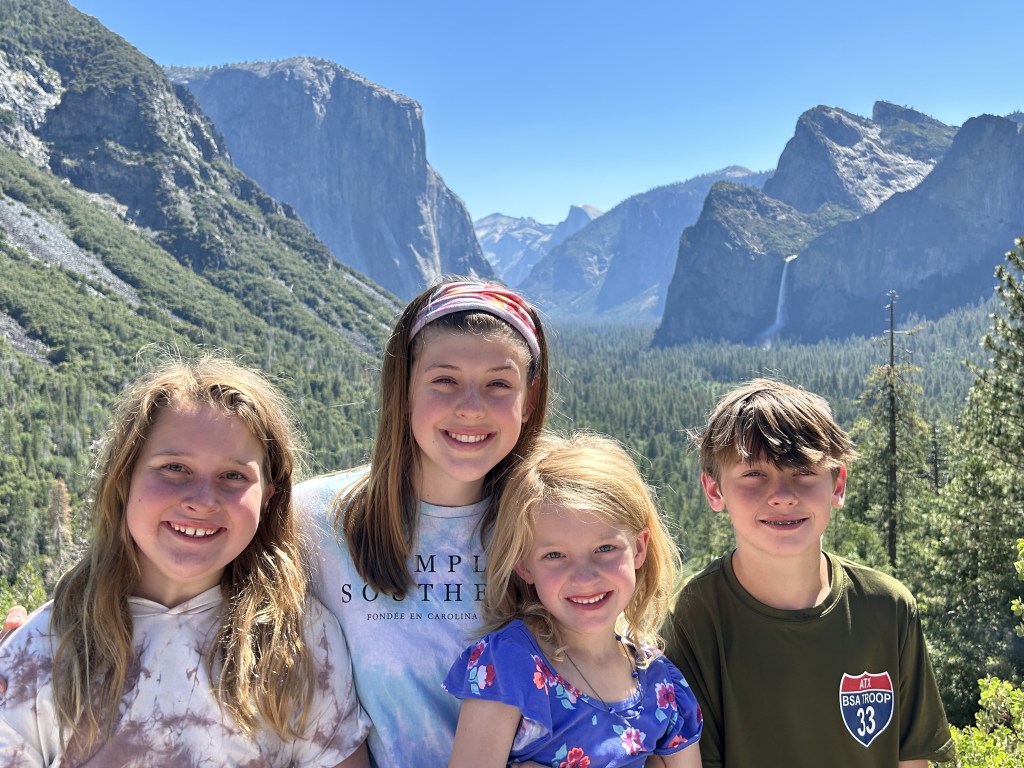
This summer we spent a few days in Yosemite Valley. It was our second trip to the park, but the first in the middle of summer. This year the park did away with the reservation system instituted for COVID, which made park mornings resemble the 1889 Oklahoma Land Rush except instead of claiming homesteads people were claiming parking spots. When we visited in late June, Tioga Road and Glacier Point Road were closed, further concentrating everyone in the Valley.
Despite the crowds, we managed to have a great time. The sights of the Valley are worth it, even though at times it may feel like you are at Disney World. Here are my Yosemite Valley middle of summer tips for families.
Get a place to stay in the Valley. The best option here is the Ahwahnee, but for those with lots of kids and finite money, you will want a campsite. We ended up getting a great spot in North Pines campground through the early season lottery. All of the sites in the Valley are reservable on recreation.gov. Apparently there are apps that scrape the website for bookings. The small cost of those apps may be worth it. If you are driving in for the day in July, you should enter the park by 6 am to get a parking spot. Personally, I don’t think I would visit without a place to stay in the Valley.
Our campsite in North Pines Campground – right on the river!
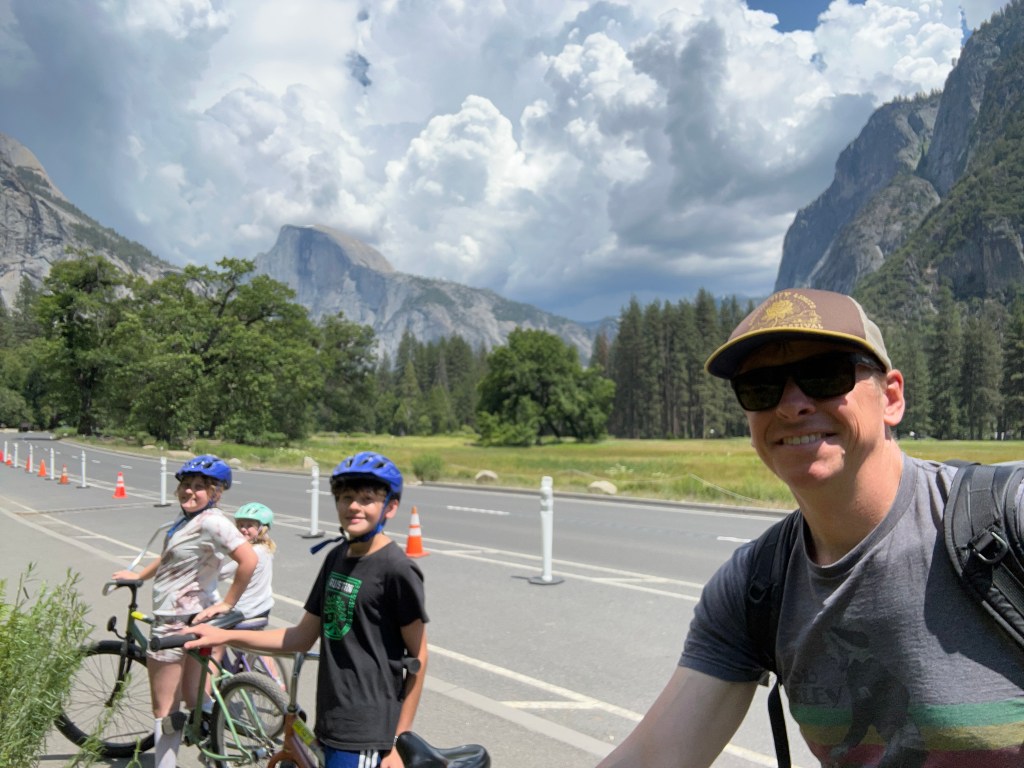
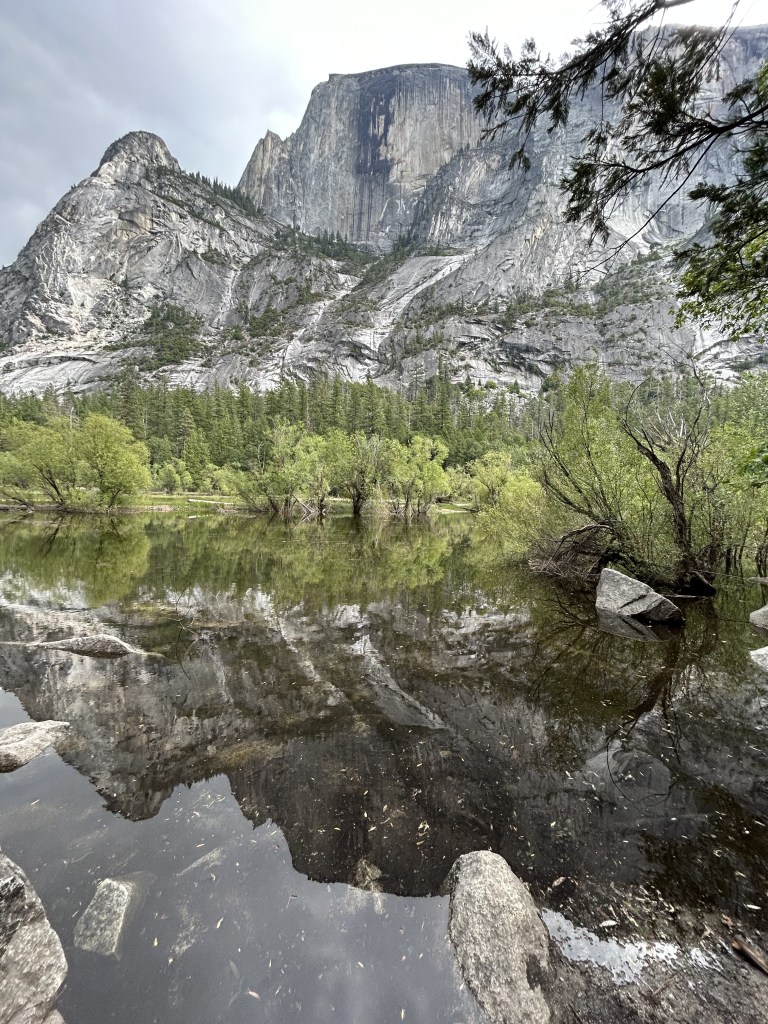
The only way to tour the Valley as a family is on a bike. Once you park your car, you are not going to move it unless you want to spend hours looking for another spot. To get around the Valley you need to either (a) walk, (b) take the free shuttle, or (c) bike on the paved bike-paths. Walking is feasible for adults and kids who can handle 6-10 miles with no problem, but not realistic for many little kids. The shuttles work well in the off-season. In the summer, they are a shit show with people waiting hours. Which leaves biking as the only reasonable option. Even if you can walk, the bikes are way more fun! Bikes are available for rent at Curry Village and Yosemite Village. We got ours at about 10 am, and got the last few. The bikes are beach cruisers, and the trails are flat. They have lots of adult and kid bikes, and a smaller number of tag-alongs. A whole day rental lets you keep the bike until 7 pm. I had heard stories of people stealing the rental bikes and riding them around, so I brought some paracord to make taking our 6 bikes for a ride a pain. Riding around and exploring the classic Valley sights like Lower Yosemite Fall, the Merced River, the Visitor Centers, and Mirror Lake make for a nice first day.
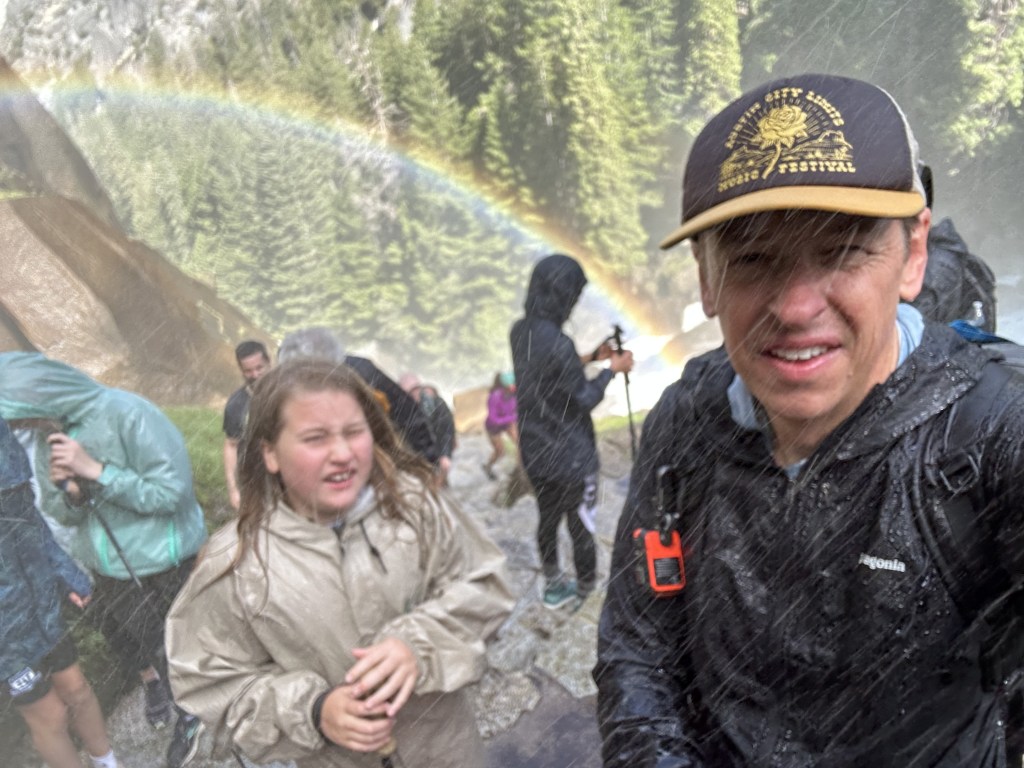
Hike the Mist Trail all the way to the top. Yes, this is one of the most popular trails in the National Park System. Yes, it’s got some climbing. Yes, if the snowmelt is going, you will get completely soaked and the kids will have a blast. Don’t stop at Vernal Falls, as the extra hike up to the top of Nevada Falls is worth it and probably 75% of the crowd stops at Vernal. Pack a lunch, get an early start, and descend the JMT in the afternoon to avoid the crowds. Our 6 year old was able to handle the hike, so kids can manage it as long as you take your time.
Getting blasted on the Mist Trail.
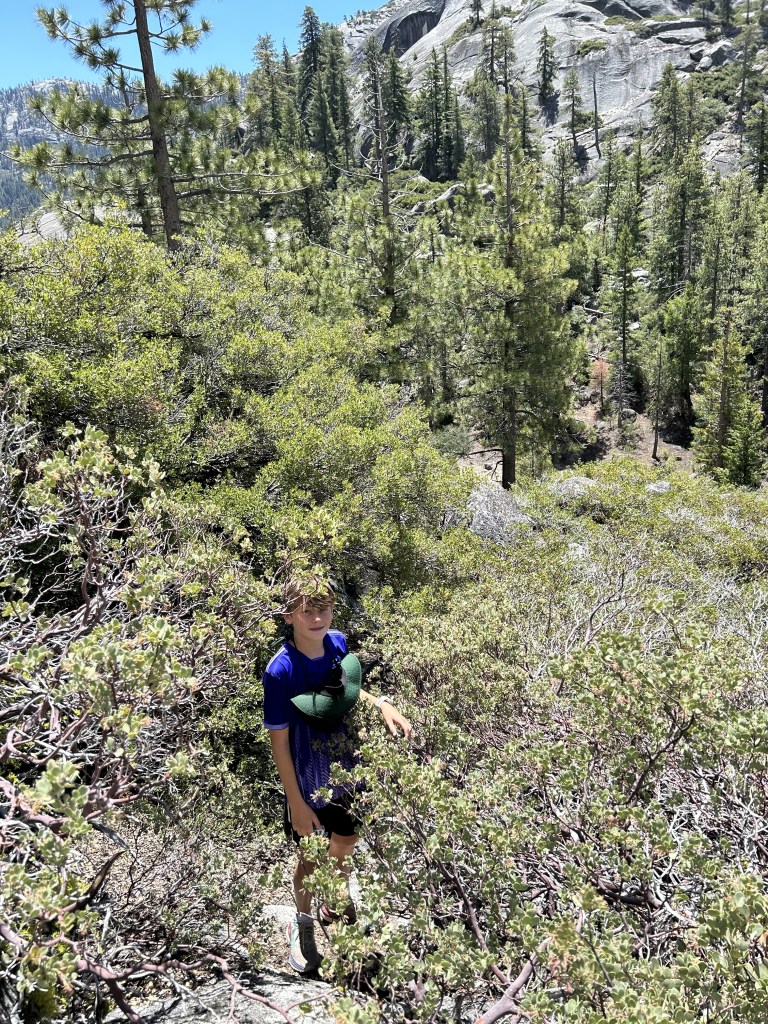
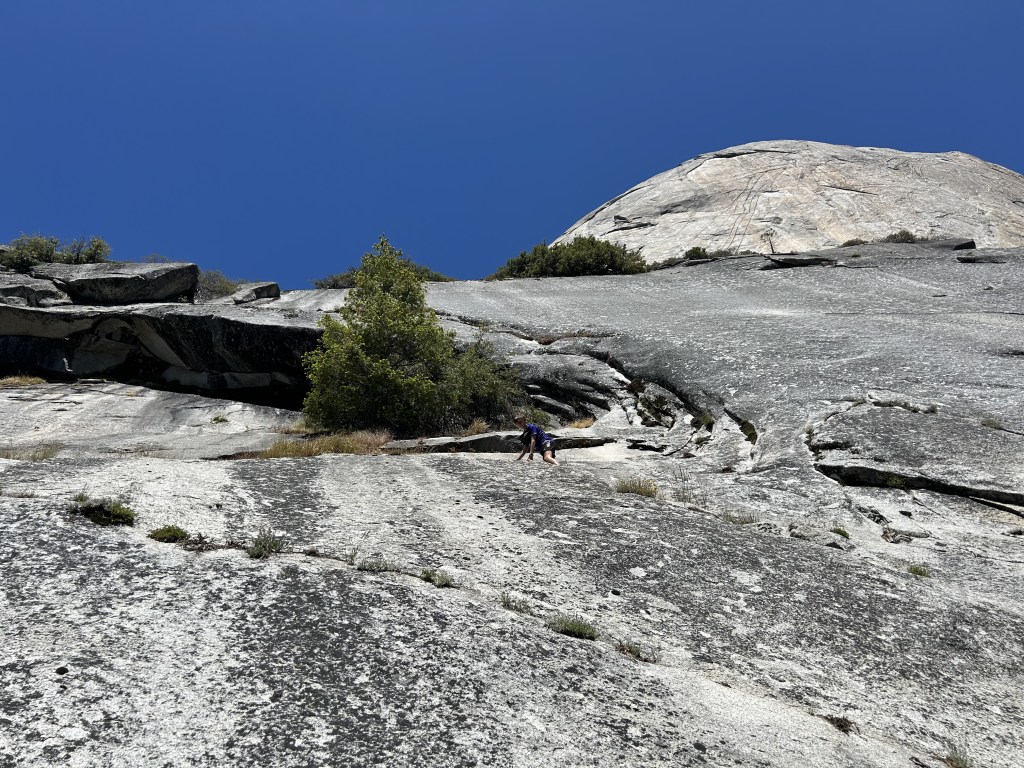
Hike Half Dome if you hit the lottery. Climbing the Half Dome chains is by lottery only. Unfortunately, we never got lucky. But had we won, I would have taken my oldest kids on this classic hike. Instead, Sam and I made a valiant effort to cut cross country a few miles above Nevada Falls to reach the Half Dome Diving Board. You don’t need a permit to reach this ledge where Ansel Adams took his famous photo of Half Dome. The route is very roughly marked with cairns, but we ended up losing the path through a field of large talus and thorny bush.
Thick stuff.This is where we decided we should have brought climbing shoes.
After some uncomfortably steep backtracks and a close encounter with a rattlesnake, we decided to head back down. Next time…
Don’t spend too much of your time in the Valley. The Sierras are fantastic. There are tremendous front-country and back-country activities in other parts of Yosemite and in nearby Sequoia-Kings Canyon. Two or three days in the Valley is plenty.
For Thanksgiving the six of us plus Michelle’s parents drove up from Austin to the YMCA of the Rockies Snow Mountain Ranch in Granby, Colorado, where we met my parents. For extra room, we rented a Ford Transit 15-person van in Austin. As we were going over Berthound Pass and taking in the winter wonderland of thousands of evergreens covered in snow, Michelle jokingly wondered aloud: “wouldn’t it be nice if we could have one of those be our Christmas tree.” Was that a challenge?
Sensing an opportunity for some whole-family Type II fun, when we got to the cabin, I did some quick research and discovered that in much of the Arapahoe Roosevelt National Forest, you are allowed to cut your own Christmas tree for $20. We took a quick trip to the Ace Hardware in Granby to buy our Christmas Tree Permit, a hand saw, and a couple of straps and rope to attach the tree to the roof of the van.
The official permit. You are limited to 6″ diameter trunk cut 6″ above the ground.
Most of the cutting areas are at high elevation on forest-service roads, requiring five to ten miles of driving on snow and ice and the Forest Service requires either a 4×4 or snow chains to access the tree areas. As we were rolling in a rear-wheel drive van with smooth highway tires, I bought a cheap set of snow chains from the Granby auto parts store. Luckily, these never left the box, and we returned them unopened for a full refund.
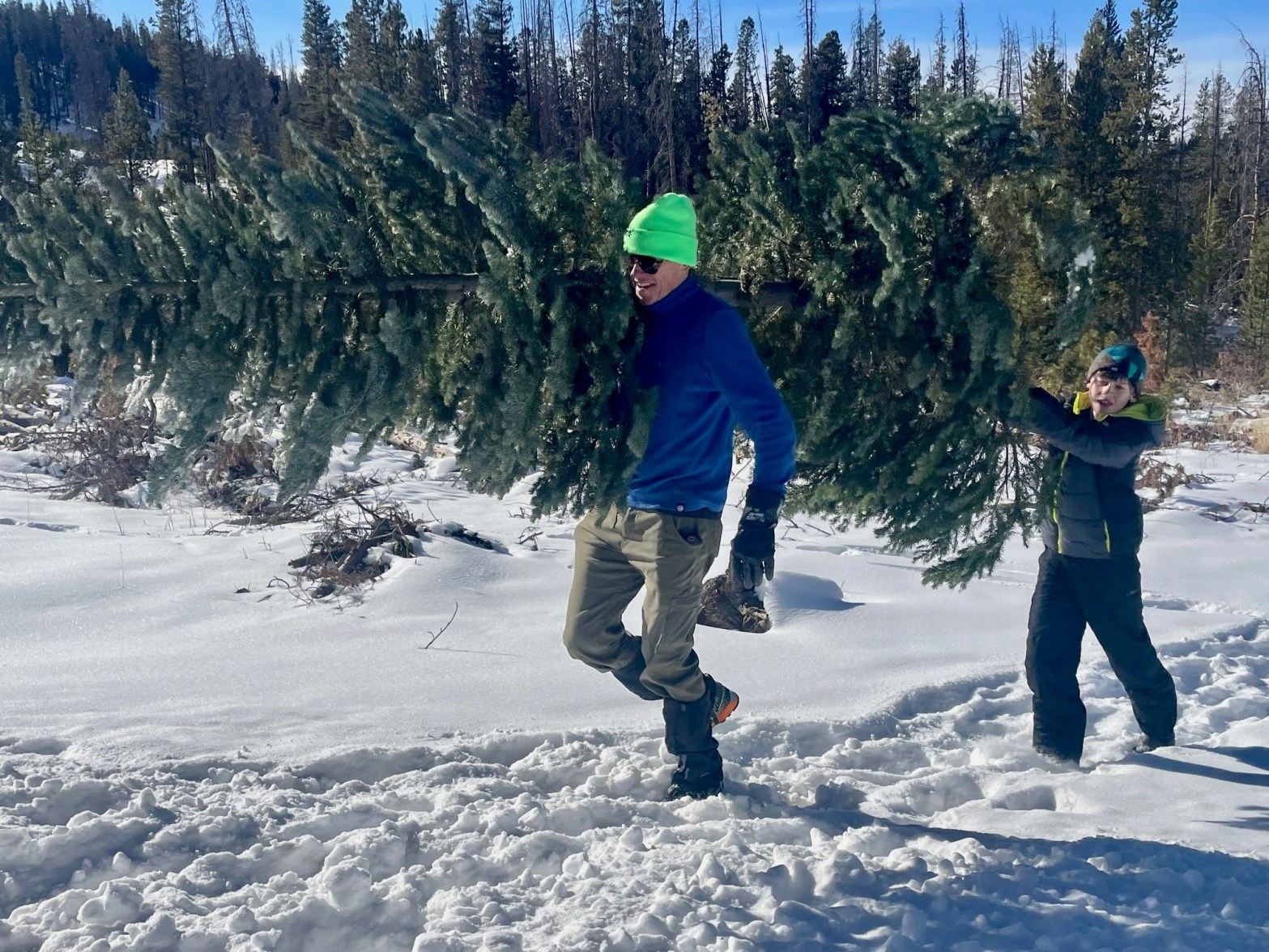
We drove up to the Meadow Creek cutting area in the Sulphur District of the National Forest and began our search for the perfect tree. It took almost three hours of walking through the snow. With the sense of Christmas adventure and enthusiasm in some of our crew waning, I finally found the Smith Family Christmas Tree at 9,134’ at the edge of a meadow about a 15-minute walk from the van.
Holding the tree while the kids take turns with the saw.
It took about 20 minutes to cut it down with all the kids getting a turn at working the saw, then we hauled it back to the vehicle.
For the drive to Texas, we wrapped the tree tight with twine, then attached it to the bare roof with a tiedown strap run through the front door frames, and the top of the tree held with paracord to two of the back seats.
Sure, that will fit in our 10-foot living room.
This setup held for the 996-mile drive back to Austin.
The tree secure to the roof in the parking lot of the Big Texan Steak Ranch (the only place to eat in Amarillo).
When we got home, I ended up cutting about 2 feet off the bottom to make it fit; we used the branches for greenery on the mantle.
Happy helpers with the tree installed.
We spent Sunday decorating the house, and putting lights and ornaments on the tree. I think this is my favorite Christmas Tree ever, even if the angel is smashed against the ceiling.
As astute readers know, I don’t go in for fancy watches. My resistance to the cult of the GPS watch is not solely attributable to my Luddite tendencies. My complaint with most GPS watches is that they are too expensive, too big, too complex, and with too little battery life.
The Coros Pace 2 fixes most of these problems. It is a GPS watch that just does the basics but does the basics well. Below is my short review of the Pace 2 after using it for a few months. If you prefer an ultra-detailed take, check out DC Rainmaker’s extremely in-depth review.
First, let’s talk about what the Pace 2 will not do.
Zero navigation functions. If you rely on a wristwatch to not get lost (a questionable idea), this watch is no bueno.
The Pace 2 will not play music or run apps. This is not a mini-phone.
Your special sport may not have a dedicated function. If you are into some niche sport and think you need a watch for that, fantastic, but look elsewhere.
If, however, all you want is a watch that will tell you how far you have gone, how fast you are moving, how many feet you have climbed, and keep working for a really long time, the Pace 2 hits the spot.
Cost: $200. One of the least expensive GPS watches out there.
GPS Battery Life: 30 hours. This mode takes one GPS reading per second and generates a high-quality track. I ran with a Pace 2 at Western States (using GPS/Glonass/Galileo/QZSS systems, see explanation below), and it still had 4% battery life after 30 hours, so this estimate is accurate at least when the battery is relatively new.
GPS Battery UltraMax Life: 60 hours. In this mode GPS comes on for 30 seconds of every 120 seconds. Algorithms calculate progress for the other 90 seconds. Coros recommends calibrating the compass on the watch before enabling UltraMax. I have had no need to test this mode, but based on the battery life on the regular GPS setting, I suspect it is pretty accurate.
Battery Life Regular: 20 days. I plug it in about once every 10 days, using the GPS a few times a week.
Size and Weight: Light at 35g with the silicone band and not obnoxiously big. Does not snag on clothes while putting on or taking off packs.
GPS Accuracy: The Pace 2 lets you use just GPS system run by the USA or GPS+Glonass (Russia)+Galileo (EU)+ QZSS (Japan). Coros recommends using all of them, but there is a slight battery savings with just using GPS. I use the “all of them” setting. The accuracy has been impressive running known distances around my neighborhood. My Western States track on the Pace 2 was 100.11 miles, while the “official” distance of the race is 100.2 miles.
Altimeter, barometer and vertical accuracy: The watch has a barometric altimeter, which slightly increases the accuracy in the vertical plane. Like all GPS devices, I can tell the Pace 2 is less accurate vertically than it is horizontally as more algorithmic smoothing (how many tiny ups and downs count) goes into calculating vertical. The official Western States vertical climb is 18,090′ while my Pace 2 calculated 16,476′. The barometer has a storm warning quickly dropping pressure.
Functions: Run, Indoor Run, Track Run, Bike, Indoor Bike, Pool Swim, Open Water Swim, Rowing, Indoor Rowing, Flatwater, Triathlon, Strength, Gym Cardo, GPS Cardio, Multisport, Walk, Custom Workouts, Training Plan. The only ones I have used in four months are Run, Bike, and Pool Swim. They work fine. I think one can upload specific training programs into the watch, but honestly, I am unlikely to ever bother.
Syncing: The sync with my phone is easy, and the app is clear and can export to Strava.
Display: Lots of options to customize the display, including big text for old guys who can’t see tiny things anymore. For running I display distance, time of day, elapsed time, current pace, average pace, and current elevation.
What else to say? It does tell time.
Face is bright and easy to read.
For the money and battery life, it will be hard to beat this watch for endurance athletes and backcountry adventurers.
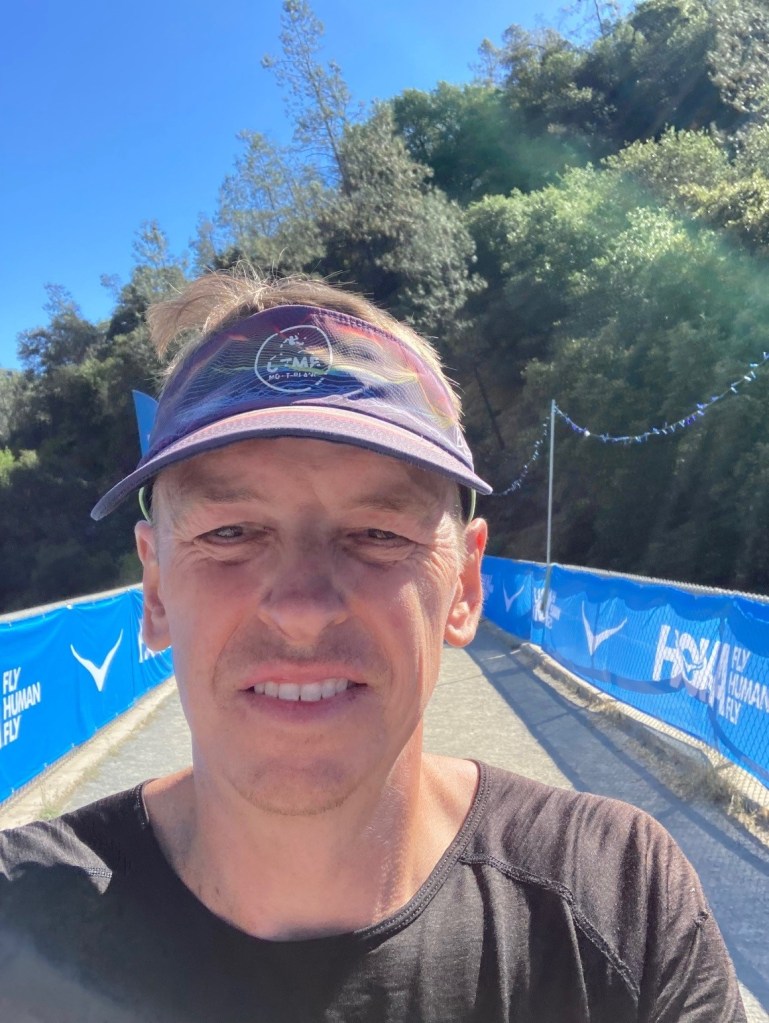
This summer I managed to finish the 100-mile Western States Endurance Run in 29:43:16, less than 17 minutes before the 30-hour cutoff. Clearly, a close run thing. Here are my thoughts on the race and advice for those who get a chance to run in the future.
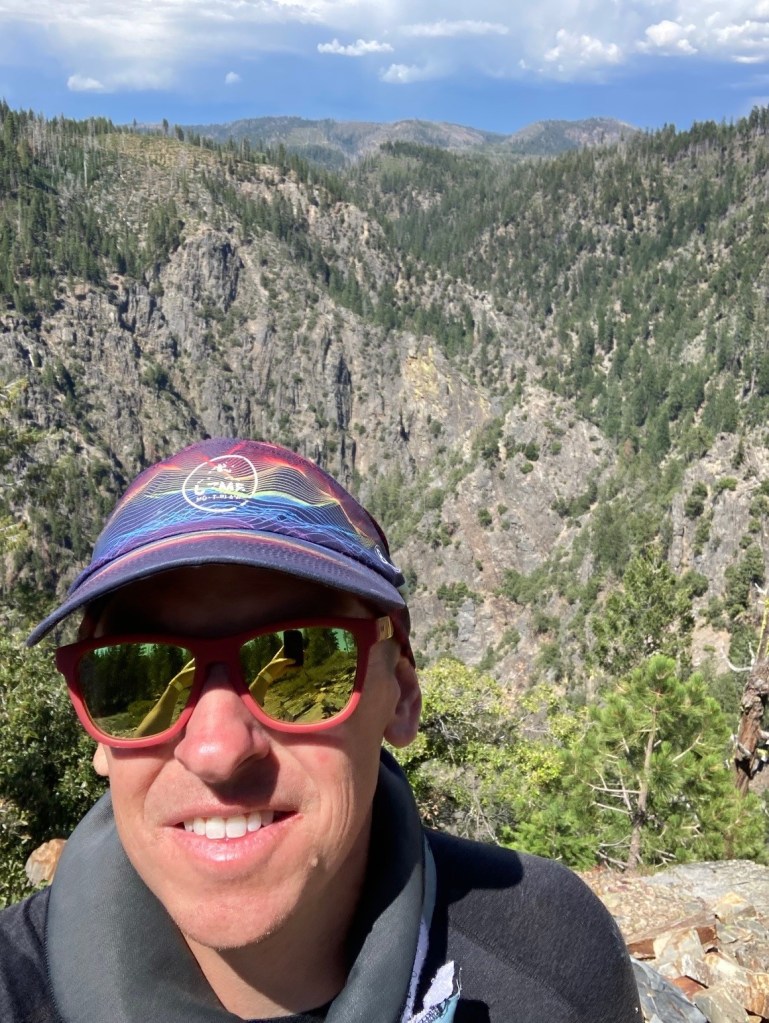
Saturday afternoon on the course high over the American River canyon.
Western States is a bucket-list race for a reason. The overall feel of this race is unique. There are faster and harder courses, but not many races that have the same vibe as far as history and hype. The only ultra in my experience that compares, atmosphere wise, is UTMB, but because Western States is capped at 369 runners, the race is much more intimate. The field is small enough that you make friends on the course.
All the organization, schwag, aid stations, and crowd support are top notch. The registration scene the day before the race was great with people from all over the world, professional ultrarunners mingling with weekend warriors, and lots of spectators. Thousands of volunteers, many of whom are race veterans, make the race something special.
Western States is an awesome race for us runners who are not professionals and not fast, but just trying to finish. At the mandatory race briefing, the organizers spoke about the “Golden Hour” between 29:00 and 30:00. The race celebrates the struggle of regular people to make it, and in fact more people end up finishing in the Golden Hour than any other hour of the race. As the race awards ceremony immediately follows the 30 hour mark, everyone involved with the race is at the stadium for the Golden Hour runners and the place is nuts.
The 30-hour cutoff is the crux. The course is not easy. It has lots of elevation and its very hot and exposed at points. In terms of difficulty as far as climbs and trail conditions, the course comparable to the Bear 100 and Run Rabbit Run. What makes Western States harder than those races is that you have six fewer hours to finish. This means that for someone like me there is no margin for error. Walking it in slowly is not an option. There are no extra hours on the board to get lost or change clothes or mess around in an aid station. The whole race is hustle, hustle, hustle.
Grinding on a typical section of trail – exposed and rocky.
Race volunteers do a great job of encouraging runners to deal with the time crunch. As an example, when I got to the Devil’s Thumb aid station at mile 47.8, it was 5:41 pm. While a volunteer was filling my water bottle, I sat down and retied my shoe. Another aid station volunteer, seeing me sitting, came up and said, “Just want to let you know that this aid station closes at 7.” I said, “Why are you telling me that?” – thinking I had at least an hour in the bank. He said, “You are cutting it close. If you are going to finish you need to move now.” I thanked him, and immediately got up and took off.
A few miles later, down a hot canyon, I rolled into an aid station and the volunteer captain said “What can we get you?” I said, “Just water. I am just going to grab a handful of oreos and keep walking.” He said, “I love it when runners say that. You are going to finish with that attitude.” At every single aid station the volunteers were helpful, positive, and reminded me that time is of the essence.
The heat is annoying, but not a big deal if you are prepared. Less daunting than the cutoff, but still a challenge, was the heat. Much of Saturday is on trails exposed to the sun, and the canyons in the afternoon were stifling. Many runners were dry heaving, unable to eat, and having other issues because of the heat. For me, the heat was a minor annoyance and not a serious issue. But I was prepared for it. Here are some of the things I did to deal with the heat.
No hot vest, just a Naked Band and handled kept me smiling in the heat.
Trained in the heat. I intentionally went for training runs at 4 pm, which in May in Austin is hot and humid. I bonked on a few of these training runs, but they helped me dial in salt pills and gear. Speaking of gear…
Lost the vest. I run almost all of my ultras with a Salomon running vest. The downside of a vest, however, is that it can act like a jacket, trapping heat. I made the switch to Naked Running Band, which worked excellent and was way cooler than a vest. There is no need for a vest at Western States.
Carried plenty of liquid. I carried an Amphipod 20 oz handheld (which I picked up at an REI garage sale for $8). In hot weather handhelds work great because I drink more often from a handheld than a bottle in a pack. For longer sections, I had two 17-oz soft flasks, which stowed in the running band.
Adhered to a salt pill schedule. I took a salt pill every hour until nightfall, when I backed off to every two hours.
Ice, Ice Baby. Every aid station had plenty of ice. I ended up running with ice carried around my neck in a device John and I have developed, and ice in a buff on my head. I had so much ice on that I would get ice-cream headaches as I left each station, but the ice would all melt before the next aid station. Advice for anyone running this event: have something to carry ice on your neck and head. I did not have them, but many runners had sun sleeves that they also packed with ice. Those are a good idea.
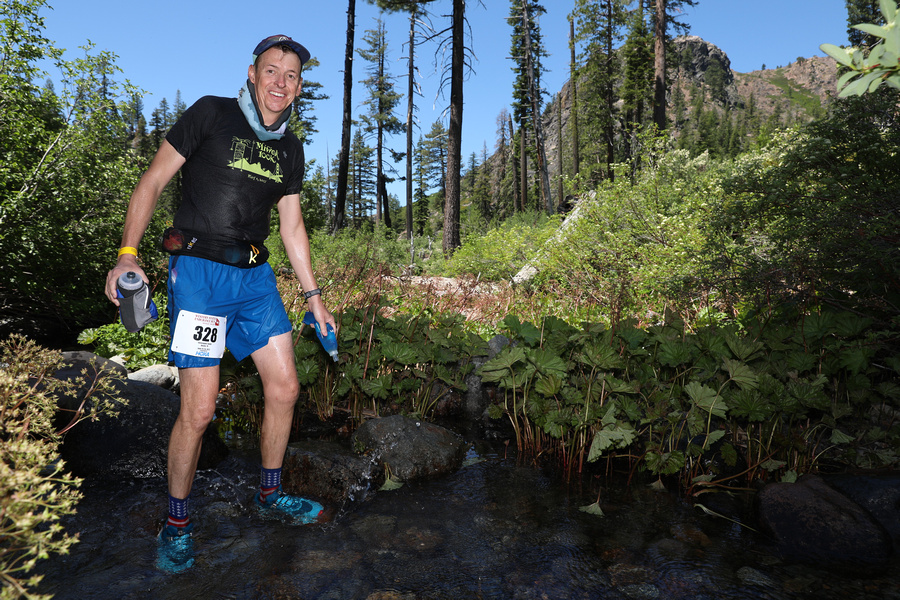
Used the Creeks. At one creek crossing in the heat of the day, I completely immersed myself. The water was shockingly cold, being fed by snowmelt. This 3 minute break dramatically lowered my temperature and it allowed me to eat a bunch of calories as I marched back up the canyon.
Just after I laid down in Duncan Creek.
Bottom line is the heat is something one can mitigate if properly prepared.
Goal setting: The only goal was a buckle. Unless one is really in contention for the 24-hour buckle, I don’t see any reason for setting A, B, or C goals. Just finish. As this was my 10th ultramarathon and 4th 100, I had a realistic picture of the challenges of the race and my limitations as an athlete. I knew that a 24-hour finish was not remotely in play, and that the 30-hour cutoff was right at the edge of the possible. I said back in December, my only goal was to finish. That never changed and informed my preparation and conservative race strategy.
The goal.
Realistic goal setting is vital for Western States because if things go wrong, there is not a lot of buffer time. My advice for recreational runners who are thinking they can run a 26-27 hour race would be to be careful. I ran portions of the race on Saturday with runners aiming for these times, many whom ended up having the wheels come off and either DNFing or just hanging on. For most of us this is a once in a lifetime chance. Don’t blow it by being dumb.
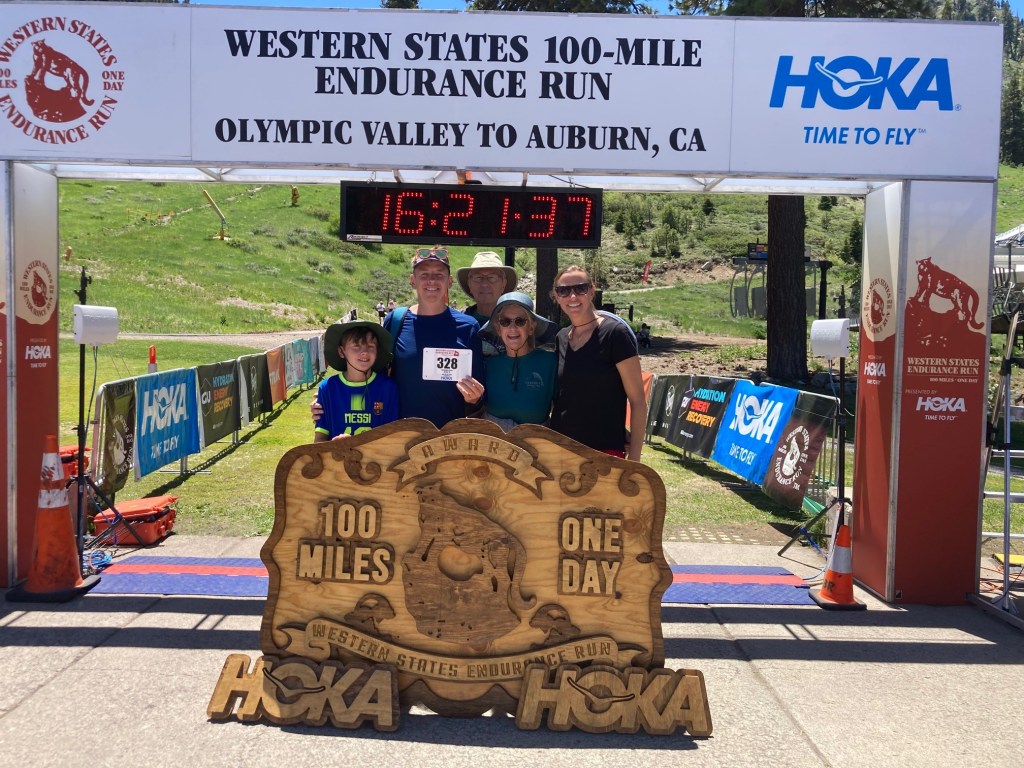
Crews and Pacers: I was lucky to have a great crew including my dad (who has been to all of my 100-milers), my mom (who has been to 3), my son Sam, and for the start my sister Liz. They met me at Michigan Bluff and Foresthill, and were able to walk me in the last mile from Robie Point.
My Crew at Registration.
Training: What is the least amount of training possible for a 100 mile race? I came close to finding out. Due to a seriously bum knee, I had to re-think my approach to training. The tried and true method of lots of miles and lots of vertical simply was not going to work. Instead, I employed a minimalist approach with light weightlifting 2x-3x per week and a tiny amount of very slow running and hiking. Only in May did I actually increase mileage to something approaching a typical training plan. Per Strava, my monthly mileage: Jan: 29 miles, Feb: 89 miles, Mar: 96 miles, Apr: 48 miles, May:142 miles, June – zero until race day. I did one hot 32 mile run in May as a prep long run.
By keeping the mileage very low, I was able to (mostly) keep my knee from flaring up. But the little I did run was intentionally designed to resemble race conditions. Usually I ran in the middle of a Texas afternoon, with temps over 100. I also practiced lots of fast, 14-15 minute per mile hiking.
I do NOT recommend my this minimalist approach , and if I had been healthy I would have done a regular training plan. For an experienced runner, training for Western States should include running (not hiking) lots of miles in the heat.
My race strategy was dialed in. Knowing that my fitness was going to be borderline at best, my strategy and in-race mental approach had to be close to perfect. My overall strategy was to take it very easy for the first 50 miles, focusing on hydration and nutrition, and saving my legs while trying to stay at or just barely ahead of the 30-hour pace.
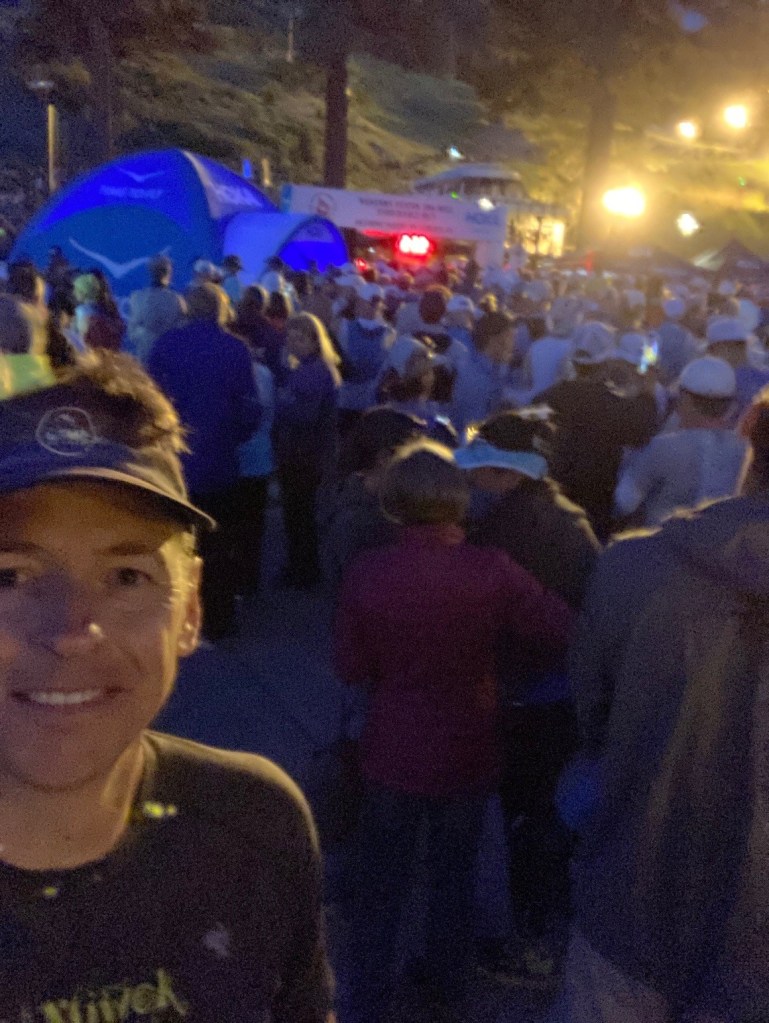
At the start waiting for the shotgun.
I had two ways to gauge my pace. First, the race has its own pace chart and the 30-hour pace was on a sign at every aid station. These times ended up being relatively accurate. I started the race about 15 minutes behind the official 30-hour pace, then during the day Saturday slowly worked my way to 1:15 ahead of the 30-hour pace. Over the night and next morning, I drifted back to finish just under 30 hours.
Second, I ran with a total average pace (in mins/mile) on my watch. I knew I had to keep that number close to 15:00 min mile for the first day to account for the night-time slowdown. 18:00 min mile is a 30-hour finish.
While I had to run for probably 40 of the 60 miles, I never ran for long stretches at a time. Every 10 minutes I would stop and walk for a few minutes. This had the effect of keeping me very measured. In ultramarathons, the euphoric emotional highs can be dangerous, especially when one feels awesome 30 miles in. All day Saturday, I kept reminding myself that there was a whole lot of race to run.
Another key part of my strategy was to minimize time in aid stations. There are 20 aid stations. Five minutes at each aid station is 1:40 mins that I did not have to lose. I was in and out of almost every aid station in under 2 minutes, and many were less than 1 minute. Basically, the approach was to always be moving (slowly). During the day Saturday I ran for a few miles with runners who eventually pulled away. I did not push to stay with them even though I felt good, trusting the plan.
Mental, as always, is key. Beyond grit, which is required for every 100 mile race, at Western States I really focused on gratitude and trying to enjoy the moment. In most of my previous races, I viewed the race just as an obstacle to conquer, not something to be thankful for. Maybe it comes with getting older, but at Western States I was able to savor the suffering. I made an effort to talk to other runners and be positive. I thanked volunteers at every aid station. A few times I stepped off the trail and took 20 seconds to snap a picture and be thankful for the chance to be in beautiful mountains and canyons. I smiled and laughed.
Most importantly, I accepted that only a portion of the race outcome was within my control. This mental approach was novel for me because Western States is the first time I have toed the starting line not confident about a finish. When we started up the ski slope at the start, I put my chances of finishing under 50%. During the days before the race, I told my parents that there was a very good chance that I would not be at the finish line. Oddly, however, this realistic view of the race was liberating. The only thing in my control was to be smart, be tough, and keep going until either they pulled me off the course or I finished. And while I really wanted the buckle, I would have accepted not finishing provided I gave it my best. The only outcome that would have caused regret would have been me voluntarily quitting, which was the one thing I could control.
Staying positive
Aid-by-Aid Report
Olympic Valley to Escarpment to Lyon Ridge – At 10.3 miles, this is the longest stage and the one with the most climbing. I took my time up the mountain and took it easy on the downhills. I also ate 750 calories on this opening stage (the only non-aid station food) as I wanted to start nutrition out right. Other than some minor knee pain, this section was fine and I cruised into Lyon Ridge near the back of the pack in 269th place.
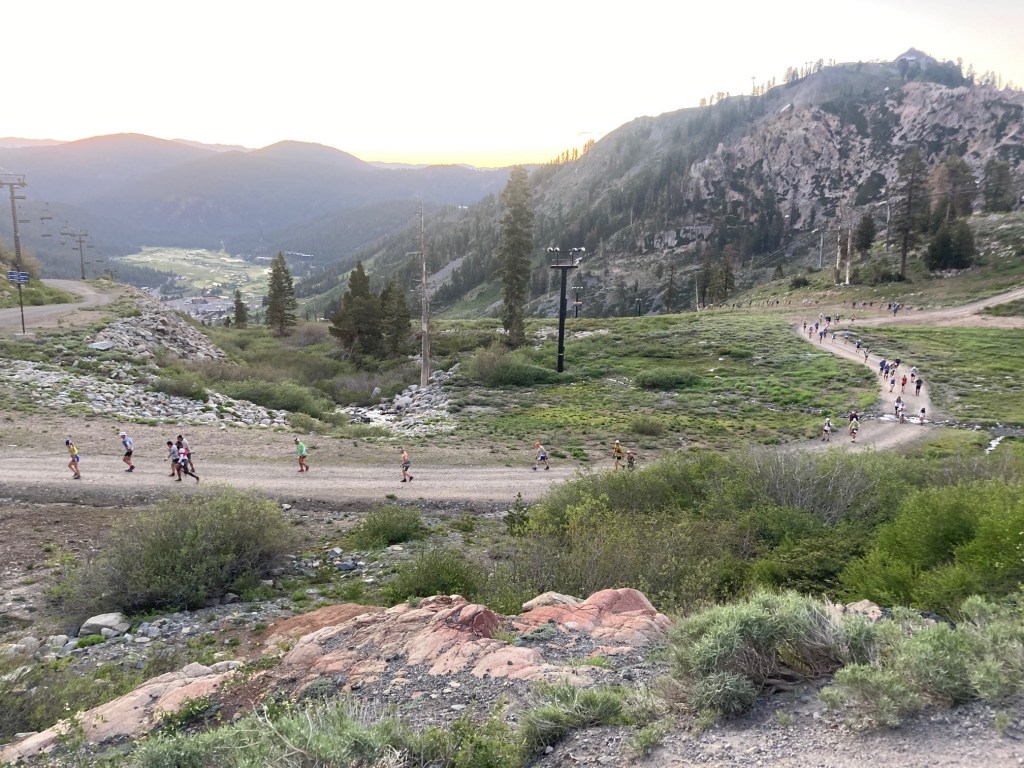
The starting climb (Olympic Valley in distance)
Lyon Ridge (10.3) to Last Chance (43.3)- This section took me from 7:47 a.m. to 4:01 p.m. on Saturday. There are 5 aid stations between Lyon Ridge and Last Chance, all relatively closely spaced. Lots of sun and relatively gradual climbs and descents. I moved pretty well through this section and kept hydrated and measured. Last Chance marked my lowest cumulative pace, at 15:15 per miles through 43 miles. From this point forward my average pace started to increase.
Last Chance (43.3) to Devil’s Thumb (47.8) – This is the first big canyon (Deadwood Canyon). Very steep descending switchbacks, which started to work the legs, followed by a slog straight up the other side. This section requires deliberate marching, and there is no way to avoid an elevated heartrate.
Bridge at bottom of Deadwood Canyon.
Devil’s Thumb (47.8) to Michigan Bluff (55.7) – This is the second canyon, with an aid station at the bottom where the trail crosses El Dorado Creek. El Dorado Canyon is longer but not as steep as Deadwood Canyon. I felt pretty good as I climbed into Michigan Bluff.
Feeling good at El Dorado Creek.
Michigan Bluff (55.7) to Forestville (62.0) – This section goes through Volcano Canyon, which is the smallest of the canyons, but was the worst. Darkness fell as I was going down the canyon, and I kept getting passed by runners cheerfully chatting with their fresh pacers. It was so dry the dust looked like fog in my headlamp, and I was in a bad spot as I climbed up toward Forestville. By the time I hit the asphalt I had about convinced myself that I was done, but then I recovered as I marched though the town. My parents and Sam were encouraging when I saw them at the aid station, but I told them that if I was going to finish it would be in the last 30 mins.
Forestville (62) to Rucky Chucky (78) – This section basically descends from Forestville to the river crossing. As I left Forestville, I saw that I was making 16:00 min miles on flat ground. Knowing that the worst part of the trail was behind me, doing the math I realized that a finish was possible but very tight. This section took about 5 hours (10:03 pm to 3:17 a.m) and was a fast night march with a little running. I managed to average 16-17 minute miles, which was great. This is the easiest part of the course.
Rucky Chucky (78) to Green Gate (79.8) – This where the race crosses the American River. The aid station was crowded with a whole bunch of end-of-pack runners trying to make it. The crossing was uneventful and there were plenty of volunteers in the cold water making sure we did not let go of the aid cable. After the crossing, the trail is up for two miles to Green Gate aid station. This was my slowest section at 27 min miles, mainly due to the delay in crossing.
Conga line across the river. Note the two headlamps (one on head and one on chest). Vital for running solo all night on rocks.
Green Gate (79.8) to Quarry Road (90.7) – This section is up and down a number of moderate hills – not easy but not that hard either. But this is where I really understood how close I was to the cutoff. I started running a lot. From here on the only thing I did at aid stations was fill a water bottle. I talked with other runners with experienced pacers, and they all said don’t worry there is plenty of time. But I was worried.
Quarry Road (90.7) to Pointed Rock (94.3) – This is the section where Jim Walmsley famously took a wrong turn, and I understand how that could happen. It is also a sneaky late-course climb that keeps going up far longer then it feels it should. The Pointed Rocks volunteers tried to get me to stop and eat, saying I needed to feel good for the lap around the track, but I was too worried and just took a Gu and some water and rolled. I had 2 hours and 20 minutes to cover the last 6 miles.
Pointed Rocks (94.3) to Robie Point (98.9) – This is a long down section to a bridge across the river, then a super hot exposed trail up to Robie Point in Auburn. I was running out of steam. As I climbed up through the woods, I could hear the race going on. I marched into Robie Point with 45 minutes to go, saw my parents and Sam, and for the first time knew that I was going to finish.
Looking rough as I cross back over American River at mile 97. Totally smoked at this point.
Robie Point to the Finish – The only other experience like this is walking through Chamonix the last mile of the UTMB finish. There were thousands of people out cheering. I walked with my family, and an enthusiastic volunteer with a megaphone who went in front of us yelling: “Lets hear it for Chris from Texas!” every 30 seconds. I was not in any hurry, and just enjoyed the moment.
Crossing the line in style.
Closing thoughts. The desire to get a Western States buckle started back in 2014 in a bar conversation with my buddy John. It was the genesis for signing up for my first ultra (Bandera 2015) and for going back to get a lottery ticket race all those years. In the last eight years I have run thousands of miles, including hundreds of miles racing on some of the most beautiful trails in the world, made great memories with friends, and had a blast. I would not change anything about those races, nor this race. Struggling to finish, nursing a chronic injury, and then making it with only a few minutes to spare and sharing the moment with loved ones, cannot be improved upon – it was a perfect race. I will treasure the buckle not just because it is a badass buckle (and it totally is) but because every time I put it on I think of all of the steps it took to earn it, the ups and downs (literally), the humbling of pride, the blisters and lost toenails, the early morning practice runs, the friends, the adventures and mishaps, and the journey to get here – and I know that I am truly blessed.
West Texas is my favorite part of the state. The crown jewels of Texas backcountry adventure, Big Bend and Guadalupe Mountains National Parks, are favorites of mine (and everyone else). Recently, I had the chance to explore a third, less popular but no less spectacular corner of West Texas: the Buffalo Trail Scout Ranch in the Davis Mountains.
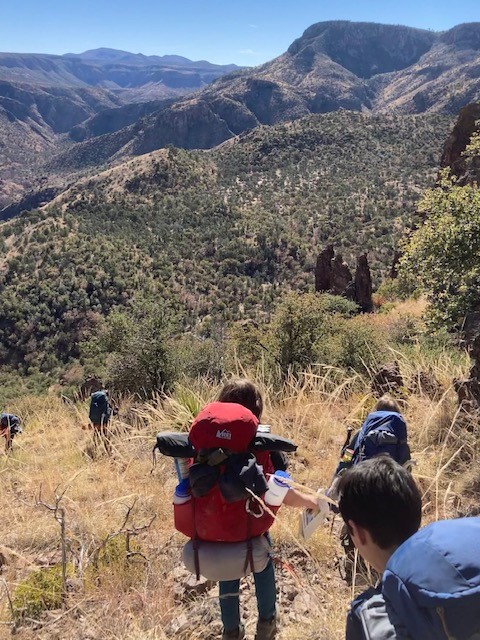
6th grade scouts starting a 1,200′ climb up from the canyons to campsite on a ridge.
BTSR, as it is known, is a 9,000 acre property owned by the Buffalo Trail Council of the Boy Scouts. Situated in the steep canyons of the Davis Mountains, BTSR is home to winter and summer camp programs. During the year, its extended backcountry is open for backpacking to scout troops. Austin BSA Troop 33, my son’s troop, spent three days and two nights backpacking the BTSR backcountry over MLK weekend.
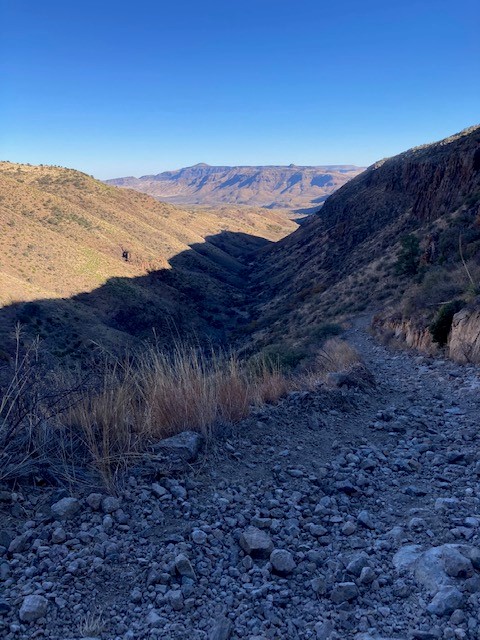
A look down Pig Pen Canyon, which we hiked up the first day.
On Saturday we left Austin early, rendezvoused at Balmorhea State Park for a last bathroom stop, then drove the final 30 minutes to BTSR. Total drive time was right at 6 hours 30 minutes. After a short meeting with the friendly BTSR ranger, the boys divided themselves into two crews and were off up the mountain, with the adults following.
View from up on top at about 5,800′.
That night we had a blue norther come in and it gusted to 35 mph while the temps dipped into the 20s. We all got to test whether the ratings on our sleeping bags were accurate. Or not. The next morning the boys planned a few easy miles in the morning along the rim of the canyon.
Boys navigating their way on rough trail.
Then after lunch they dropped down into the canyon, where our second campsite awaited.
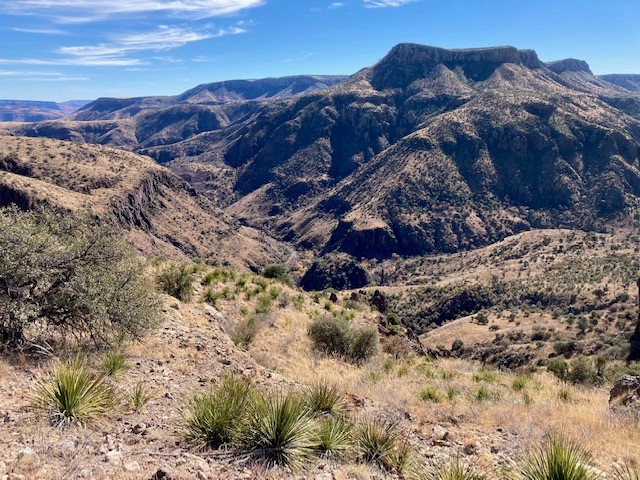
BTSR has National Park-level scenery. The dry creek visible at the bottom is about 1,200′ below where I took this photo.
During this trip the scouts were learning and, in some cases, relearning how to use a map and compass, how to take bearings, and how to follow trails. BTSR contains a good mix of easy to follow trails, harder to follow trails, and basically no trails. It is an outstanding place for practical navigation experience. Getting lost – or at least losing the trail – happened to our crews multiple times.
Descending a steep slope with a very faint trail. Note the map in the scout’s hand. It took about an hour to go a half-mile while stopping many times to confirm where we were.
Water was a bit of a challenge on this trip. Up on top there are no springs, but there are muddy stock tanks. The stock tanks did provide water, but they repeatedly clogged our water filters. Down in the canyon there are pools of clear spring water.
The appropriately named Needle.
Perhaps the best thing about BTSR is that over the popular MLK weekend the only people in the 9,000 acres of backcountry were the eleven scouts and eight adults from our Troop. That is solitude (to the extent one can call hiking and camping with a bunch of 6th to 9th graders solitude).
Scouts leading the way hiking out on a glorious West Texas winter morning.
If you work with a scout troop in driving distance of West Texas that is looking for a great opportunity for a legitimate, uncrowded backcountry experience, BTSR should be on your list.
I first saw a Western States 100 buckle on a phone while drinking beer at a bar with John at a law firm happy hour back in 2015. Of course I wanted one and thought it a simple as signing up and running the race. Thus began my dabbling in the world of ultramarathons.
As anyone who has tried knows, you don’t just enter the Western States 100. You first have to complete either a 100k or 100 miler that is on a list within a specified cutoff, then you have to enter a lottery. The first year you enter the lottery you get one ticket. The next year you get 2, then 4, then 8, and so on. Prior to COVID, you had to enter the lottery every year or you lost all of your accumulated tickets. Every year since 2016 I have managed to run a qualifying race. This year a ticket with my name was pulled.
Normally, that would be a reason for pure excitement, but over the last half decade these wheels have seen a lot of miles. In the last six years I have finished two marathons, five 100ks, and three mountain 100 milers. The hundreds of hours and thousands of miles running have taken a toll. One of my knees has advanced cartilage degeneration and most of this year I have been sidelined with injury. On a backpacking trip this summer I was hobbled and for the first time ever was the slowest hiker in a group, struggling to keep up with my 11 and 13 year olds. I will turn 45 in May, and am confronted with the reality that things don’t heal like they used to.
These circumstance have forced me to think about athletic priorities. At the top of the list is maintaining the ability to go on big wilderness adventures, particularly now that my kids are just reaching the age where they can handle these trips. I want to take them to the Grand Canyon backcountry, to the top of Gannett Peak, and packrafting in Alaska. That is not going to happen if I can’t cover the miles. At the bottom of the list are road races. I have made peace with the fact that Boston was my marathon last act.
In between are very few, very special races, including the Western States 100. Is it worth the cartilage capital it will require? This week I was forced to decide.
On one side of the ledger are the challenges: I have 200 days to prepare, have not been running for months, am in the middle of physical therapy trying to rehab the knee, and have real doubts that I will be physically able to finish this race. On the other side of the ledger: I have experience, knowledge of how to prepare and a realistic understanding what I will face, and the mental toughness to walk for hours through pain. We usually regret the things we don’t do more than the things we do, so passing on my one (and probably only) chance to go get that buckle with the mountain lion is simply not something I am going to do.
It’s on, with no agenda, no expectations and no goals other than to finish. This may be my last ultramarathon ride, so better make it a good one. Let the suffering begin.
For car camping, we have had the REI Base Camp 6 tent for fourteen years. The current iteration is $470. It is bombproof and has survived storms with winds over 40 knots. Even after a decade of use, the only problem is that the plastic windows on the rain fly are shot, but this is not a real issue and the tent itself is still waterproof. I often recommend the REI Base Camp 6 as a family camping tent. But the problem with the Base Camp 6 is that it really does not fit six people comfortably. With four growing kids we began a search for a new family car camping tent. The only options at REI for bigger tents are well over $500, and they are not that big.
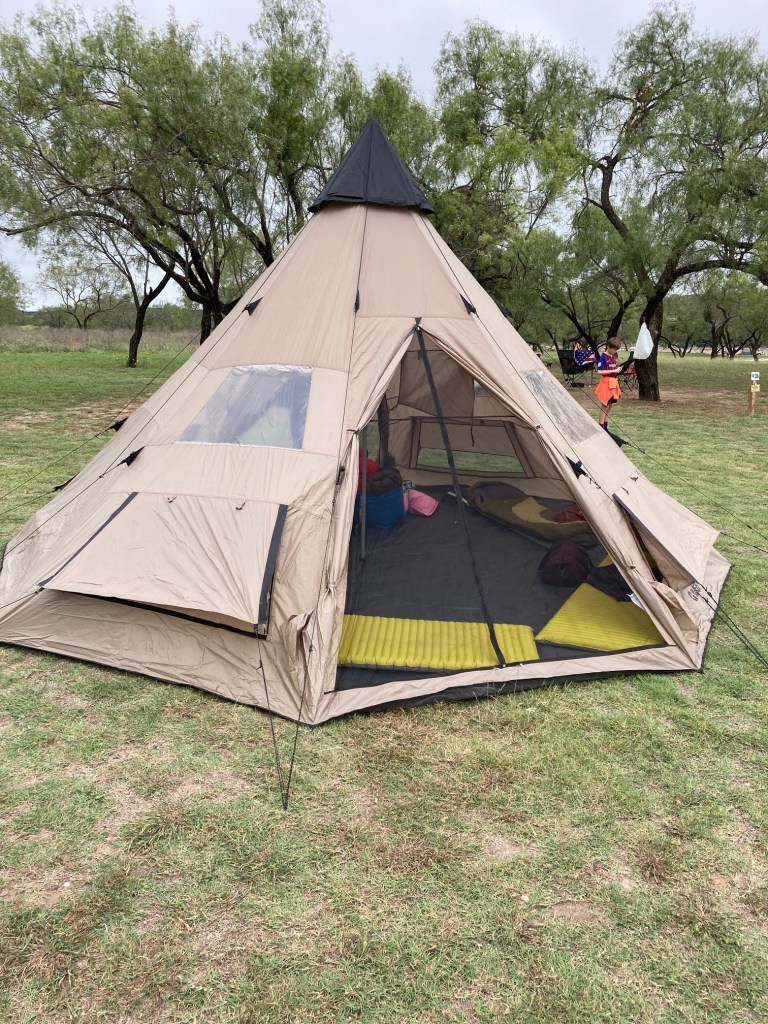
We ended up buying the enormous Guide Gear 18’ x 18’ Teepee Tent from Sportsman’s Guide for about $220. We have been pleasantly surprised with how well this cheap, big teepee has worked. (I have no relationship with Guide Gear or Sportsman’s Guide)
Each corner is staked and then there are 8 stakes for the tensioning lines and windows.
Its packed size is a cylinder about 32” long and about 11” in diameter. It weighs about 25 lbs. This package is compact enough to easily fit in checked luggage. Set up, the footprint is an octagon that is 18’ in diameter from corner to corner and 16’ in diameter from side to side. The height of the tent is 9’9” at the center pole.
The tent floor is polyethylene, very similar to “blue tarp” fabric. It has held up well to rough kids. The tent upper is a single wall 190-denier polyester with a P/U coating. There are two large screen doors and four screen windows, and four clear plastic window panels.
Setting up the teepee is easy and fast IF you have a site with good staking ground. The basic set-up process is to stake out the 8 corners, insert the 4-piece steel pole, then stake out the windows and tensioning lines with 8 more stakes. In soft ground, this takes me about 10 minutes. Where things get complicated is rocky ground. The stakes that come with the tent are crap. They are “L” shaped and rotate easily, causing the lines to slip off the stakes. They are also made of a mild steel that bends easily. As the stakes bend I am replacing them with stouter stakes. In some rocky sites that would not hold stakes I have ended up tying lines to heavy rocks and trees.
Other than the cheap stakes and the challenge of rocky ground, the biggest issue with the teepee is finding sites large enough. You need at least a 16’x16′ area to set up the floor. Many campground tent pads are not that big.
The stakes that come with the tent suck.
The teepee tent has kept us dry in the rain. The key to this is to stake out the doors so that water running down the doors does not come back in the tent. If you don’t stake out the doors water ends up inside. Do I think the teepee is as bombproof as our old REI Base Camp 6? No. The REI tent has a more sturdy design and better construction. That said, when it comes to car camping we don’t camp in hurricanes. For most of our car camping, if the weather is going to be bad we bail.
Window covers staked out in storm mode.
As with any single wall tent, we have experienced condensation with six people sleeping in humid conditions in the rain. However, the teepee is surprisingly well ventilated. The four screen windows have covers that allow them to stay open during rain and the large screened roof vent is waterproof. With both large screen doors open (when no rain) there is plenty of ventilation and no condensation. This is particularly good for typical Texas camping.
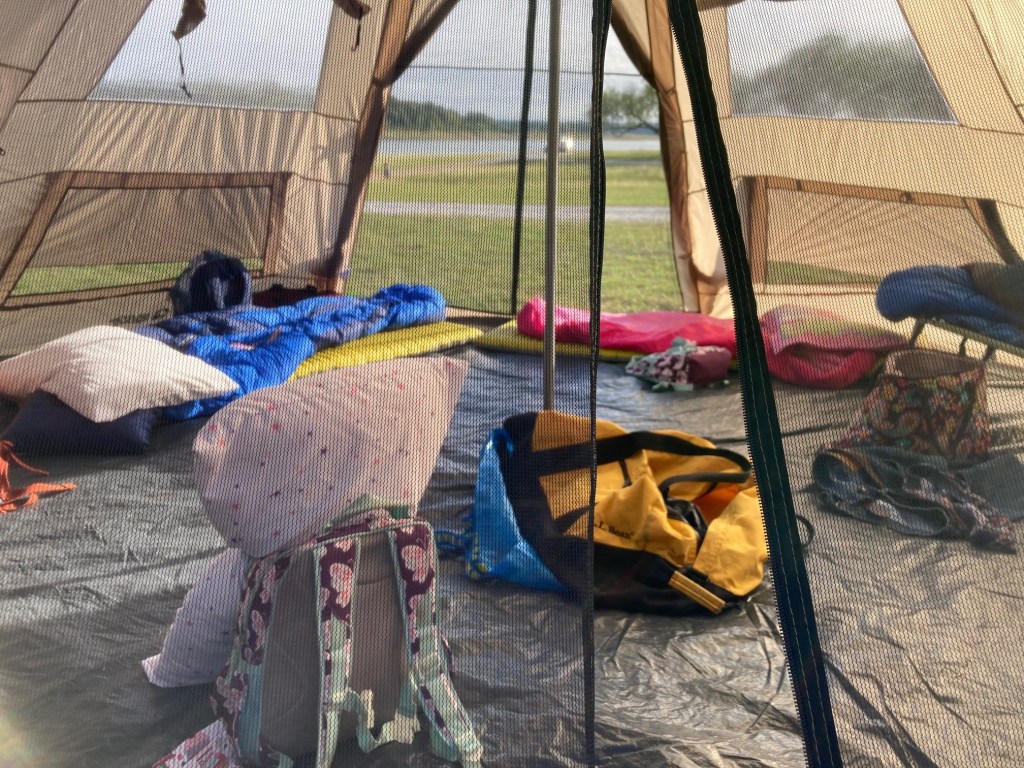
We have found having a blanket for shoes helps keep the tent clean.
The best thing about this tent is that it is HUGE. All six of us can sleep in it comfortably, regardless of how many bags or cots we have. There is plenty of headroom to stand up and change.
One of the fun things about this tent is that whenever we set it up people stop by and ask about it. It is really hard to overstate how huge it is. In sum, aside from the crappy stakes, the Guide Gear 18′ Teepee is a pretty good tent for large families seeking lots of space to spread out.
Nobody goes there anymore, it’s too crowded – Yogi Berra
The huge post-COVID increase in crowds is evident to everyone who spends time outdoors. My hometown of Austin is in the process of being overrun by crowds of new people. Gone are the days of being able to just show up at Barton Springs Pool on a Saturday (need an entry pass) or spending hours training on the Hill of Life (limited paid parking). These are not local phenomena. The National Park Service is experiencing record visitation, straining basic infrastructure to the breaking point. Many parks have already or are in the process of adopting day pass systems to preserve visitor experience. What is one to do?
As with any problem, acceptance is the first step. The crowds are not going away any time soon. So we need to adapt. Four tried and true strategies to deal are to go early, go far, explore something new, and plan ahead.
Go Early. People are lazy. Even the most crowded outdoor spots – like the South Rim of the Grand Canyon or Old Faithful in Yellowstone – are almost empty at sunrise, even in the middle of July. By 10 a.m. those spots are Disney World. I know, its hard getting up early. But it is the only way to see the famous bucket list spots and have those to yourself.
Sunrise on the South Rim. Only a handful of people. We got up at 4:00 am (no daylight savings time in AZ!) and drove an hour from a NFS campsite near Flagstaff. It was worth it.
Go Far. People are lazy. There are simply fewer people willing to through the effort to get to remote places. This summer I planned a small backpacking trip in Colorado for my older kids and their cousin. Rocky Mountain National Park was out because of red tape and crowds. Wilderness areas were on the list, but we avoided those within a 3-hour drive of Denver or I-70. We ended up going to a wilderness area (which shall remain nameless) with a trailhead down a 38-mile gravel road. We saw only two other parties in 5 days and caught all the naïve trout we wanted, in a place with scenery (picture at the top of this post) that compares favorably to the more famous destinations.
Over an hour on washboard then an hour hike through the desert to this awesome slot canyon. About 10,000 fewer people than the Zion narrows.
Explore Something New. People are lazy. They are much more likely to google Top 10 destination lists than explore an area for hidden gems. National forests, BLM lands, and state parks often have scenery and adventure potential on par with much more famous (and crowded) destinations.
Exploring a Wyoming canyon on a hot afternoon. This state park is not on any top 10 destination lists but was lots of fun.
Plan Ahead. People are lazy. More parks are moving to entry passes and reservations. This has the upside of improving the in-park experience if you are Johnny-on-the-Spot enough to get a permit. Recreation.gov and your analogous state park reservation systems are your friend. Better to have a reservation that you cancel than not have a reservation. Also, plan for off peak days and times. One can find solitude on the Barton Creek Greenbelt in the middle of Austin on most Tuesday mornings at 10 a.m., while on a Saturday there are thousands of people on the trail. Also consider visiting parks during shoulder seasons. If COVID has taught us anything it is that school is optional so take the kids on that trip in October! I kid. Kind of.
This is one of the more popular trails in Great Smokey Mountain National Park, the most visited Park in the country. But in November you can have it to yourself.
With crowds here to stay, at least until the cruise ships and Vegas get back to full capacity, a little creativity is all we need to keep finding those awesome experiences.
While watching my nephew’s YouTube report of his family’s vacation to a resort in the Bahamas my wife Michelle asked me “why don’t we do vacations like that?” I had to tell her it was because we only do Type II fun.
I did not come up with the fun classification system, but I love it. The system divides fun into three categories:
Type I Fun: Fun in the moment, not particularly memorable.
Type II Fun: Not very fun in the moment, very memorable.
Type III Fun: Fun in the moment, regrettably memorable.
Just about all the great fun is Type II fun, or at least Type I fun with some Type II spice. Occasionally, I like pure Type I fun, for instance a day at the beach. But if I am honest, I get bored with Type I fun in about two days. Hopefully, most of my Type III fun is behind me now that I go to bed by 10 pm.
Type II fun is the best because it is the most memorable, and the joy of the memories is worth the pain and frustration that comes in the moment of Type II fun. There needs to be some element of challenge or adventure or uncomfortableness to really have a great fun memory. A Type II fun adventure requires a plan that is a little (sometimes a lot) beyond the comfortable skill levels of the participants.
Tim and I deciding to canoe Barton Creek at 850 cfs when the only other people out there were kayakers with helmets. So we flipped and got worked. At least I did not lose my hat that day. Total Type II fun.
The key distinction between Type II fun and no fun is the word “almost.” Nobody likes an actual disaster. But an almost disaster is epic. Adventures involving bears, a raft full of camping gear going down a Class VI canyon, things catching on fire, marching through ice at 3 am on messed up legs – these are all great fun as long as everyone makes it home with life and limb. It can be a fine needle to thread.
Type II fun at mile 88 of the UTMB. Doesn’t V look like he is having fun?
Type II fun also involves some element of work, of effort. This can be physical effort, like a long day of biking, mental effort like mile 82 of a 100 mile race, or spiritual effort, like not going insane on the 18th day of a road trip camping with four kids.
But great memories require great effort.
Little ones with packs and PFDs for adventure down the trail.
The most Type II fun of Type II fun has been introducing my kids to appreciate Type II fun. It is a work in progress, but they are coming along.
Anyway, bravo to all the tough ones out there going out and having some Type II fun.
In the age of watches that can play music, send messages, and do all sorts of other fancy things, I am a still big fan of the Timex Ironman Classic. The Timex has been around pretty much unchanged since the 1990s. It costs $35 dollars and is basically indestructible, small, light, and runs for years on a single battery. It just plain works.
Basically the same since I was in middle school.
What I like most about the Timex is its simplicity. It only does a few things, but it does those very well.
Its screen is easy to read in almost all light conditions and even with polarized glasses.
Its stopwatch function is very simple. One button gets you to the stopwatch then starting, stopping, and laps are controlled by two big buttons that are easy to hit swimming or running on a dark track.
It has a basic countdown timer.
It has alarms.
That’s it.
One of the trends in newer watches that I do not like is that they are huge and have sharp angles. This hurts function as huge watches get caught on clothes (taking off a layer) and the big faces can get damaged by things like Kettlebell workouts. The Timex is light and tiny and survives everything I have thrown at it.
Oddly enough, even though I own a GPS watch I find the Timex superior for some types of workouts. Specifically, track workouts and hill repeats. For these workouts I don’t need mid-workout pace data; I just need a stopwatch with a great lap function. The simplicity and big buttons of the Timex watch function works better than my GPS watch chronometer.
The other situation where the Timex holds its own is long runs or races, like ultramarathons, where I don’t need or don’t want my live pace but where the overall time is vital. For these I always have my phone anyway. The phone records my track just as good as a GPS watch, has far superior navigation tools, has a bigger battery and is easier to recharge mid race. The GPS watch is superfluous to the phone and is less reliable than the Timex.
There are some circumstances where I don’t pick the Timex. If I want to record my track but I am not taking my phone, I leave the Timex at home and take the GPS watch. If I am doing a workout that requires live feedback on pace or distance – like a tempo run – I take the GPS watch. Finally, if I am running a mountain ultra or doing a big backpacking trip in the mountains, I sometimes leave the Timex at home in favor of a non-GPS watch that has a long battery life but also an altimeter and barometer as knowing real time elevation in the mountains is useful.
Obviously, GPS watches are amazing inventions, and they have their place. If you like yours, great. But with complexity comes downsides. Maybe I am a Luddite, but I like my Timex for what it avoids: a mental distraction of always checking miles, wondering whether I have enough battery life to complete a run, frustration when the battery runs out or when the GPS data is not very accurate or it can’t find satellites. I think I will keep mine for at least a few more decades.