
A multiday canoe trip is one of the best high-adventure options for scout troops. River canoeing can involve excitement, the fun of getting wet, fishing, wilderness, and freedom for the scouts to learn skills without a strict itinerary or program requirements. This post describes two awesome multiday trips reachable from central Texas. Although the discussion is framed in terms of a scout troop, these trips would also make great family trips.
What is special about a multiday river canoe trip?
A troop-planned canoe trip has several advantages over attending national or council high adventure bases. First, there is no age limit. Most programmed high-adventure programs require scouts to be 13 or 14. Even without official limits, most 11-year-olds are too small to carry their own gear for a multiday backpacking trip or take a flatwater trip with portages. But even small scouts can participate in a river trip where the current helps move the boat downstream. For our trips, we even allow newly crossed-over scouts (rising 6th graders) to participate, provided they can pass the swim test and earn the canoeing merit badge before the trip. Pretty much all scouts can go on these trips.
Troop-planned multiday float trips can also accommodate large group sizes. Most programmed high-adventure trips are limited to 8-12 participants. The rivers below allow large groups of over 20 people to participate, presenting an excellent opportunity for a “whole troop” trip with both new and older scouts. Seeing the mentorship and leadership that occurs when experienced scouts teach new scouts is awesome.
The cost of participating in a troop-planned river trip is also a fraction of any formal high adventure program. The trips below cost $500 or less per person, including transportation, equipment rental, and all camping meals. Including travel, national and council high adventures are usually cost $1,500-$2,500 per person.
Finally, wilderness river trips are simply fun. These are some of the most fun times our scouts have had in scouting, even compared to the national camps like Philmont and Sea Base.
River experience is, of course, a prerequisite.
I will do a separate post on the planning process, but these types of trips require adult volunteers with experience to safely manage the trip. That means adults who can read rivers, identify river hazards, teach others to avoid them, and implement a rescue should an emergency arise.
Where to go?
Several Texas Rivers offer fun multiday experiences. However, I don’t recommend them as a first option for scout troops or young kids because they can be difficult for beginners (Devils River), have very unreliable flows (Rio Grande), offer limited outfitter services or really long shuttles, and have limited camping due to riparian properties being privately owned (almost all Texas rivers).
Just to our north, however, are the Buffalo River in Arkansas and the Current River in Missouri. These rivers are managed by the National Park Service, serviced by several outfitters, have great gravel bar camping, and, at most flows, provide an appropriate challenge.
The Current River
The Current River and Jack’s Fork River (a tributary of the Current River) are part of the Ozark National Scenic Riverways. They are located in southern Missouri, about a 13-hour drive from Austin. Troop 33 covered 54 miles in four river days on the Current in 2022.

The Current River is unique in that much of its flow is fed by several very large springs. The water is cold and clear, and the river is spectacular. The river is mostly Class I with some Class II rapids. The most significant danger is not rapids but strainers (trees in the river that can hold canoes and people). Unlike the Buffalo River, the springs discharging into the Current River make the flow reliable in summer, as river flows are not dependent on recent rainfall.

A river trip on the Current provides interesting side hikes to springs, a cave you can canoe into, and the convenience of passing several developed campgrounds with bathrooms. Living up to its name, the river moves, making covering miles relatively easy.
The Buffalo River
The Buffalo National River in northern Arkansas was established in 1972 as the first national river. Troop 33 covered 41 miles in 2 1/2 river days in June 2025. The Buffalo’s fishing and wildlife are comparable to the Current’s, but the scenery is more dramatic on the Buffalo, as there are high bluffs all along the river. The water is also warmer on the Buffalo.
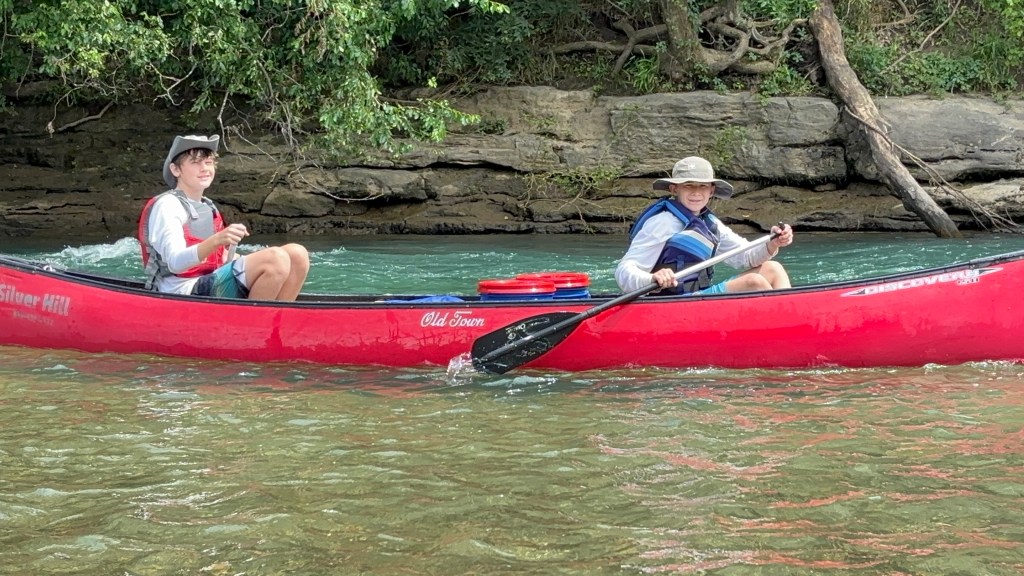
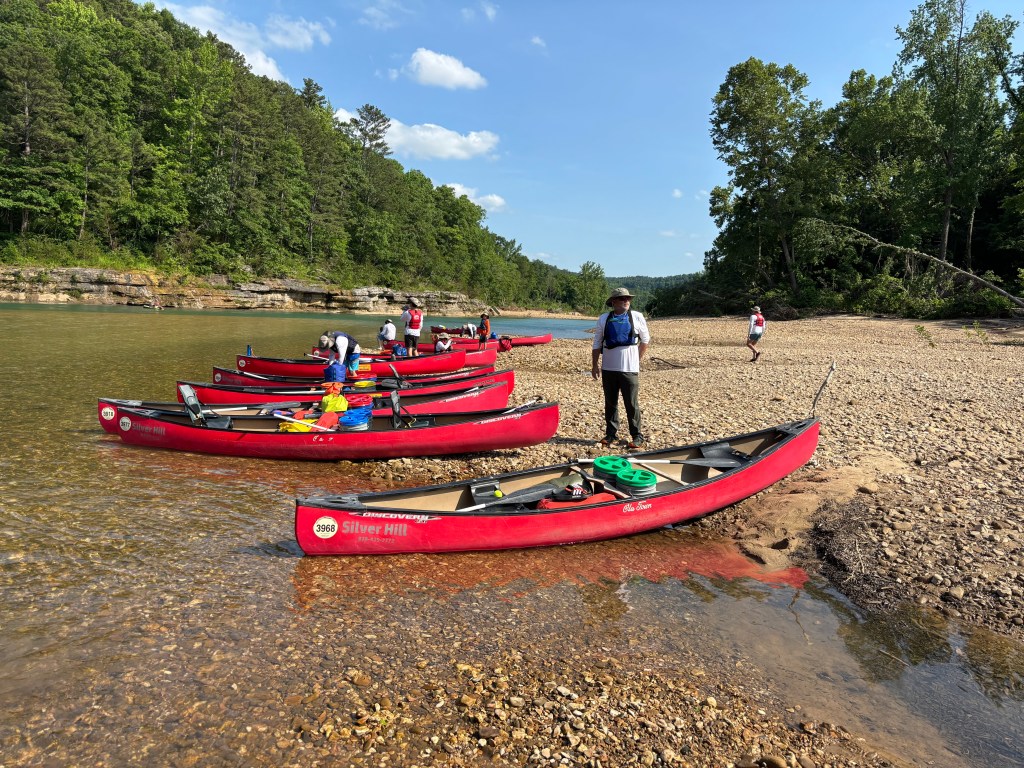
The rapids on the Buffalo are Class I and small Class II, but there are many trees and root balls to avoid. The Buffalo and Current have many gravel bars, but the Buffalo’s gravel bars are generally bigger and have more spacious campsites. Like the Current, the Buffalo has several developed campgrounds that are convenient for bathroom breaks.
Current River vs Buffalo River
These are similar rivers, and both provide an excellent experience. I would be hard pressed to say which was more fun; they are both great. But there are some differences.
For travel, Scouting America’s safety policies limit us to driving 10 hours per day. This means that for those of us in central Texas, the Buffalo River is a one-day drive, but the Current requires three more hours on a second day. This logistical inconvenience makes the trip to the Current longer.
From a float trip perspective, the main difference between the Buffalo and the Current is that the Buffalo is entirely rainfall-dependent, while the Current is not. The Buffalo tends to flood suddenly, then drop over a few days. This means that when the upper section of the river has ideal flows, the middle and lower sections may have high water from the previous flood, which makes paddling unsafe. Or that the upper section is too low when the middle and lower sections are ideal. The Current, located in rolling hills rather than steep bluffs, is not quite as prone to flooding and retains a base flow all summer. In practice, this means that the floating window for the Buffalo is significantly less reliable than the Current. When we floated the Buffalo in early June 2025, the week before and after our trip saw high water that would have caused us to cancel.
The Buffalo is also better suited for shorter trips, in terms of mileage, while the Current may be better for those seeking lots of miles, particularly those aiming for a 50-miler. This is due to the unreliable flow issues described above and how the National Park Service has awarded concessions to outfitters. On the Buffalo, there are different outfitters for the river’s upper, middle, and lower sections. When we floated the Buffalo, our outfitter (serving the middle section) agreed to take us to a put-in at Pruitt (on the upper section) to give us a 41-mile float. But I get the feeling that is unusual and that the Buffalo outfitters stick to their sections. On the Current River, the outfitters did not appear to be geographically limited, and finding an outfitter for a 50+ mile float was easy.
The big takeaway is that a summer trip on the Buffalo River may require a backup plan or flexibility if the flows are not ideal, while a trip to the Current River requires less backup.
Go float
I can’t emphasize enough how fun these little float trips are and how much camaraderie they inspire among the scouts. They are incredibly dollar- and time-efficient compared to the other high-adventure options. Incorporating these types of trips every few years into a troop’s high adventure plan makes high adventure experiences accessible to everyone, even those with limited means and time. So go get on the water.
 Vamonos Baby!