
The foremost rule for gear is to go as light as possible and not take unnecessary stuff. Your base weight should be 21-22 lbs or less, equating to 30-35 lbs once loaded with food, water, and crew gear. If your pack is more than that, it is too heavy.

Philmont recognizes that people bringing too much stuff (compounded by participants being out of shape) is a problem, and, to their credit, going lightweight is discussed in the prep material Philmont sends out. But in this regard, Philmont is fighting the “be prepared” headwind of BSA, which has traditionally encouraged an antiquated – by that, I mean heavy – approach. Large packs, leather boots, heavy pants, thick socks, white-gas stoves, multiple Nalgenes, huge multitools, and knives are all common at Philmont. Over the past few decades, the light/ultralight backpacking movement has proven that all that stuff is unnecessary, particularly in a benign Northern New Mexico summer environment. Yes, it thunderstorms many afternoons, and it can be chilly on some mountaintops, but these are not conditions requiring an extreme amount of gear. A fleece or light puffy under a raincoat will suffice even when cold.
Unfortunately, at Philmont and scouting in general, the least physically prepared individuals are often the ones who show up with the heaviest packs. It’s not a problem if an in-shape 165 lb sixteen-year-old varsity athlete wants to carry a heavy 65 lb pack. It will likely be a disaster for the crew, a 105 lb fourteen-year-old or an overweight 50-year-old to try to carry the same pack. Thus, the slowest hikers should be the most concerned with limiting pack weight.
Comfortable pack weights are possible.
The average pack weight for our crew with food, 2-3 liters of water, and crew gear was about 30 lbs (mine was 33), with a few packs under 20 lbs and one pack over 40 lbs The scout with the heavy pack had unnecessary items like a full-sized beach towel and a 2 lb hatchet so should have been lighter, but it ended up not mattering because as a high school cross country runner he spent most of the hike waiting on us geezers anyway.
Philmont has an official packing list, which is generally good. Below are some of the strategies we used to have light packs, as well as observations on gear that was/was not necessary.
Items on the Philmont Packing List
Backpack – One can rent a large Osprey backpack from Philmont for $18. Most, however, will purchase a pack for training and other uses. Philmont says the pack size needs to be at least 65 liters. Most of our crew had smaller packs in the 55-liter range, which worked. If you have a smaller pack, you should have a way to strap on or attach a bear bag to hold food at a significant resupply. Get a pack that is 3 lbs or less. Sam and used the following, but we had a wide selection of packs in our group from ULA, HMG, Osprey, Granite Gear, and REI.
REI Flash 55 – Sam used this one and his pack weight when we hit the trail was 19 lbs. This is a good pack for a small person, and is probably on the small end of what you can get away with. He often carried a crew hear between the lid and pack body.
ULA Catalyst – This has been my workhorse for over a decade and was more than large enough at Philmont.
Backpack Rain Cover—This is mandatory for the July Monsoon. I used a light ULA one. Others used Osprey, REI, and cheap Amazon ones (which do not have a grommet and collect water). Make sure to get a large size to cover bear bags and other items you strapped on the outside of your pack.
Waterproof stuff sacks—Trash compactor bags and Gossamer Gear pack liners are the lightest options and are sufficient, and waterproof stuff sacks also work well. The main advantage of stuff sacks is organization for those who dislike stuffing everything in thei but slightly her pack.
Sleeping Bag – If you are going to spend money, a sleeping bag or quilt is the place to splurge. Something light (2 lbs or less) and comfortable in the 30s (which means a 20-25 degree rating) works. Western Mountaineering, Feathered Friends, and Enlightened Equipment make nice bags; other options are cheaper. I slept in shorts and a T-shirt every night and was warm in my WM Terralite 25 degree bag.
Tents—We had three scout tents: a 4-man REI shared by three scouts, a 3-man Alps Mountaineer shared by three scouts, and a Philmont Thunder Ridge shared by two scouts. They all worked fine. If I had to do it over, I would just encourage all the scouts to share the Philmont tents, which are not that heavy if split. The adults all had lightweight one-man tents. We never had a problem finding a place to pitch the tents.
Clothes
I never used gloves or long underwear. Otherwise, the Philmont clothes list is pretty good. One could drop a shirt from the list and be fine. Most days I hiked in quickdry Patagonia shorts and a merino shirt or light sun hoodie, but some days the activities required pants.
One suggestion when picking clothes is to make sure that each item is the lightest possible version. A postal scale is helpful, as I was surprised to find a large variation in the weights of shirts and pants. Some items are surprisingly heavy, which is bad not only for the weight but also because light clothes dry quicker. Merino shirts are nice because they are light and don’t smell nearly as bad as synthetics.
If you are concerned that things will get too dirty, trail laundry is an option. One sunny morning, I washed a shirt, socks, and underwear in a ziplock using trail soap. I pinned these to my pack with safety pins, and they dried out pretty much on the hike to our next camp.
Puffy – A lightweight down jacket is nice but unnecessary if you have a fleece. Mine weighs 8 oz and doubled as a pillow.
Raingear—I wore my rain jacket daily and rain pants about half the days. Make sure your rain gear is light. Frog Toggs work but are not durable. The Montbell Versalight jacket and pants are pricy but super light and nice for adults. REI has decent cheap rain pants that worked for Sam. I also carried a 6-oz umbrella, which was helpful in sun and hailstorms.

Shoes—Only one scout brought proper boots, and that scout had the worst blisters. Trail runners, even high-top trail runners, are the way to go. Half the group had blisters due to not training in their shoes before the trek.
Socks – Lightweight merino socks are the way to go.
Camp Shoes—Not necessary, but nice. Most brought Crocs. I did not bring my flip-flops but I should have, as Philmont is not a closed-toe shoe area, unlike most BSA camps.
Bowl – Anything light. Fozzils work great.
Mug – Vital for adults. Scouts do not need.
Headlamp – Mandatory and extra batteries, as most summits require a pre-dawn departure.
Not on the Philmont gear list but worth bringing:
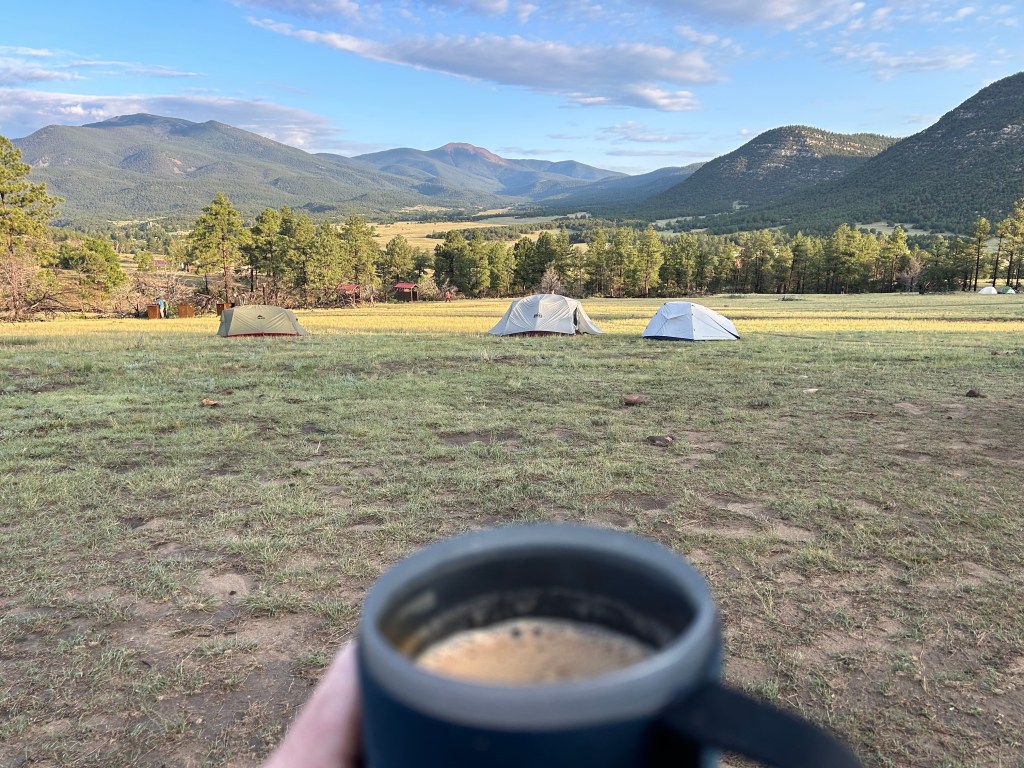
A Jetboil—A shared jet boil for adult coffee is mandatory for a civilized trek. We brought three cans of Starbucks instant coffee and a box of Chamomille tea, which worked well for four adults over seven trail days.
Chair – For adults, the 1 lb penalty for a camp chair is worth it. There is significant time in camp, and afternoon everything is wet.
Hot sauce – We went through 4 small bottles of Yellow Bird in 7 days.
Battery—I took one Nitecore 10000 mAh power bank (6 oz). With my phone mostly in airplane mode/low power, I had plenty of power for seven days in the backcountry. I spoke with others with solar chargers, including my wife, and I don’t think they are worth the weight penalty.
Crew Gear:
Dining Fly—We brought our own dining fly, a 12×12 Equinox tarp. This tarp is bigger than the Philmont-issued dining fly, and we rigged it using paracord so it was pitched high. We spent a lot of time sheltering under the fly in the storms and were happy we had it.

Stoves—We brought two Kovea Spider canister stoves (we only used one). Many troops bring white gas stoves, which are less reliable and messier than canister stoves. It does not get cold enough to impair the use of gas.
Pots – We brought our own pots, which are the same model as Philmont rents. This was useful as two nights, the boys built tripods, and weowever, this blackened the pots, which heated water on the campfire. We don’t mind the pots being black but Philmont might.

Bear Bags and Kitchen Stuff – We used the Philmont-issued spoon, scraper, bear bags, and bear rope. I don’t see that bringing these from home is worth it.
A note on Phones
My primary use of my iPhone was as a camera, with a secondary function of double-checking navigation using Gaia. Cell phone reception was limited, but I could call and text home a few times from high areas, including on my daughter’s birthday. While on Baldy, I took pictures of each scout and texted their parents, which was appreciated.
I regret that we allowed the scouts to carry phones. One scout started watching Netflix when we were at a camp with reception. The phones were a distraction. I recommend requiring all scouts to store phones at base camp, as there are enough photographers with adult phones.
Steps to ensuring a lightweight pack: Now that you have an understanding of what is useful and what is not, here is how to dial in weight:
- Assemble and weigh everything on the Philmont packing list.
- Remove anything you think you will not need (gloves, long underwear, maybe a shirt).
- Go do a big hill hike with your pack, include 2-4 liters of water and 10 more lbs to represent food and crew gear.
- Only if the pack weight feels fine, consider if you want to bring an optional item.
These steps will ensure a comfortable pack weight, which will make for a safer, more enjoyable experience and better cohesiveness with your crew.
 Vamonos Baby!
One thought on “Preparing for Philmont: Gear”