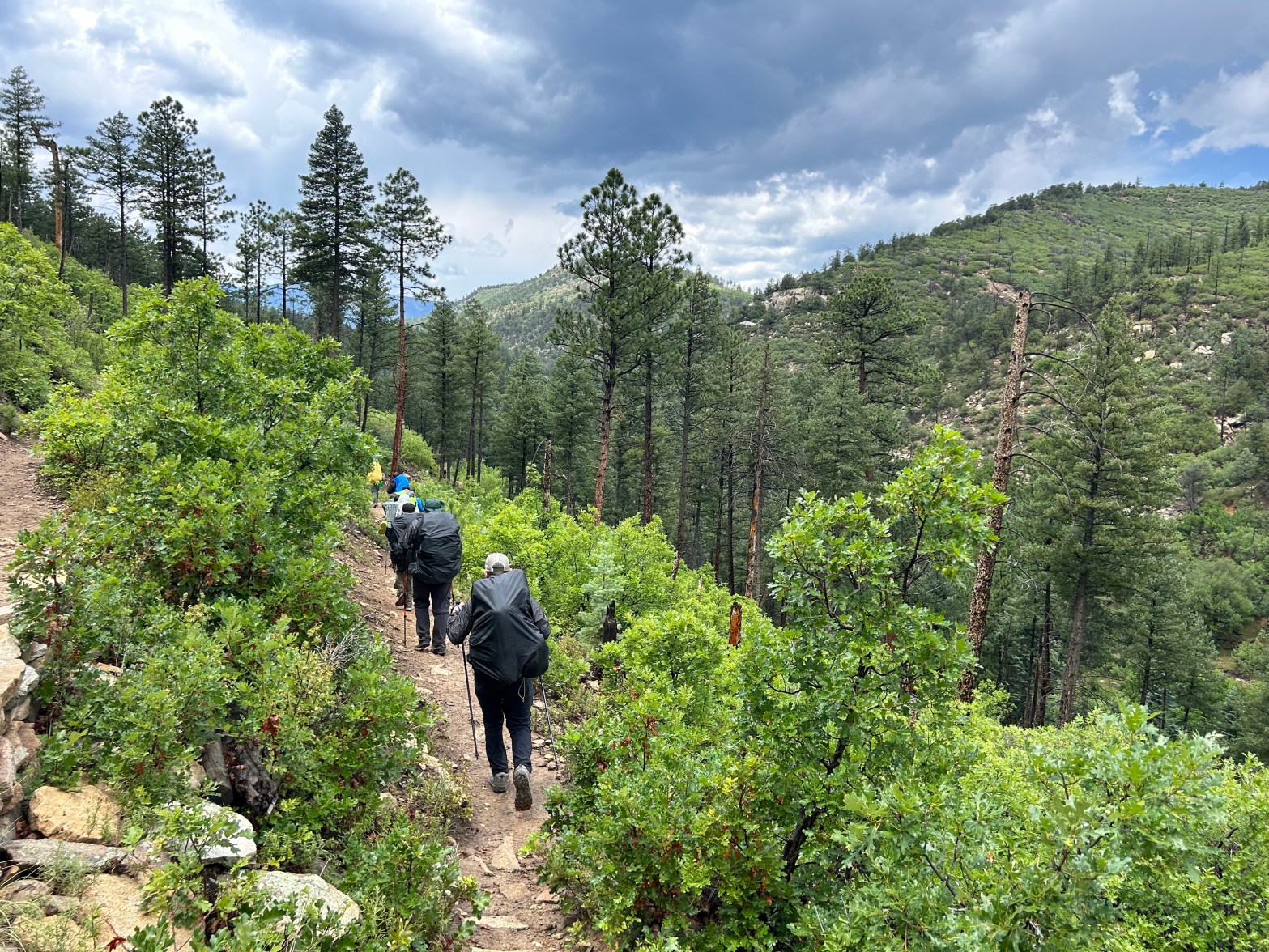
The two most important things for a successful Philmont trek are:
- A high level of physical fitness.
- The personalities in the crew getting along.
Everything else – gear and backcountry skills – can be bought or learned after you arrive at base camp. But showing up at Philmont out of shape or with an a-hole in your crew cannot be remedied.

On Fitness: Philmont does not allow crews to split up, which means the entire crew moves at the speed of the slowest person. In extreme cases, one person’s failure to adequately train can cost a whole crew the opportunity to participate in activities and achieve crew goals. Nobody gets to summit the mountain if 11 crew members want to, but the twelfth person cannot. Therefore, failure to train adequately is a failure to be a good teammate. This concept – that failure to train is a failure of accountability to others – must be explained to the whole crew well before the trek to give everyone adequate time to prepare.
The adult leader of the crew needs to assess the crew participants early and identify members who will need extra help and encouragement getting into shape. Roughly speaking, crew participants can be divided into four categories:
Physically active youth play competitive, year-round, rigorous sports requiring running or high exertion (martial arts, football, soccer, basketball, cross country, track). They require little if any, extra training. These scouts are not overweight, eat with a hollow leg, and are the workhorses of the crew.
Less active youth are not heavily involved in sports. These scouts lack the physical work of regular sports practice and the mental strengthening that comes with tough workouts and competition. Some of these scouts are just plain soft, while others are surprisingly tough. These scouts need to attend crew workouts regularly.
Physically active adults who already train. This category includes adults who are not overweight and who legitimately train (i.e., more than just walk around the neighborhood) over 7 hours a week. Good metrics: Can comfortably run 10 miles, can comfortably bike 30-40 miles, can comfortably swim 1-2 miles, can do 10 pull-ups, or can easily deadlift more than one’s body weight for reps. This group will find a Philmont trek easy.
Less active adults are the most common adult group and struggle most on the trail. This group lacks an endurance base, strength, or (most commonly) both and carries too much weight. Adults in this group cannot run even 5 miles and cannot do a pull-up. This group needs extensive training, at least 7-10 hours a week for a year.
The best way to convince crew members of their need to train is to require an early, mandatory workout involving hill repeats with a full (30-40 lb) pack, which exposes weakness. For this test, I prefer to let everyone hike at their own pace (scouts as buddies) and see how everyone does after 2 hours. Here in Austin, we have the Hill of Life, about 300 feet of climbing over half a mile on a rough trail. This workout separates the youth and adults in shape (that was easy/not too bad) from the ones out of shape (very slow, out of breath, taking lots of breaks, gassed).
After the initial test, the crew leader (for the scouts) or lead adult advisor (for the other adults) should regularly check in with each participant who is not in one of the “physically active” categories above and confirm they are executing a training plan of 7 to 10 hours. The most efficient workouts are those with vertical components like hill repeats, inclined treadmills, and the Stairmaster.
Be blunt and tell your crew: Don’t go to Philmont if you are unwilling to do the work. Philmont is a physically demanding adventure. Most of the problems on treks result directly or indirectly from participants who are physically or mentally weak. When forming a crew, it is essential to communicate the expectations for fitness and training. The lead-up to the trek is over a year, which is more than enough time to get in shape. With positive encouragement, everyone can be physically and mentally at Philmont ready for success, but everyone must commit and be accountable.
Crew relationships. Besides a lack of fitness, internal conflict is the most likely thing to blow up a crew. The adult advisors in a crew should be familiar with the youth and have a plan for encouraging positive behavior. I was fortunate to have three other laid-back dads as advisors in our crew with great senses of humor. While there were occasional tensions within the scouts, there were never adult conflicts, and we were able to help the scouts resolve their conflicts.

As mentioned in the prior post, having an asshole adult as one of the advisors will be disruptive and is likely to result in a bad experience for everyone. An overbearing, conflict-seeking, or bossy adult can be a cancer for a crew. I would be particularly wary of adults in troops who like to pretend they are in the military (if you are involved in scouting, you know what I mean). These are the adults with ribbons all over their uniforms who like to give orders rather than empower others to lead. I would not participate in a crew with such a person nor allow my child to participate.
Physical fitness and a great crew are the keys to a good trek. Take care of those two issues and the crew will likely have an excellent experience. The following post will deal with the less critical but always fun topic of gear.
 Vamonos Baby!
One thought on “Preparing for Philmont: Getting fit and crew dynamics”