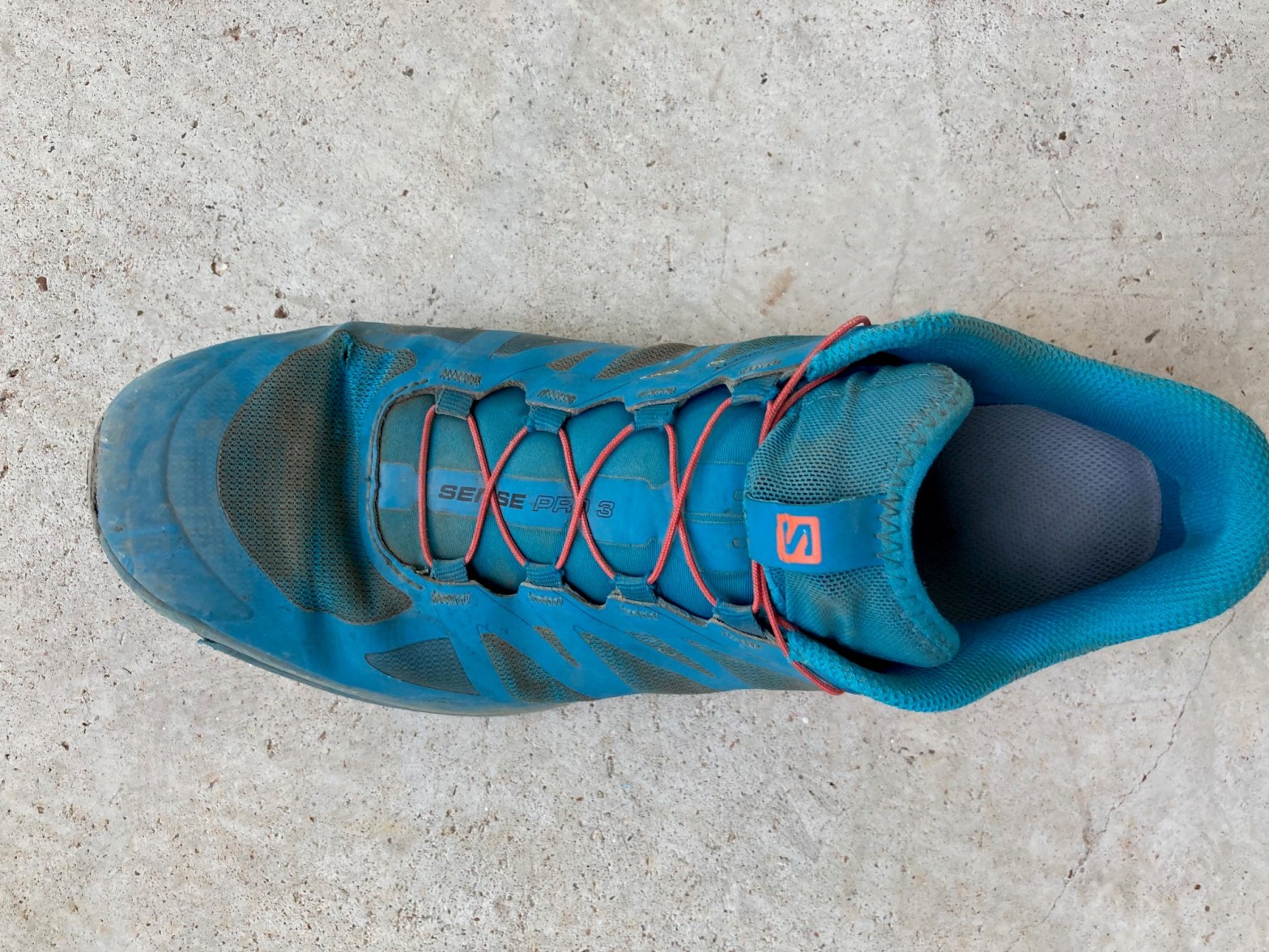
Recently a friend new to running asked how often I replace my shoes. She had heard that they should be replaced every 250 miles and was surprised when I told her that some of my shoes last over 700 miles even though I do lots of running on rough rocky trails.

Throw out any “replace shoes after X miles” rule. Those rules were written by the shoe companies. Instead, look at the shoes to see whether they need to be replaced. Inspect:
- The uppers (the cloth). After a while they will develop holes. Eventually they will fall apart. I usually keep running until they fall apart or until the holes get too big to keep rocks out.
- The outsole (the tread). When you run through the rubber or run off the tread they are done.
- The mid-sole (the foam). This one is trickier because it’s less visual. Some shoes simply get squashed over time but the uppers and outsole look fine. The shoe loses its ability to cushion. This problem is worst with shoes with soft foam. Some super soft shoes can be destroyed in one race. Mid-sole foam compression is often determined by feel. If your dogs are barking when they should not be, this may be the cause.
To increase longevity, use shoes for their specific purpose. For instance, one of my favorite muddy trail shoes is the Salomon S-lab Sense SG. It’s a lightweight, thin stack, trail shoe with huge lugs. If I took that shoe on a road run it would work but would needlessly wear down the tread.

When I run on the road, I use my road shoes with more cushion and a road-specific flat tread outsole. Likewise, some light road shoes will fall apart early with heavy trail use as they don’t have robust uppers.

When shopping for shoes understand that there is a lot of variability in durability. Although I like to save money, I generally run in expensive shoes (mainly the Salomon Sense Pro and Salomon S-lab Sense models). I do this because these models fit but also because they are durable. If amortized over 500+ miles the per mile cost of my Salomons is less than cheaper shoes that fall apart an a couple of hundred miles.
How can one tell which shoes are likely to be durable? Reviews can often be a good source of information on durability, but my rule of thumb is that if the shoe feels like a soft slipper when you try it on it is going to fall apart quickly. Shoes that are comfortable, but firm are more likely to last. That is why I usually go for shoes with harder midsole foam – they provide more long-term cushioning.
Finally, for races considering buying a dedicated pair of race shoes. For me, this is the exact same model as my primary trainer – so it a model that I have hundreds of miles in in the months right before the race. Other than a 10-mile break in just to make sure there are no defects, these sit in my closet and only come out when I am on the starting line of a big race. That way my feet have maximum protection, cushion, and tread for the event. It’s a good confidence booster to know that whatever goes wrong, I don’t have to worry about my shoes. And, of course, NEVER EVER run a race with a shoe model that is unproven through hundreds of miles of training outdoors, in the weather, on surfaces similar to the race or a shoe that has questionable fit.
Happy running.
 Vamonos Baby!