With a race on the calendar for August, I recently started the process of putting together my yearly training program. I find this is always a good time to review my library of training books and see if there are any other resources out there that may be of aid. A few weeks ago, I picked up a new book, The Cyclists Training Bible by Joe Friel.
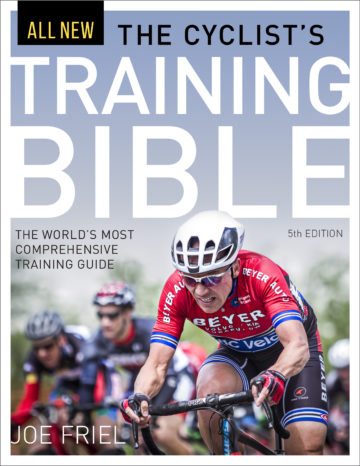
Although clearly targeted to cyclists, this book does a great job of explaining the principles of training and, due to the similarity of running and cycling, is easily adaptable to running-based pursuits. Importantly, Friel does a better job of explaining key training concepts such as periodization, the components of fitness (aerobic capacity, lactate threshold, anaerobic capacity, and economy) and how to train each component than many running-specific books. Much of the book is devoted to the understanding of volume versus intensity and how to incorporate each into specific training plans depending on individual circumstances.
The book is organized into five parts, with part one discussing the benefits of systemic training and listing Friel’s “Ten Commandments” of training. The author highlights the need for moderation and consistency in training, which in my observation are two of the most common pitfalls for runners. In the first section he also raises the concept of “limiters” – weak links in physical and mental fitness that cap potential performance – and continues to hammer the point for the rest of the book. He argues, correctly, that most of us spend way too much time working on what we are already good at and not enough time on our weaknesses. Athletes with good endurance like long easy rides (or runs) but shy away from demanding interval work. Strong athletes love hitting the weight room but find reasons to avoid long endurance efforts. Athletes with poor economy do not spend time addressing form. Friel argues that greater improvement comes from uncomfortably improving limiters than comfortably working on strengths.
The second part of the book is a summary of the science of training. This is the section discussing fitness, fatigue, and how individualization, progression, overload and specificity should be programed for best results. Part three addresses how purposeful training applies these concepts to the demands of cycling events. Again, as endurance, force production and economy are components of running and cycling, these sections are directly applicable to marathoners and ultra-marathoners.
Part four of the book discusses how to put together a training plan for a cycling race. Obviously, the actual training routines for cyclists differ from running workouts, but the deeper concepts remain the same. From a physiological standpoint there is not that much difference between a 40-minute criterium or time trial on a bike and a 10k footrace or between a 6-hour bike ride and a 3-hour running event. Friel explains why for shorter races one should build training blocks of volume and then intensity while in very long races one should train intensity before volume. (Incidentally, this is one of the reasons marathon training does not work well for ultra-marathons). Anyone with a modicum of running experience should be able to take these concepts and create their own training plan that will likely be successful.
The last part of the book focuses on strength, stretching, nutrition, and recovery. Friel is an advocate of the weight-room and dedicating early-season training to strength. He also recognizes the importance of real strength work, including barbell squats, even going so far as to state that riders should get their barbell squats up to 1.3-1.7 times bodyweight in the off-season. I think this is great because most endurance training books either completely discount the benefits of strength or recommend exercises that are sub-optimal at improving strength (Hello Bosu ball!). But I don’t think this book does the best job of preparing a reader who has never lifted for understanding strength or the mechanics of lifts. For that you really need a dedicated lifting book. Where this book shines, however, is how to incorporate lifting into the overall training plan from offseason, through training blocks, and to race day.
The discussion of nutrition is helpful but would be completely inadequate for someone training for an ultramarathon. For a 100k or 100-mile race one really needs to read up on the specific demands of ultramarathoning.
If you are the kind of person that just wants a training plan but has no interest in the scientific principles behind the plan, the book is not for you. But if you are your own coach and want to maximize efficiency in training, The Cyclists Training Bible is great resource for any endurance athlete.
 Vamonos Baby!