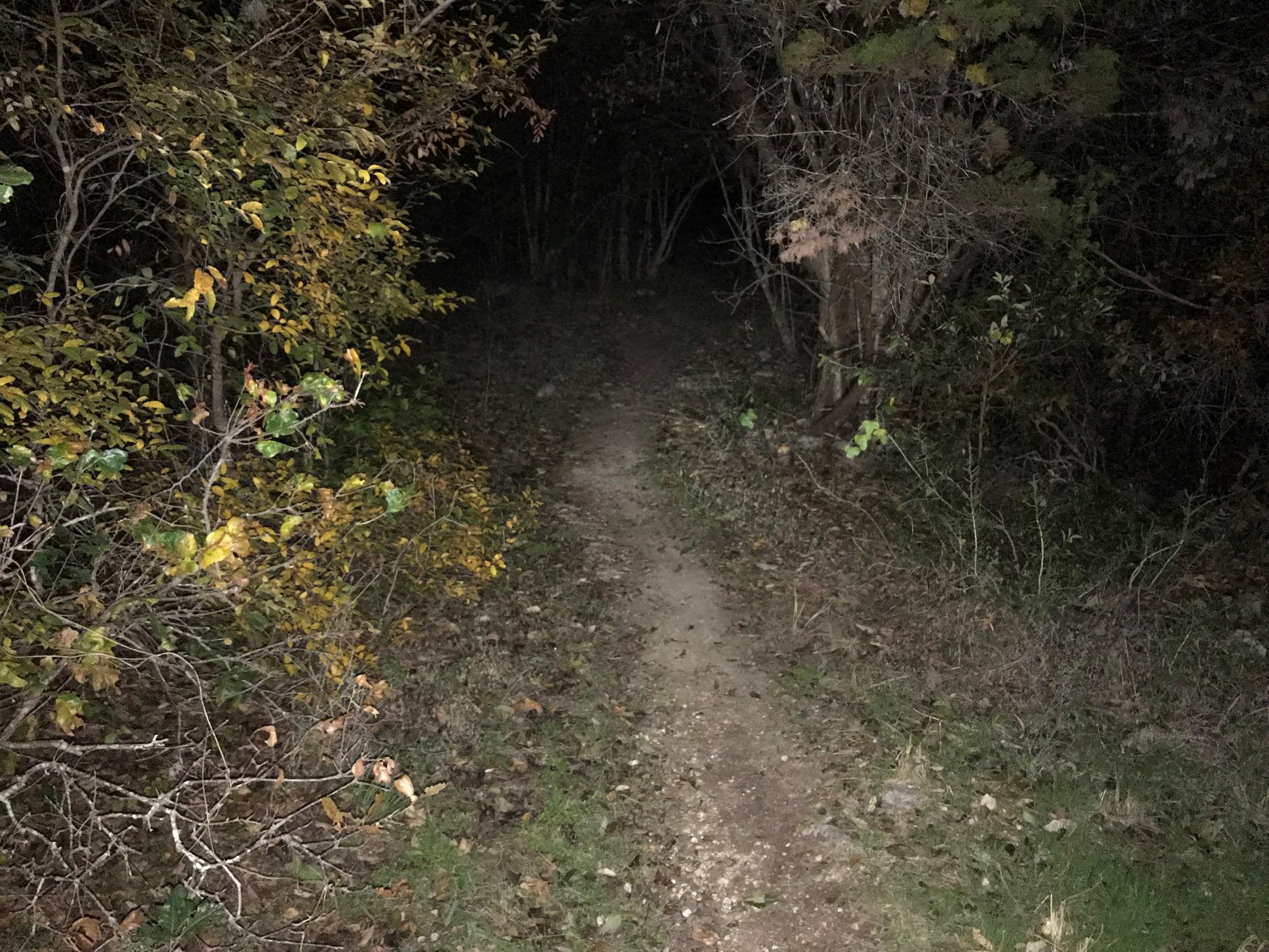
Adventures don’t stop when it gets dark. When you are depressed and cold at 3 am on a lonely trail you don’t want to be messing with a dimming light. That’s when you want t he spotlight they have on police helicopters. The kind of light that causes people across the valley to wonder, “Why is there a locomotive on that trail?” The kind that lights up everything.
I have a collection of headlamps and flashlights that are are not up to snuff. That’s OK because I have a bunch of kids that love to steal headlamps. At my house headlamps go missing like yappy dogs in coyote country. The kids get all my old lights with:
- Plastic frames that crack in cold and break after a while.
- Big on/off buttons that can be accidentally turned by stuff in my pack.
- Tiny AAA batteries that are hard to change in the dark with cold hands.
- A single rechargeable battery. Nice in theory but not in practice.
- Lack of waterproof seals.
- Dim, underpowered lights.
- Lights with huge battery packs and a bunch of wires.
- Vastly exaggerated performance specs.
My real lights are secured in an undisclosed location, safe from little hands. Before we discuss details, what do I need to move effectively at night?
- Brightness. Too many “ultralight” headlamps just don’t throw enough light for hustling down a rocky trail at night. What is bright enough? Factors like the difficulty of the trail, the weather, moonlight, and tree cover impact how much light you need. But in tough conditions I want a light that can throw a minimum of 200 lumens. That is pretty bright. For comparison most car low-beam headlights are about 700 lumens. So what I want is not actually as bright as a car but is WAY more than most running headlamps can sustainably produce.
- Toughness. My lights will get dropped, wet, and dirty and they need to keep working.
- Simple Operation. Headlamps today are way to complex. I don’t need a red light and I don’t need my headlamp going on strobe-light mode every time a push a button.
- Reasonable battery life. Almost all headlamp specs are lies. Most will put out something close the published max lumens for a few minutes and then rapidly dim. Changing batteries every couple of hours is fine, as long as the light can produce a bright beam for the whole time.
- Simple battery changes. This means headlamps that use a single AA battery. I can change these in the dark in 15 seconds, even with cold hands and they are ubiquitous. I use regular alkaline for training and the more expensive but lighter and better performing lithiums for races.
- Redundancy. Lots of races (e.g. UTMB) require runners to carry two lights. Even when not required, I carry two lights. This has a few advantages. First, I have a backup. Second, running two lights lets me raise overall light output while increasing the time between battery changes. For example, two lights on medium may throw as much light as one on high, but I have many more hours between changes. Third, running two lights from different positions lets me see more depth and reduces shadows.
The system that works for me is to use two Zebralight H53 AA headlamps, one on my head and one on my waist. The waist light is pointed on the ground right in front, while the head light is a high beam down the trail.

These headlamps weigh 2.8 oz each, including band and loaded with a single AA Energizer lithium battery.

They are made of metal, they are bright, waterproof to 2 meters for 30 minutes (I suspect the actual waterproofness is way beyond these limits), and they work. The light fits in a flexible silicon holder and you just rotate it to point the beam.

Zebralight’s claimed specs are generally accurate. The lights have three basic settings: High, Medium, and Low. Within those settings there is an option for sub-settings. Once you set up the preferred sub-setting, the operation is simple High/Medium/Low. I set the High setting to 198 lumens (which lasts over 2 hours) and the Medium to 65 lumens (which lasts over 8 hours).

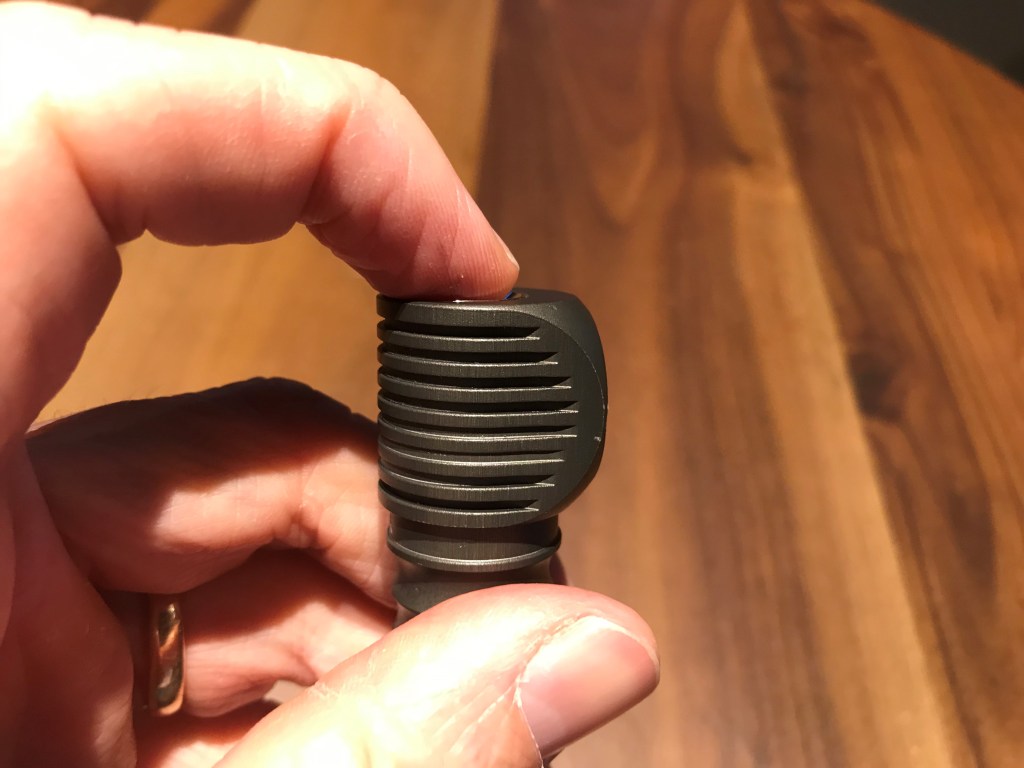
The great thing about these lights is that they do not dim. Instead, when the battery is drained they step down to the next lower level. This means when the light is on High, it is throwing the specified lumens the whole time until it is forced to switch to Low. This makes it obvious when to change batteries. Most other headlamps just go dim.
Many people have never heard of Zebralight because they don’t sell through the usual outdoor retailers. I discovered the company on an the candlelpower internet forum, which is the online home for flashlight nerds. The lights retail for $59 and are available on Amazon and directly through the Zebralight website. (Note: I have no affiliation with Zebralight but I do receive a small commission for items purchased through links to Amazon on this blog)
How many batteries to bring?
I do not hesitate to run with (or put in drop bags) enough batteries to run one light on bright and a second on medium. That means over 250 lumens all night long. In really challenging conditions I bring a couple extra so I can run both lights on high for extended periods. Some people may think that overkill, but a few ounces is worth the ability to light up the woods and roll.

I don’t claim that this system is the best one in the world, but its the best that I have found. If you find night running challenging, a bright light system that lets you see and helps keep your mood positive might be the solution.
 Vamonos Baby!
One thought on “Light it Up”